The following is a Glossary of technical terms and words used in theater, events, shows and performances. While these are the technical terms over the years and based on people's experience and history in the entertainment industry people have sometimes used different terms. The following glossary is the standard terms and words used.
A TYPE
See JACK.
A-D CONVERTER
Short for Analogue / Analog to Digital Converter. Changes a continuously varying electrical signal into a stream of binary data. Found in computer soundcards, MiniDisc & CD Recorders etc..
A.J. / AJ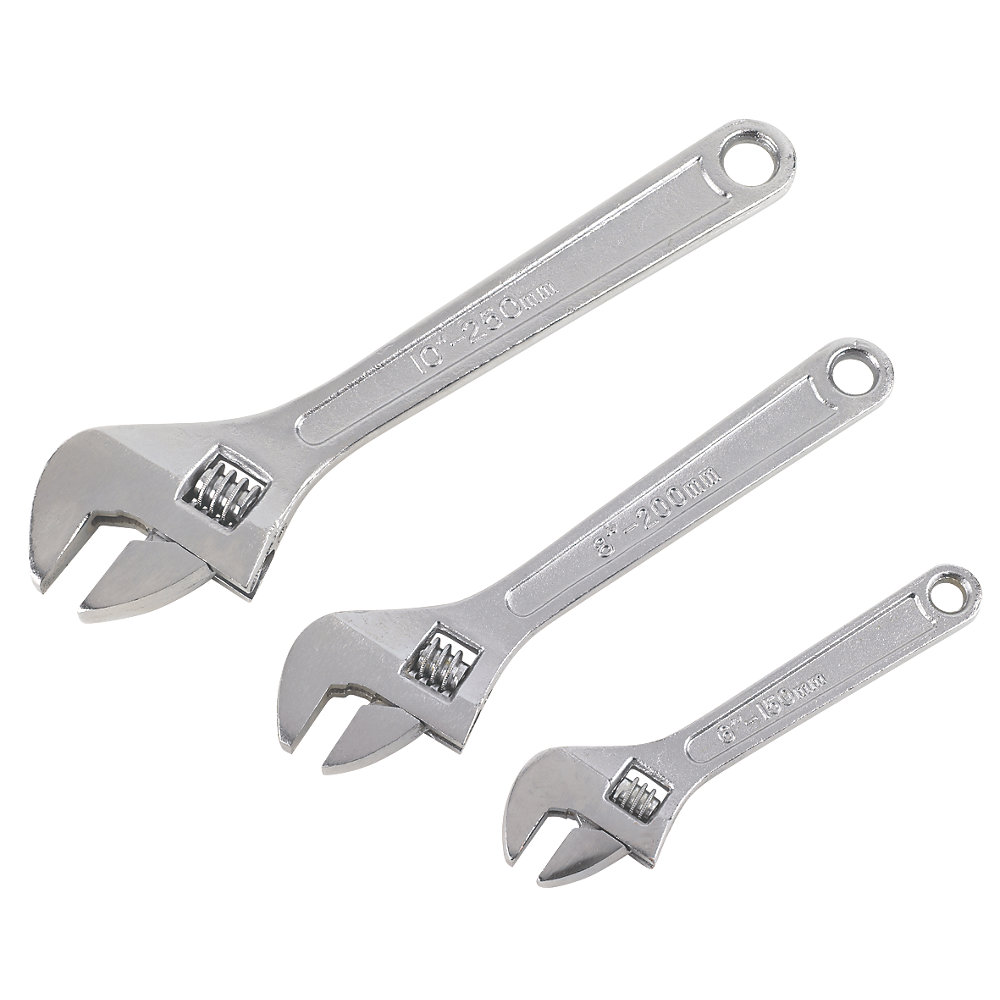
A.L.D. / ALD
Association of Lighting Designers.(UK)
ALD Website
A0/A1/A2/A3/A4/A5/A6 PAPER SIZES
A range of standardised paper sizes used worldwide in publishing and printing.
The sizes are part of the ISO216 standard.
A0: 841 x 1189mm (33.11 x 48.81 inches) [large scale drawings / plans]
A1: 594 x 841mm (23.39 x 33.11 inches)
A2: 420 x 594mm (16.54 x 23.39 inches)
A3: 297 x 420mm (11.69 x 16.54 inches) [twice an A4 page]
A4: 210 x 297mm (8.27 x 11.69 inches) [standard photocopy / document size]
A5: 148 x 210mm (5.83 x 8.27 inches)Â [half an A4 page]
A6: 105 x 148mm (4.13 x 5.83 inches) [quarter of an A4 page - used for postcards / small booklets]
In the USA, the Letter size (216 x 279mm / 8.5 x 11 inches) is used instead of A4.Â
Paper Sizes
A1
Lighting Industry Forum code which identifies the (original) recommended usage of different lamp types. A1 coded lamps are for use in projection. See also CP, T, P2, K.
AB
A technique used to record in stereo. Two (identical) microphones are placed next to each other, parallel to each other, and pointing in the same direction. As you're looking at the action, the one on the left is panned hard left on the mixer and the one on the right is panned hard right. There are some problems with this technique, such as reflections off each microphone, leading to comb filtering and also a narrow coverage. Some sound techs try to overcome the coverage problem by spacing out the microphones, although this can lead to 'muddy' sounds due to delays. See COMB FILTERING and XY.
AB POWERING
See PHANTOM POWER.
ABO
Association of British Orchestras.
ABO website
ABOVE
An actor move upstage (e.g. Clive moves above the chair).
ABSORPTION
The ability of a surface to absorp sound. The absorption coefficient of a material is a figure between 0 and 1, representing its degree of absorption.
ABSTRACT
A scenic or other design which is nonrepresentational and suggests the situation rather than simulating it.Â
ABTT
The Association of British Theatre Technicians, which was formed in 1961 as a charity, to provide a forum for discussion among theatre technicians, architects and managers of all disciplines, and disseminate information of a technical nature, to all its members.
ABTT Website
AC
Short for ALTERNATING CURRENT. An AC cord or cable is used to connect between a mains power socket and a piece of equipment.
A range of different connectors are used to connect to the equipment. The 3-contact IEC cable is common in Europe, and is sometimes known as a Kettle Lead. A figure 8 cable is used on smaller equipment which is double-insulated and has just two connections. Powercon is used on heavier duty equipment and locks into place to prevent accidental disconnection.Â
ACAPELLA
A sung performance which is not accompanied by musicians. (From the Italian A CAPELLA, meaning 'as in the chapel')
ACCENT LIGHTING
Lighting on a particular item or area on stage, to make it stand out or for aesthetic reasons, rather than to light an actor or functional area. Examples include lighting on specific architectural features on the set or in the theatre to make them 'pop' or because they're particularly significant.Â
ACETONE
A flammable solvent used in some prop/costume-making processes. Used by make-up artists to remove skin adhesive from the netting of wigs and moustaches by immersing the item in an acetone bath, then removing the softened glue residue with a stiff brush. Also one of the primary components of some nail polish removers.
ACL / A.C.L.
Acronym for AirCraft Landing Light. See AERO.
ACN
Advanced Control Network. A new (2003) ethernet-based control protocol between control desk, dimmers & moving lights. Developed by ESTA and Strand Lighting. DMX nodes are used to communicate with non-ethernet devices.
ACOUSTIC PICK-UP
See PICK UP
ACOUSTICS
The behaviour of sound and its study. The acoustic of a room depends on its size and shape and the amount and position of sound-absorbing and reflecting material. The quality of sound in a given space, measured and analyzed by its clarity, loudness, liveliness, reverberance, echoes, dynamic range, envelopment, spaciousness, warmth and silence or noise control rating.
ACT
1) Subdivision between sections of a play. A short play is a 'One-Act-er', a play with one interval has two Acts etc. Acts are subdivided further into Scenes.Â
2) The thing Actors can do which makes them different from Techies (!!).
ACT CHANGE
A change of either scenery, lighting, costume, props or other technical elements between acts of a play or musical. Theatres with little backstage space may have to reconfigure scenery stored offstage during the interval so that the next act runs smoothly.
ACT DROP
Victorian stretched framed and painted canvas. Used as a visual stimulation during scene changes, and to indicate that there was more to come (the end being indicated by the HOUSE TABS). There are believed to be only two operational today - an original one at Gaiety Theatre, Isle Of Man, and a 1996 reproduction at Her Majesty's Theatre, Ballarat, Victoria, Australia.
Term now used to refer to any front cloth or tabs lowered during intervals. Especially pantomime / musicals.Â
In ballet, the act drop permitted pre-interval curtain calls to take place.Â
Gaiety Theatre
Her Majesty's Theatre
ACTING AREA
That area within the performance space within which the actor may move in full view of the audience. Also known as the playing area
This term is also used to describe the smaller subdivisions of the main stage area which are lit separately by the lighting designer (e.g. 'The stage is split into 6 acting areas, 3 downstage and 3 upstage').
(Also the name of an early Strand down-lighting floodlight - it was called an Acting Area Flood, and was colloquially known as 'Ack Ack' or 'A.A.').
ACTING EDITION
Published copy of a script containing notes for the actor and technicians, often credited to the design team of the premiere production not necessarily the playwright.
ACTION PROP
A hand-held practical prop used by an actor for combat or for a specific purpose.
ACTION VEHICLE
A car / van / bus / other vehicle that takes part in a stunt during a film / TV shoot. See also PICTURE CAR.
ACTIVE
In electronics (particularly audio), an 'active' circuit operates with an external power supply and is usually low power, while a 'passive' circuit operates directly on the signal using the inherent power of the surrounding circuitry.Â
This is why an active crossover is usually placed before the amplifiers, with integrated circuits and line level signal processing (100 Ohms impedance or greater), while a passive crossover acts after the amplifiers where the power level is much greater (16 Ohms impedance or less). Amp to speaker level is generally between 2 and 16 Ohms, while preamplifier electronics are generally 100 to 100K Ohms.
Submitted by Bruce Trotter
ACTOR
Person (male or female) whose role is to play a character other than his/her own. Although the term 'actress' is sometimes still used for a female actor, many women prefer to have the same title as the men.
ACTOR AUDIENCE RELATIONSHIP
There are many different theatre shapes and styles, but the most important factor when designing a space for performance is the relationship between the audience and the actors on stage. The audience should be able to clearly see and hear all of the actors on the stage, in order to have a connection or relationship with them.
A space where the audience is close to the stage (or feels close to the stage) is known as an INTIMATE auditorium.
If the space is too big, it's harder for the audience to feel involved in the performance.Â
AD LIB
From Latin Ad libitum meaning "at one's pleasure".
The presence of mind by an actor to improvise when;
1) another actor fails to enter on cue
2) the normal progress of the play is disturbed
3) lines are forgotten
4) It may also be a bad habit developed by some actors whereby unnecessary "gags" are introduced into the dialogue.
In the past, any business or words that were not in the scripted act 'as known' would be seen as a breach of contract by some No.1 Managements.Â
ADA
Acronym for Americans with Disabilities Act, which became law in 1990. It covers similar ground to the Disability Discrimination Act (DDA) which became law in 1995 in the UK. Both Acts are designed to outlaw any kind of discrimination against people with any form of disability.Â
The acronyms ADA and DDA are used also to describe the amendments that are made to procedures, buildings and resources to comply with the Act.Â
ADAM
See DIGITAL RECORDING.
ADAPTOR
1) Connector which allows two or more electrical devices to be connected to a single power outlet. The connection is normally parallel, that is, each device is fed the same voltage, but the current is divided between them. Sometimes known as a 'Twofer'. A three-way splitter is known as a 'Threefer'. A Series splitter is also available where a voltage is shared equally between two loads.
2) Also an ADAPTOR can be the same as a JUMPER.
See SERIES SPLITTER, JUMPER and GRELCO.
ADAT
See DIGITAL RECORDING.
ADB
(Manufacturer) Belgian manufacturer of lanterns, control desks and dimming equipment. Named after the initials of it's founder, Adrian de Backer.
ADB website
ADB 62.5
Near-obsolete digital lighting control protocol developed by ADB. Uses a 5 pin XLR connector but is NOT compatible with DMX512
ADDITIVE COLOR MIXING
See COLOR MIXING.
ADDRESS
(LIghting) Each item of equipment controlled by DMX512 has an address, which is the first DMX control channel to which it will respond. A dimmer rack requires 1 DMX channel per dimmer. A moving light requires many DMX channels.
For example, in a situation where you have three 6-way dimmer racks, the first should be addressed to 1, the second to 7 and the third to 13. Moving lights requiring 16 DMX channels each might be addressed to 120, 137, 154 etc.
The address is either set via pushbuttons (up / down) to get to the correct channel, or via a menu screen, or via small rotary selectors where you can set each digit of the address.Â
ADJUSTABLE SPANNER
ADN
Advanced Dimmer Network. Networking protocol developed by ADB.
ADB website
ADR
Stands for Automated Dialogue Replacement. Also known as "looping" this is the post-production process on a film / TV shoot where actors re-record their lines after original filming, either because the original production sound was not up to standard or due to external factors (aircraft noise in a period piece) which weren't noticed at the time of filming.Â
ADVANCE BAR
(UK) Lighting bar positioned just downstage of the proscenium arch. Also known as ANTEÂ PROSCENIUM (from Latin 'Before' or "In Front').
AEOLIPHONE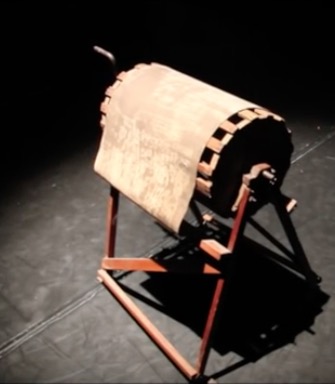
Video
AERIAL
Cable or rod used to send and receive radio signals (connected to transmitter and receiver or tuner).
AERIAL GOBO
A gobo projected from a moving light or profile which is focussed into the air above the stage or audience, in order to add atmosphere and dimensional texture through smoke or haze in the venue.Â
AERO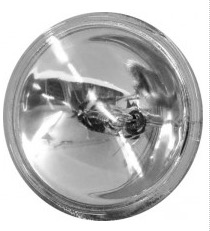
AES/EBU
Audio Engineering Society / European Broadcast Union. Digital audio transfer standard, similar to S/PDIF. Uses 3 pin XLR connectors.
What is AES/EBU
AESTHETIC DISTANCE
Aesthetic distance refers to the gap between an audience member's conscious reality and the fictional reality presented on stage. If the audience member becomes fully engrossed in the illusory narrative world of the drama, the director has achieved a close aesthetic distance. If the director then jars the audience member from the reality of the story, essentially reminding them they are watching a play, the director is said to have "violated the aesthetic distance."Â
AETTI
Arts & Entertainment Technical Training Initiative (UK).
AGC
Automatic Gain Control. Circuitry within recording equipment which compensates for differences in volume in the incoming sound signal by adjusting the gain automatically. Helps to reduce wild swings in volume.
AGITPROP
The original sense of agitprop was "agitation and propaganda on behalf of Communism", or "a government agency or department responsible for agitation and propaganda". The main current sense of the word is simply "propaganda, especially socially or politically motivated propaganda appearing in literary works, films, etc."; though the word often refers to political propaganda, it is not restricted to communist doctrine.Â
The word agitprop is first found in English sources in the mid 1930s.
From the Random House Word of the Day website.
AIFF
Audio Interchange File Format. Uncompressed Audio file format used on Mac systems.Â
Digital Audio File Formats
AISLE
A passage through seating.
ALGINATE
An organic polymer which is a viscous gum found in the cell walls of brown algae. The commercial variety is extracted from seaweed. Supplied as a powder, when mixed with water it becomes a fast-setting mould-making material which is used to make casts of body parts or delicate prop items. The resulting mould is very detailed and strong. Dental alginate is used to make casts of teeth and gums. Take care to store the powder in an air-tight container as it's very absorbant and will 'go off' very rapidly if left open to the air.
ALPHAPACK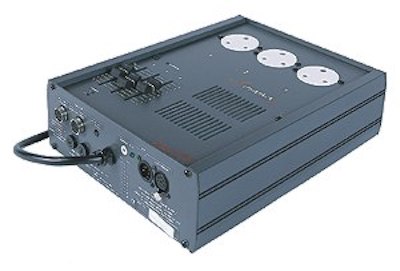
Zero 88 website
ALTERNATE
Alternative name for an Understudy who is hired to understudy a main role but also contracted to play that role in certain performances. See also STANDBY, SWING, UNDERSTUDY.
ALTERNATING CURRENT*
An electric current that reverses direction in a circuit at regular intervals. Abbreviated to AC. UK mains electricity is AC and changes direction 50 times per second (that is, the frequency is 50Hz).
See also DIRECT CURRENT.
AMATEUR
Member of a theatre company which is not professional.
AMBER DRIFT
A phenomenon seen when tungsten halogen lamps are dimmed which results in the light output becoming warmer (lower in COLOR temperature) as it becomes dimmer. LED lights maintain the same COLOR when dimmed, unless they have been designed to emulate the amber drift of tungsten light sources.Â
AMBIENT LIGHT
The light in a venue with no stage-lighting sources switched on. Background light.
AMBIENT NOISE
The sound heard in a given room with no sound sources. Each space has a particular sound which aids our identification of the kind of space we're in.
AMDRAM
Short for Amateur Dramatics.
AMP
Abbreviation for ;Â
1) AMPERE
2) AMPLIFIER
AMPERE
The standard unit for measurement of electrical current passing through a circuit (usually abbreviated to AMP). Written as 'I' in equations. Cables, fuses and switches are designated by their current carrying capacity. (Following phrase refers to UK standards). Square pin plugs are rated at 13 Amps maximum and Round pin plugs at either 5 Amps or 15 Amps maximum, depending on the size of the pins. If a cable rated at 5 Amps is used with a load of 15 Amps (for example), the cable will overheat and possibly catch fire.
AMPHITHEATRE
Circular or oval open-air theatre with a large raked seating area (often semi-circular) sloping down to the stage. Originates from ancient Rome where vast amphitheatres were built for spectator sports and games.
AMPLIFIER
Sound equipment that amplifies/boosts the low voltage, low current signal from a CD player, mixing desk etc. into a higher current signal suitable for driving speakers.
As a general rule, each speaker in a sound system requires a separate amplifier. Each amplifier unit usually contains two amplifiers (for the two stereo components (left and right) of the sound signal), so with a single amplifier box, you can drive two speakers.
See POWER AMPLIFIER, CROSSOVER.
AMPLITUDE
The strength of a vibrating wave; in sound, the loudness of the sound.
AMX
Powerful programming language with allows you to control a wide range of audio-visual equipment using simple interfaces (push buttons or touch screen). Widely used in complex audio-visual installations.
AMX website
AMX-192
See MULTIPLEXED SIGNAL.
ANACHRONISM
A scenic item, prop or costume which is from a different time period than that being portrayed on stage. Usually, it's a modern item that shouldn't be seen in a period piece.Â
ANAGNORISIS
Anagnorisis is a moment in a play or other work when a character makes a critical discovery.Â
ANALOGUE SIGNAL
A continuously variable signal that can have any value over a given range.Â
1) In lighting: an analogue voltage within the range 0 to 10 Volts can have values of 0, 2, 8.785 or any value between. Most dimmers require an analogue voltage in order to operate (from 0 to -10V or 0 to +10V depending on the manufacturer). Most lighting control desks produce a digital multiplexed output, which is converted by a demux box to an analogue signal for the dimmer. See also Digital dimmer.Â
2) Sound: An analogue recording will record the exact waveform of the original sound, simply converting it to an electrical signal at the microphone, and back into air movement at the speaker. See DIGITAL.
ANGEL
One who privately finances a production, usually often with several other backers; their identity is traditionally kept private. May be an individual or a company.Â
See also PRODUCER.
ANGSTROM
Unit of measurement of length (e.g. for wavelengths of light). 1 Angstrom is equal to one ten billionth (1 x 10⁻¹⁰) of a metre. The unit is named after the Swedish physicist Anders J. ?ngstr?m.Â
See WAVELENGTH.
ANILINE DYE
A type of deep penetrating natural dye originally made from coal tar. Water-based or alcohol-based dyes are available. As the product will stain anything it comes into contact with, protective gloves and eye protection should be used.
ANIMATEUR
(From French) Facilitator of a community, education or group event (social, cultural or artistic). The Animateur may be a group leader, or may have initiated a project. She or he is responsible for running the event.
ANIMATION DISC
See EFFECTS.
ANIMATRONIC
Originally Audio-Animatronicâ„¢, this term describes a robotic figure, particularly in a theme park environment or on a movie set, which is able to repeat a limited range of pre-programmed functions, typically in synchronisation with a pre-recorded soundtrack. The term now describes a character controlled either electronically by radio remote control, or by cable/lever controls.Â
ANNOUNCER
In seventeenth century theatre and street performances, the Announcer would greet the audience, and give the play some context, either in terms of political or social background, or just to fill in some background detail to help the audience understand.Â
ANSI / A.N.S.I.
American National Standards Institute. Three letter ANSI codes are used in the US to identify lamps.
ANSI website
ANTAGONIST
The opposite of the PROTAGONIST in a drama.Â
ANTI PROSCENIUM
Originally Ante Proscenium, meaning in front of the proscenium.
See ADVANCE BAR.
ANTI RAKE
The act of modifying furniture or props by shortening the upstage legs etc. so that they can stand level on a raked stage. Known as COUNTER RAKE in the US. See also Raked Stage.
ANTISTROPHE
The second section of an ancient Greek choral ode or of one division of it.Â
APOLLO DESIGN TECHNOLOGY
(Manufacturer) US-based manufacturer of gel, gobos, effects and scrollers.
Apollo Design Technology Inc. website
APPLAUSE
Applause (Latin applaudere, to strike upon, clap) is primarily the expression of approval by the act of clapping, or striking the palms of the hands together, in order to create noise. Audiences usually applaud after a performance, such as a musical concert, speech, play or a performance to mark the sign of enjoyment and approval. Audience members clap their hands at random to produce a constant noise; however, it tends to synchronize naturally to a weak degree. As a form of mass nonverbal communication, it is a simple indicator of the average relative opinion of the entire group; the louder and longer the noise, the stronger the sign of approval. (from Wikipedia)
APPLE BOX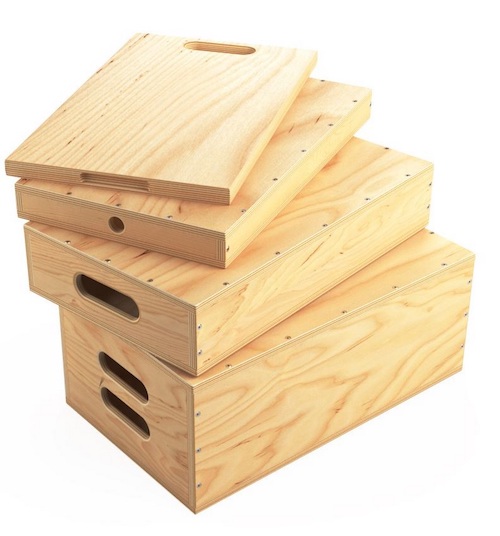
More about Apple Boxes
APRON
The Apron is a section of the stage floor which projects towards or into the auditorium. In proscenium theatres, it's the part of the stage in front of the house tabs, or in front of the proscenium arch, above the orchestra pit. Also known as Forestage.
If an apron stage extension is added to an existing traditional proscenium arch theatre, this often results in poor sight lines from seats that are higher in the auditorium, leading to audience members having to lean forward in an attempt to see.
German: vorbühne (literally, forestage).Â
ARBOR
US equivalent of CRADLE in a counterweight flying system.
ARC LIGHT
See DISCHARGE LAMP.
ARCHITECTURAL LAMP
A type of linear filament lamp with contacts at 90 degrees to the filament which can gives the appearance of a continuous line of light (similar to neon, but dimmable).
ARCLINE
(Trade Name) A COLORed plastic tube containing a number of small strobe units which, when triggered, flash in sequence down the tube. Many tubes can be connected together.
ARENA
Form of stage where the audience are seated on at least two (normally three, or all four) sides of the whole acting area.
See END ON, THRUST, IN THE ROUND.
ARIA
A solo performance in an opera used to highlight the emotional state of the main character(s).
ARMOURY
The Department in a large producing theatre which deals with the maintenance and storage of prop weapons.
ARRANGEMENT
The arrangement of a piece of music defines how it will be performed, and how it will sound. It covers which musical instruments will play each part of the melody and harmonies. The score for a piece of musical theatre may have arrangements for a small (school) band, or a large Broadway orchestra.Â
ARRAY
A set of loudspeakers flown in a performance space. See also CLUSTER.
ARRI
(Manufacturer) German/US manufacturer of film lighting and cameras (Arriflex). Founded in 1917. Previously, Arri made a range of lighting desks (including Imagine, Impulse, Mirage, Microlux) which were early versions of desks now produced by ETC. ETC took over the lighting control side of Arri in 1995.
ARRI website
ART-NET
Ethernet-based lighting control protocol, developed by Artistic Licence. ArtNet can carry up to 256 DMX512 universes on the ethernet saving on cable runs. With the development of wireless networking the possibilities are endless.
Art Net website
ARTIC
Short for Articulated Lorry. Lorries of 40 feet length (or more) are used to transport sets, costume, props and sound & lighting equipment from venue to venue. A number of companies specialise in moving theatrical and musical tours around the country / world.
ARTISAN
(Trade Name) Moving light control console made by Vari*Lite.
Vari*Lite Website
ASCAPÂ
The American Society of Composers, Authors and Publishers is a not-for-profit performance rights organisation that protects its members' musical copyrights by monitoring public performances of their music, whether via a broadcast or live performance, and compensating them accordingly.
ASCAP website
ASIDE
Lines spoken by an actor to the audience and not supposed to be overheard by other characters on-stage.
ASM
Assistant Stage Manager.
ASPECT RATIO
A ratio which defines the relationship between the height and width of a movie frame.
The Academy ratio is 1:1.375 (i.e. if the height of the image is 1 unit, the width will be 1.375 units).
Silent movies were shot in 1:1.33.
Cinemascope is 1:2.35.
A traditional TV picture is known as 4:3 (width:height, which can be expressed as 1.33:1). A widescreen TV is 16:9. (or 1.77:1)
ASSISTANT DIRECTOR
Assistant to the Director - works on specific tasks, sequences etc. to lighten the workload of the Director.
ASSISTANT STAGE MANAGER
Usually shortened to ASM, the assistant stage manager is the most junior member of the Stage Management team, and is often in charge of sourcing and running Properties during the run of a show. She or he is also a member of the stage 'crew'. See also STAGE MANAGER and DSM.
Association of Sound Designers
UK & international organisation representing the interests of sound designers and technicians.Â
Association of Sound Designers website
ATAEA / A.T.A.E.A.
Australian Theatrical and Amusement Employees Association. Union for Australian theatre technicians, now part of MEAA. See BECTU and IATSE for the UK and US equivalents.
ATMOSPHERE
The normal background sound at any location.
ATTENUATE
To reduce the intensity of a sound signal. This is what the 'PAD' switch does on a sound desk.
ATTRIBUTES
The controllable parameters of a COLOR-changing or moving light are known as the ATTRIBUTES.
All moving lights will have pan & tilt, with many having COLOR wheels, gobo selection, gobo rotation etc. as additional attributes. LEDs can operate in a number of modes, based on the number of COLOR sources they have, as well as whether certain parts of the beam can be separately controlled.Â
AUD
Abbreviation for Audience, used frequently in Iconic Productions. See AUDIENCE, SELECTED AUDIENCE MEMBER.
AUD-M
Abbreviation for Audience member.
AUDIENCE
Person(s) attending a performance. The audience sit in the auditorium or arena with a view of the stage.Â
AUDITION
Process where the director or casting director of a production asks actors / actresses / performers to show him/her what they can do. Sometimes very nerve-wracking, but auditions can be a fairly painless process if handled properly. Performers are often asked to memorise a monologue from a play they like to perform for the director. Books full of suggested monologues are available. You may be asked to do a 'Cold Reading' which tests your own response to a piece of text you've not prepared. Some audition processes have pages of text available outside the audition room for actors to familarise themselves with before the audition.Â
AUDITORIUM
The part of the theatre accommodating the audience during the performance. Sometimes known as the "house". From the Latin Audio - "I hear".
AUGMENTED REALITY
Augmented reality (AR) is a live, direct or indirect, view of a physical, real-world environment whose elements are augmented by computer-generated sensory input such as sound, video, graphics or GPS data. It is related to a more general concept called mediated reality, in which a view of reality is modified (possibly even diminished rather than augmented) by a computer. As a result, the technology functions by enhancing one’s current perception of reality.
AUTOCAD
Industry-standard CAD program for architects and designers. WYSIWYG contains a cut-down version of Autocad, along with visualisation tools.
AUTOMATED FIXTURE
See MOVING LIGHT.
AUTOMATIC STOP
Many reel-to-reel tape players for theatrical use have a facility that stops the tape mechanism when a piece of clear leader passes a detector adjacent to the erase head. This can be used to cue the tape up ready to start the next effect.
AUTOMATION
1) Facility available on larger sound mixing desks allowing channel muting or even fader moves to be taken under the control of a computer to ensure accurate and repeatable mixing.Â
2) Describes the method used instead of stage crew for moving bits of set around shows with a big budget. See MOUSE, SPADE.
AUXILIARY INPUT or RETURN
A route back into the sound desk for a line level signal sent to a piece of outboard equipment (usually effects processor / EQ unit etc.) via an auxiliary send.
AUXILIARY OUTPUT or SEND
An additional line level output from a sound desk which can be used for foldback or monitoring without tying up the main outputs. Each input channel will have a path to the Aux buss. Also used for feeding a signal to an effects processor. See Auxiliary Return.
AV
Short for Audio-Visual, referring to projected or screened video or textual material.Â
AVAB
Swedish lighting equipment manufacturer.Â
Also, AVAB can refer to a digital lighting control protocol developed by the company. It's slower than DMX512 but still in use. It often uses a 5 pin XLR connector, but is NOT compatible with DMX512.
AVAB website
AVANT-GARDE
French term used in English as a noun or adjective to refer to people or works that are experimental or innovative (literally, 'ahead of the guard'). As experimental techniques have been adopted by mainstream theatre, the boundaries which define the avant-garde are constantly shifting.Â
Wikipedia entry
AVISTA / A VISTA
A change of setting / scenery unhidden from the audience. This technique is increasingly popular due to modern advances in scenic automation, where entire set changes can be accomplished in seconds.
AVOLITES
(Manufacturer) UK-based manufacturer of lighting control consoles (Azure, Pearl, Sapphire, Diamond) and dimmers.
Avolites website
AWG
American Wire Gauge. US system for measuring the thickness of wire. The lower the number, the thicker the wire.
AWG
Australian Writers' Guild.
AWG website
AXIS
(plural AXES). An individually controllable moving element controlled by a scenic automation or powered flying system. For example, a system controlling three flying pieces will have three axes of automation.Â
B-TYPE
See JACK.
BACK PROJECTION
See PROJECTION.
BACK WALL
The rear wall of the stage (part of the building which cannot be moved!). Sometimes a blank brick wall (often painted black) is a good backing to a show, where theatrical masking is not part of the design aesthetic. Such 'bare walls' productions may also have completely exposed lighting rigs, and no traditional masking, even exposing the exit doors from the stage.
For technical reasons, some shows have a constructed back wall which looks like it's the back wall of the theatre, but actually isn't (e.g. Billy Elliot).Â
BACK-UP
A section of a lighting control board (sometimes a separate unit) which provides an alternative method of control should the main board fail.
BACKCLOTH
See CLOTH.
BACKDROP
See CLOTH.
BACKFLAP
Hinge frequently used in Scenic Construction.
BACKING
1) Scenic piece which goes behind an opening in the set (window etc.) to hide the technical areas beyond. Also known as a Backing Flat
2) The money invested in a commercial production (by a Backer).
BACKING VOCALS (B.V.s)
Additional vocals for a musical which are performed offstage, often in a specially constructed booth (or an adapted room just offstage). The BV Booth has a video feed from the musical director so the singers can keep time.Â
BACKLIGHT
Light coming from upstage, behind scenery or actors, to sculpt and separate them from the background.
See also TOPLIGHT.Â
BACKLINE
Backline refers to the equipment which stands at the rear of a live band when they are performing. Guitar amps, bass amps etc. are standard backline equipment. Basically, everything a live band needs apart from the instruments the band hold (e.g. guitars), the PA (and front of house desks etc.) and the band themselves is backline.
BACKSTAGE
The part of the stage and theatre which is out of the sight of the audience. The service areas of the theatre, behind, beside or underneath the stage. Also refers to the personnel who work in the technical departments that work to create the performance, alongside the actors and musicians.Â
BAFFLE
1) A sheet of material used to prevent a spill of light in a lantern or in part of a set.Â
2) A panel in a loudspeaker cabinet designed to reduce back interference noise by isolating the front and rear of the loudspeaker diaphragm.Â
3) A panel in an auditorium positioned so as to reduce sound reflections and improve the acoustics of the space.Â
4) What most of this jargon will do to any non-technical theatrical type.
BAGGAGE MASTER
Redundant term, in use theatrically between approximately 1884 and 1960 in the UK, it originated on the railway system. The Baggage Master is part of a touring theatre company, and is responsible for all personal and company luggage, and has to check all luggage (including props, costumes, scenery etc.) is packed and ready when the show leaves for a new venue.Â
BAKELITE
(Trade Name) Early type of thermosetting plastic often used for electrical plugs and sockets. Has a distinctive fishy (ammonia) smell when burning.
BALANCE CALL
Session with opera performers in a new venue (or on a new set) to check the balance of voices and orchestra is correct, and that the performers can hear the orchestra enough. Foldback can be used to increase the volume of certain key instruments (e.g. piano / keyboard) on stage for the performers.
BALANCED LINE
A method of carrying sound or data signals which reduces interference by using a third conductor, the shield. In the balanced line the shield, which is grounded, is in addition to the two signal- (or data-) carrying conductors. Balanced lines are less prone than unbalanced to interference. In balanced lines, one of the signal wires carries the audio signal, while the other carries an out-of-phase (inverted) copy. When the signal reaches the destination, the inverted copy is flipped and added to the original. Any noise added by interference is also inverted. When combined with the non-inverted noise, the two noise signals cancel each other out. See UNBALANCED LINE.
BALCONY
(US) American term for the Circle - upper level in the auditorium.
BALCONY RAIL
See CIRCLE FRONTS.
BALLAST
A unit used in conjunction with discharge lamps containing capacitors, inductors and other start-up circuitry. The inductor is initially used to develop a high potential (voltage) to strike the discharge and is then used to limit the current flow while the lamp is lit.
BALLYHOO
(US) Swinging a followspot beam around in a figure of eight pattern. A more random effect is sometimes known as an RKO (after the searchlights used in the RKO Pictures movie logo.
BALUN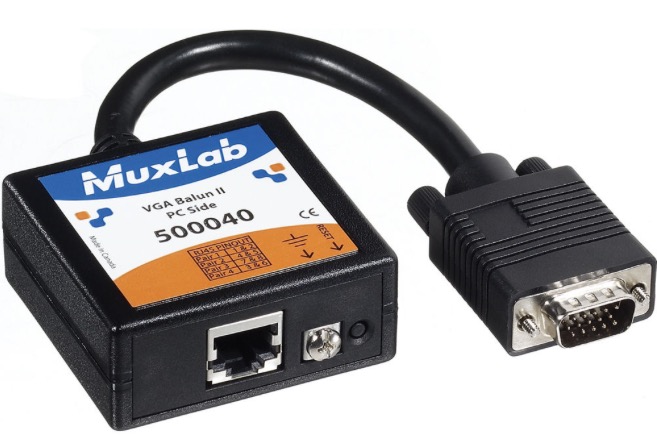
The term is commonly seen now for devices that adapt an analogue audio or video signal so that it can travel long distances over standard wiring (such as CAT5).Â
BANDWAGON
A wheeled platform on stage.
Originally, a large wagon that carried the circus band in a circus procession. The term was first popularised by P.T. Barnum. Parade viewers paid a lot of attention to the band wagon, so politicians started to use a band wagon on the campaign trail. The phrase 'to jump on the bandwagon' came to mean anyone who takes advantage of a popular trend to further their own agenda.
BANDWIDTH*
The range of a piece of sound equipment. If an equalizer has cutoff frequencies of 200 and 2000 Hz, then the bandwidth is the difference between them, in this case 1800 Hz.
BANJO
(US) Horizontal rail along which a curtain runs (also known as a BANJO TRACK).
BANTAM
See JACK.
BAPAM
British Association for Performing Arts Medicine. Specialist health and safety support for performers and technicians.
British Association for Performing Arts Medicine website
BAR
The horizontal metal (steel or alloy) tube (usually 48mm in external diameter, but can be up to 60mm) hung from flying lines (or forming part of a grid) from which lighting equipment and scenery etc. may be suspended. Also known as a BARREL. When vertical, known as a BOOM. Sometimes known as a PIPE in the US, although many curse that usage, and demand the use of Batten ; 'A pipe is what you smoke; a batten is what you hang your instruments from.'.
Language, especially in theatre, is rarely universal! In German, ZUGSTANGE.Â
BAR BELLS
Bar Bells are rung in public areas of the theatre to warn the audience that the performance is about to start/continue. Usually operated from the prompt corner and sometimes followed by Front of House Calls. The bells are also used as a warning to FOH and bar staff that the interval is about to commence or that the show is about to end.
The bells may be rung by the DSM, or by the duty stage manager.Â
BARE ENDS
Term to describe an electrical cable which has no connector at one end (for example, a SPEAKON to BARE ENDS cable is used to connect the terminals of a speaker cabinet to a speakon socket, and a 63A socket to bare ends might be used to wire in a temporary supply from a power distribution board before connecting equipment. Any installation work of this sort should only be carried out by a qualified electrician, and should never be done 'live'.
BARNDOORS or BARN DOORS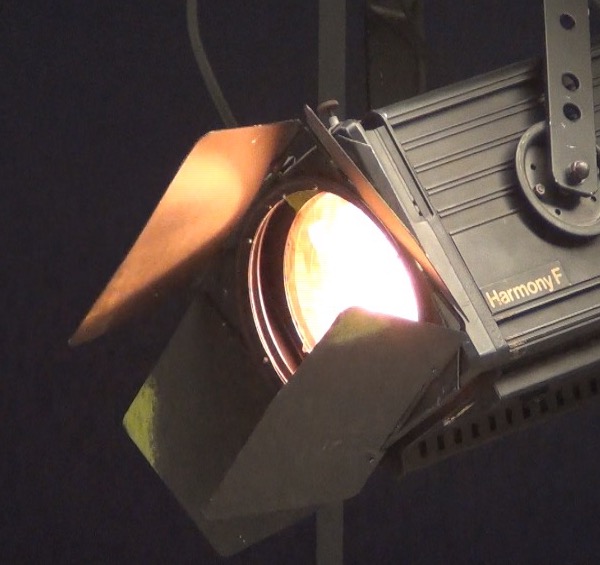
Profile lanterns use SHUTTERS to achieve a greater degree of control and accuracy.
Barndoors are also available for parcans and birdies. BLACKWRAP can be used to reduce additional light spill where barndoors aren't doing the job.
BARREL
See BAR.
BASE COAT
An initial coat of paint to provide a solid COLOR, or to prime the surface and to prepare it for a more detailed paint job. The base coat may be a cheaper type of paint, to prepare the surface for a thinner coat of COLOR.Â
BASE PLATE
A metal plate which prevents damage to floors when using scaffolding or trussing.
BASKET
The generic rigger's term for using a basket hitch with an extra shackle to ease or speed fitting or removing slings at height or in awkward situations.
Submitted by Chris Higgs
BASKET HITCH
A method of slinging that employs a sling wrapped around an object and both ends or eyes being connected by a component at the support point, hook, etc..Â
To lift a load as if in a basket.
Submitted by Chris Higgs
BASKET SHACKLE
Rigging term: In a BASKET assembly the basket shackle is the bow shackle connecting basket hitch sling to the rest of the lifting system (motor, down leg, etc..) Sometimes called the base shackle (US).
Submitted by Chris Higgs
BASS
Lower end of the musical scale. In acoustics, the range (below about 200Hz) in which there are difficulties, principally in the reproduction of sound, due to the large wavelengths involved.
BASS BIN
Slang for a speaker cabinet containing a Woofer designed for Bass sound reproduction (see also Subwoofer).
BASSC
Short for British Academy of Stage and Screen Combat.
(From their website:Â The British Academy of Stage & Screen Combat was founded in 1993 with the aim of improving the standards of safety, quality and training of stage combat and promoting a unified code of practice for the training, teaching and assessing of stage combat within the United Kingdom.)
BASTARD PROMPT CORNER
Used when the Prompt Corner is Stage Right instead of the usual Stage Left. This may be for architectural reasons in a theatre with no wing space Stage Left, or may be because of the layout of set pieces which obscure a view from Stage Left, or because the band is on Stage Left and the Deputy Stage Manager can't hear her/himself cueing!
BASTARD SIDE (B.S.)
Terminology used to describe Stage Right when there is a Bastard Prompt. Stage Left is then known as Opposite Bastard (O.B.)
BATTENS
1) Timber at the top and bottom of a cloth. A Sandwich batten is used to carry a hanging cloth. It comprises two flat pieces of timber screwed together with the edge of the cloth between them.
2) Timber used for joining flats together for flying.
3) Compartmentalised floodlights set up to allow COLOR mixing. See also GROUNDROW. Low voltage battens are commonly used as light curtains & for COLOR washes. Known in the US as a STRIPLIGHT or BORDER LIGHT.
4) US term interchangable with PIPE for a flying bar.
BAUD
(Bits per second) Measurement of the speed of electronic communications protocols. DMX512 operates at 250,000 baud (i.e. 250,000 electronic signal changes per second).
BAUPROBE
(German) A rehearsal on the stage where a show is to be performed, with a basic set laid out, so the director and designer can work on any staging issues to do with the size of the scenery, before it is built.
BC HOLDER
Type of UK domestic lampholder that has largely been replaced by the ES (Edison Screw) and the GES (Goliath Edison Screw) for general lighting applications in the theatre. Stage lighting equipment uses prefocus lamp bases. (Most types of Festoon still use BC holders.)
BEAM ANGLE
The angle of the cone of light produced by a lantern. Defined as the angle within which the lowest intensity in a beam of light from a lantern is not less than one-tenth of the maximum.
BEAMLIGHT
A PARCAN is a special type of beamlight.
Beamlite in the Backstage Heritage Collection
BEAT
1) In acoustics, a periodic variation in amplitude which results from the addition of two sound waves with nearly the same frequency. Also affects radio reception.
2) A deliberate pause for dramatic / comic effect.
3) A measure of time when cueing (e.g. "The LX cue needs to go four beats after the door is closed" or "Leave it a beat after the blackout, then play the sound cue").
4) A unit of action, as suggested by Stanislavski to help actors determine the through-line of a role.
BEBEE
(US) An American lever hoist, the name of which is often used generically for any lever chain hoist.
Submitted by Chris Higgs
BECTU
Broadcasting, Entertainment, Cinematograph and Theatre Union. The UK entertainment technicians union. (US equivalent is IATSE)
BECTU website
BEGINNERS
A call given by Stage Management to bring those actors who appear in the first part of a play to the stage. e.g. "Act One Beginners to the stage, please". The actors/actresses are then called by name.
A similar call is given after the interval (e.g. "Act Two Beginners to the stage please").
The call is usually given 5 minutes before the advertised performance start time, but this may vary depending on how long the actors take to get into position.
See also HALF, QUARTER.
See Calls and Cans
BELAY
Marine rigging term for making off a line. Often encountered in climbing and mountaineering meaning the actions of rope management in arresting falls.Â
The belay is the attachment point to a rockface or structure. The belayer is the person tending the rope and belaying equipment (see DYNAMIC BRAKING) and 'to belay' means to perform the action of belaying. Originally with just gloved hands, now via sophisticated friction devices.
Submitted by Chris Higgs
BELL BOARD
A live sound effects board on which are mounted a number of different types of doorbells / phone bells etc. Usually operated by stage management. The switch or bell push to operate the doorbell (or even the whole bell board) can easily be mounted on the set if the director wants the actors to operate it themselves.Â
BELOW
An actor move downstage of an object (or other actor) (e.g. "Clive crosses below the chair and exits downstage left").
BELT VOICE
Singing term - refers to a voice which has not been classically trained, but can 'belt out' songs. See also LEGIT VOICE. (For example Cosette in Les Miserables needs to have both a Legit Voice and a Belt Voice)
BELTPACK
Part of the communication ('cans') system in a theatre, the Beltpack contains the controls and circuitry to drive the HEADSET worn by crew members. Each beltpack connects into the headset ring and back to a PSU (Power Supply Unit) which is powered from the mains.
See also CANS.
BENEDETTO CANTINELLA
Actor in Rome and Florence in the mid 16th Century who played Pantalone in the Commedia dell'Arte.Â
BEST EIGHT BARS / BEST SIXTEEN BARS
(US)Â A section of a musical number, which shows off a performers' singing voice well, and is the excerpt used in auditions. The bar count is a rough guide rather than a stipulation.
A 16 bar cut is expected to be around 30-45 seconds, and a maximum of 1 minute.Â
BETA SP
Professional video tape format developed by Sony (short for Betacam SP). Beta SP is broadcast-quality and is a relative of Sony's failed Betamax domestic standard.
BETACAM
A range of half-inch professional videocassette products developed by Sony in 1982. Consists of Analogue and Digital formats.Â
Wikipedia entry
BETAMAX
(Trade Name) Consumer-level analog videocassette magnetic tape recording format developed by Sony, released on May 10, 1975
Wikipedia entry
BETAPACK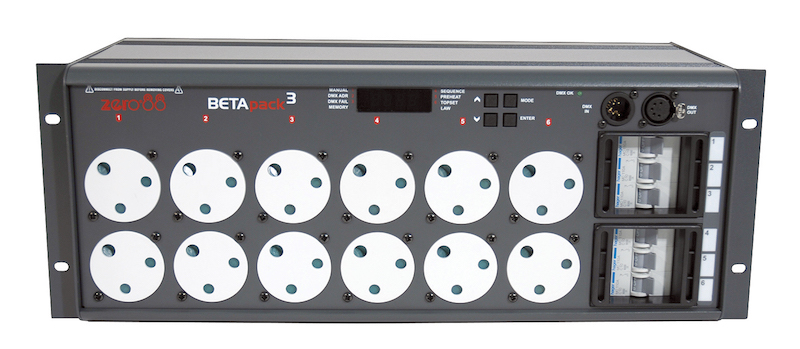
Zero 88 website
BI-AMPLIFICATION
A way of optimising the efficiency of a speaker system by separately amplifying the High Frequency (HF) and Low Frequency (LF) portions of the sound signal (after the crossover) and sending them down two pairs of cables to the speaker. Multipin Speakon connectors have been developed to do this.
BIBLE
Usually refers to the PROMPT BOOK - this document contains the full script of the show and all cues, and is used by the DSM to call the show.Â
BIFOCAL SPOT
Profile lantern with two sets of shutters, one of which produces a hard edge, and one a soft edge. Not necessary in zoom profiles, because this requirement is fulfilled by two lenses.
The first theatre lantern with this functionality was the Patt.264. The T-Spot range also had bifocal shuttering.Â
Patt.264 in the Backstage Heritage Collection
T Spot (1976)
BILLY BLOCK
A pulley on a short length of rope used to divert the pull of a working rope, or to suspend a single item in storage.
BINARY*
BIT = Binary Digit. More information coming soon.
BINAURAL
Sound reproduction using two microphones usually in a 'dummy head' (to emulate the shape and the response of the human hearing system) feeding a pair of headphones, so that the listener hears the sound he or she would have heard at the recording location.
BIOBOX
(Aus) Australian term for the lighting / projection control booth at the rear of the auditorium. Shortened version of BIOGRAPH BOX, after it's original function as a cinema projection box. Sometimes also known as the DOME if followspots are controlled from the same position.
BIPLANE
(Lighting) Describes a fllament inside a lamp which has two sections, a front and a back filament, which enables more light to be produced from a smaller point than with a monoplane filament.Â
BIRDIE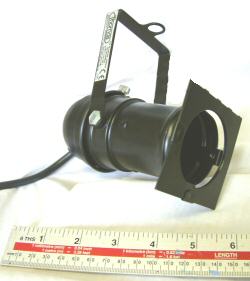
Low voltage birdies require a 12 Volt external transformer. Mains voltage birdies are also available.
Due to its compactness, the birdie is ideal for concealing in pieces of set or as downstage uplights. The beam angle can be narrow - a range of different lamps are available with differing beam widths.
See also MR16.
Types of Lantern
BISCUIT POTTERY / BISQUE POTTERY
Eathernware product that has been fired once but not yet glazed. It can easily be painted / decorated and can be used for plate / cup smashing scenes on stage as it breaks more easily / gently than a fully glazed product. However, breakaway cups or plates made from wax are the only really safe solution, as even biscuitware can have sharp edges.
For a long-running show, or for a more controllable effect, consider using a glazed plate / cup and pre-smashing it, then using filler or glue to 'fix' it so it holds together. It will break far more easily, so minimum effort will be required.
Any breakaway or pre-smashed item will need a sound effect 'smash' to make it fully believable.
Ensure that use of any ceramics / crockery on stage is fully risk-assessed.Â
BIT PART
A small role in a play, television production or film.Â
BLACK ART
Technique to bring objects to life against a black background, using black-clad performers.
Precise lighting of the object (puppets etc) only, with no light on the performers, ensures the illusion is flawless.
See also Ultraviolet.Â
BLACK BOX
A kind of flexible small studio theatre where the audience and actors are in the same room, surrounded by black tabs (curtains). Doesn't necessarily describe the audience layout, which can be easily reconfigured.The stage can be defined by a change of flooring (e.g. black dance floor), or a raised platform. If actors leave the stage, they do so through gaps in the curtains.Â
A black box type of venue is easy to set up in non-theatre spaces, and can be found occupying hundreds of spaces around cities such as Edinburgh during their Fringe Festivals.Â
BLACK COMEDY
A comedy play with a distinctly disturbing quality. It may have a macabre theme, or relate to the more unpleasant side of life. Also a play by Peter Shaffer with unusual lighting requirements.
BLACK HOLE
An accidentally unlit portion of the stage.
BLACK LIGHT
See ULTRA-VIOLET.
BLACK TACK
Self-adhesive high strength putty (similar to Blu-Tack, but stronger and black). Used for temporary fixes (e.g. of camera equipment like a Go Pro). Must by kneaded in the fingers before use.
See also BLACKWRAP.Â
BLACKOUTÂ
1) Complete absence of stage lighting. Blue working lights backstage should remain on and are not usually under the control of the board, except during a Dead Blackout (DBO), when there is no onstage light. Exit signs and other emergency lighting must remain on at all times.
2) The act of turning off (or fading out) stage lighting (e.g. "This is where we go to blackout")
BLACKS
1) Black clothing worn by stage management during productions.
2) Any black drapes or tabs, permanently or temporarily rigged. Used for masking offstage and technical areas.
3) Any blacks used to cover tables or road/transport storage boxes.
Running Blacks are full stage width black tabs with a split half way, which are usually fitted to a tab track so that they can be opened and closed horizontally AND flown in and out. The tab track control can either be operated from stage level or from a fly floor (when they're flown out).
Hard Blacks are black-covered scenic flats used as masking.Â
A Full Stage Black is a black cloth which can be flown in and is the full width of the stage. This is used to go upstage of a gauze to make transformation scenes work effectively, or can be used as a neutral backing for carefully lit scenes downstage.
Blacks flown vertically at the edge of the stage are known as LEGS.
Blacks across the top of the stage are BORDERS.
BLACKWRAP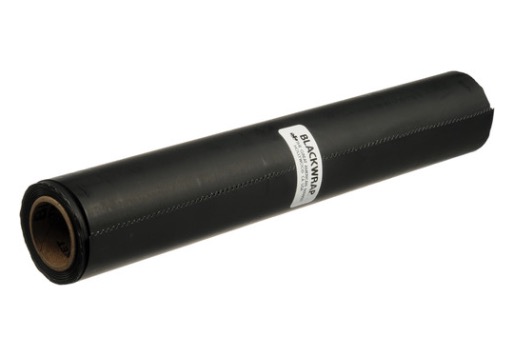
BLEECON
Trade name for a type of low voltage 8 pin connector which is similar to the audio DIN plug. Used most often for carrying signals from analogue lighting control desks to dimmers or to demux boxes. Originally manufactured by Belling and Lee, hence BLEEcon (for connector).
BLEED
1) Dimmers which are incorrectly trimmed are said to bleed. That is, the dimmer still gives a small output, causing the lantern to glow, when the control signal is at a minimum.
2) A contrasting COLOR paint still showing through a newly-applied top coat is said to be bleeding.
BLEED THROUGH
Transformation from a scene downstage of a gauze to another scene upstage, by slowly crossfading lighting from downstage to upstage. If a gauze is lit steeply, or from the sides, it will appear solid. If this light is turned off and light added to the set upstage of it, it will disappear.
BLIND PLOTTING
The facility on some lighting control desks for the operator to make changes to the plot, without affecting the state on stage.
BLINDERS
1) Lamps arranged around the stage directed into the auditorium, originally to prevent spectators seeing the stage during scene changes when the house tabs were not lowered. Now used for effect in rock concerts etc.
2) A strip of dense black material fastened behind a crack between two flats or scenic pieces to prevent light leak. Cloth hung behind a gauze to prevent transparency before the effect is required.
BLOCK
1) Frame in which one or more pulley wheels (sheaves) are mounted.
2) Wooden cuboid box that can be used to sit or stand on in a rehearsal or drama classroom situation. Also known as a Drama Cube or a Rehearsal Cube.
BLOCK PULLEY
TO BE DEFINED.
BLOCKING
The process of arranging moves to be made by the actors during the play, recorded by stage management in the prompt script. Positions at the start of scenes are noted, as are all movements around the stage (using terms such as 'Gardener X DSL' meaning the Gardener crosses to downstage left.) It must be described in minute detail, but simple enough to enable anyone to read and understand it. As well as being used to 'run the show' the prompt book is also used for the rehearsal of the understudies.Â
Stages which are not end-on must often use alternative notation, sometimes based on the clock face or the points of a compass.
Blocking Notation
BLONDE
2000W open-faced flood lamp used in film / TV lighting. So-called because of it's yellow/gold paint finish. See also REDHEAD.
BLUE-OUT
(Lighting) A fade to blue backlight only. Better than a full blackout, especially if the scene change is well choreographed.Â
BLUES
Blue lights used backstage in a performance situation. See also working lights.
BNC
BO'SUN'S CHAIR
A small seat or cradle rigged on a rope over a pulley whereby a technician may be hoisted to work at an otherwise inaccessible position.
BOARD
The main control for the stage lighting. Originally known as the switchboard or dimmerboard, it is now usually remote from the dimmers. The lighting operator for a show is said to be "on the board", and is sometimes known as the "board op". In the US, the board operator is said to be "running the lights".
Known in the US as the Light Board. Also known as the Lighting Desk, LX desk, control desk, lighting console.
BOARDS
Slang term for the stage floor. (e.g. "How long have you been treading the boards?").
BODICE
The upper part of a womans dress, close-fitting and covering the chest and back above the waist.Â
BOMB TANK
Metal bin or box covered with fine mesh in which Theatrical Maroons can be safely detonated.
See also PYROTECHNICS.
BOOK
1) See PROMPT BOOK.
2) The script of the show. (e.g. Actors need to be off book in 2 weeks)
3) The action of opening or closing a BOOK FLAT.
4) The non-sung text of a musical is known as the Book. The sung text is called the Libretto.
BOOK FLAT
Two flats hinged together on the vertical edge, to be free standing, and normally used as a backing for a doorway or window. They should always be 'run' with the hinged edge leading, to prevent them opening up. Book flats are free-standing when angled open, allowing quick setting and compact storage. Booking describes the action of opening or closing a book flat.
BOOM
1) Vertical scaffolding pole (usually 48mm diameter) on which horizontal boom arms can be mounted, carrying lanterns. Often used behind wings for side-lighting etc. Booms have a base plate (known as a TANK TRAP) or boom stand at the bottom and are tied off to the grid or fly floor at the top (not always necessary for short booms). Booms can also be fixed to the rear of the proscenium arch (Pros. Boom) or hanging from the ends of lighting bars. Sometimes known in the US as a LIGHT TREE. A light tree mounted upstage of a Tormentor is known as a Torm Tree.
2) An arm mounted on a microphone stand.
BOOM ARM
See BOOM.
BOOM BASE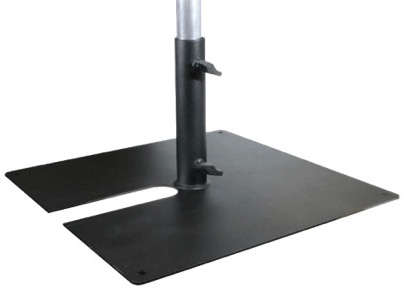
See also Tank Trap, which is a purpose-made all-metal boom base.Â
BOOMERANG
1) See COLOR CHANGER.
2) Old name for a BOOM (vertical lighting position).
BOOTH
(US) Control Room.
BORDER
A narrow horizontal masking piece (flattage or cloth), normally of neutral COLOR (black) to mask the lighting rig and flown scenery from the audience, and to provide an upper limit to the scene. Often used in conjunction with LEGS.
Spanish: Bambalina
BOSS PLATE
Metal plate fixed to the stage floor into which a bolt can be screwed for fixing scenery.
BOTTLESCREW
(Also Bottle Strainer, Barrel Strainer) Threaded device which is used to tension a wire, or to provide an adjustable link in a cable, to fine-tune the height of flown scenery. (Known in the USA as a Turnbuckle)
BOUNCE
1) Diffuse light that has been reflected from the stage, walls, cyclorama etc.
2) 'Bounce' is sometimes used for a flat (non-curved) cyclorama. Strictly, a bounce is a white or light blue cloth onto which light is bounced to backlight another cloth. A bounce doesn't need to be seamless, whereas a cyclorama should be.
3) Describes the fast in/out movement of 'bouncing' flown house tabs, traditionally used during curtain calls. This can also apply to the fast blackout/lights up cues that happen at curtain calls. When taking curtain calls, the Stage Manager would instruct the head flyman 'On the Bounce Please' for all calls prior to the final call, which was always 'Hand over Hand', i.e. slowly.
4) This facility was available on many multitrack tape machines. Describes the mixing down of multiple sounds from different tracks onto one track, hence freeing up the other tracks to be re-used. It allowed many sounds to be recorded onto one tape. The term now refers to the digital equivalent - taking multiple audio tracks and mixing them together at their set levels onto a single (pair of) tracks.Â
BOUNDARY MICROPHONE
A microphone mounted on a flat plate which acts as a reflective surface directing sound into the mic capsule. Used for general pick-up over a large area. A PZM (Pressure Zone Microphone) is an omnidirectional boundary mic for picking up sound from all around. A PCC (Phase Coherent Cardoid) picks up only from in front of the microphone.
See also THREE TO ONE RULE and COMB FILTERING.
BOWENS
Short for Bowens Flash Unit. Instrument which produces a bright white flash when triggered. Used by professional photographers. Unlike a STROBE, the Bowens unit needs to charge up between flashes (around 10 seconds) so is unsuitable for the same applications, but is ideally suited for recreating bright lightning flashes on stage.
BOWLINE
Most riggers' knot of choice. Secure and easy to undo after heavy loading.
Submitted by Chris Higgs. Video
BOX
1) Lighting Box - see CONTROL ROOM.
2) Enclosed seating area at the side of the auditorium in a traditional proscenium arch theatre. In the UK, some London theatres have a ROYAL BOX, which is usually equipped with an additional private reception room and is available for members of the Royal family (or other VIPs) to use.Â
BOX BOOM
US term for a front of house vertical lighting position (predominantly sidelight as the booms are rigged from the boxes nearest the proscenium arch).
BOX OFFICE
(UK) Part of the theatre front of house area where audience members can buy tickets. Most Box Offices are now computerised, and offer phone reservations. Some offer online (internet) bookings also.Â
Also known as the Ticket Booth (USA).Â
See also WILL CALL.
BOX OFFICE MANAGER
Member of the theatre staff responsible for the operation of the Box Office, including customer service standards, ticket sales in person, by phone or online, and the correct recording of ticket sales, repayments to theatre companies etc.
BOX SET
Naturalistic setting of a complete room built from flats with only the side nearest the audience (the fourth wall) missing.
A single static box set that represents more than one room is called a COMPOSITE SET (for example if the living room and the kitchen are both on stage permanently).Â
BOX TRUSS
See TRUSS.
BRACE
1) Angled strengthening timber within a flat.
2) (UK) Support for scenery (flattage) on stage
  2a.) Extendible, hooking into a screw eye on the flat and being weighted to the floor (commonly known as a 'Stage Brace')
 2b). French Brace, right-angled non adjustable triangular frame, made from timber, and attached to the flat with pin hinges. Known in the USA as a Jack. Often swung flush to the flat for storage or flying.
See also Jack (US for Brace).
BRACE WEIGHT
Slotted cast iron weight placed on foot of extendible or French brace to prevent movement. Often referred to as a 'Stage Weight'
BRAIL
A horizontal rope, wire or chain attached at either end of a piece of scenery or lighting bar pulling it upstage or downstage of its naturally hanging position to allow another flying item to pass, or to improve its position. See also BREAST LINE.
In a hemp house, to 'Brail' a static piece a single dead line was put round the 'short' and 'long' line to move the piece to a new position. A running brail was a breast which allowed the flown piece still to fly in or out, in its new position.
BREAK A LEG
A superstitious and widely accepted alternative to 'Good Luck' (which is considered bad luck). More available at the link below.Â
More on Break A Leg
BREAKAWAY
Prop or item of furniture designed to break/shatter with impact. Breakaway furniture and some props are usually capable of restoration to be 'broken' again.
BREAKING DOWN
Treatment given to freshly painted or newly made props, scenery or costume, to make it look either aged, lived-in, or less "new". Ofter involves spattering with paint to add interest and texture to areas lacking it.
BREAKOUT
A connection at the end of a multicore cable which allows the connection of many items to it. (e.g. there is a breakout box at the end of a sound multicore cable which allows you to plug microphone cables into it).
BREAKUP
A commonly used abstract GOBO which gives a textured effect to the light, without throwing a specific pattern onto the stage. Used to add interest to light beams. A leafy breakup is used for outdoor scenes / forests / spooky wood etc. to break up the light on the actors faces.
BREAST LINE
A form of brail running horizontally across the width of the stage, passed across the fly bars' suspension lines and attached at the fly floors to brail the scenery up or down stage, to create a larger space between adjacent pieces.
BRECHT / BRECHTIAN*
TO BE DEFINED
BRIDGE
1) A walkway, giving access to technical and service areas above the stage or auditorium, or linking fly-floors.
See also CATWALK.
2) A lighting position above the auditorium, commonly with a catwalk above it to access lighting equipment and electrical systems is known in Dutch as a Zaalbrug.
3) A section within a song which provides a break from the previous verse / chorus, to prepare for the final chorus or climax, and can also provide a contrast with the previous lyrical tone or style.Â
BRIDGE LIFT
An elevator which raises and lowers sections of the stage floor, usually by electrical or hydraulic means.
BRIDGING
Technique for getting more power out of a stereo amplifier by feeding it a mono input signal and then connecting the outputs together. The amplifier is said to be 'BRIDGED'. Check the owner's manual of the amplifier before trying this. Some amplifiers have a switch which does the bridging internally.
BRIDLE
1) A vee-shaped arrangement of lifting equipment or rigging materials that enable load to be spread or shared between the 'legs' of the bridle, usually around four feet apart. Also, to reduce structural spans between suspension lines by creating such 'vees' at pick up points on the structure, or an assembly arranged to create a lifting point where required between two or more structural points.
2) The steering device on a horse.
Submitted by Chris Higgs
BRIGHTNESS
A measure of the amount of light produced by a display screen, projector or light source.
Data projector brightness is measured in lumens. A lumen is a measure of the brightness of a light source.
One lux is one lumen per square meter. One lumen is one candela per square radian (to measure the light travelling outwards from a light source).
Cinema screen brightness is measured in nits. A nit is unit of visible-light intensity, commonly used to specify the brightness of a cathode ray tube or liquid crystal display computer display. One nit is equivalent to one candela per square metre.
BROADWAY
The group of 40 professional theatres with 500 or more seats located in the Theatre District centered along Broadway, and in Lincoln Center, in Manhattan in New York City, USA. Along with the West End of London, Broadway theatre is widely considered to represent the highest level of commercial theatre in the English-speaking world.
Wikipedia Entry on Broadway Theatre
BROADWAY FLAT
Also known as a Theatre Flat, or just a Flat!
Theatrical scenery flat where the framing timber is parallel to the surface of the flat.
See also HOLLYWOOD FLAT.Â
BSI
British Standards Institute.
BSL
British Sign Language.
British Sign Language website
BUBBLE
1) (especially TV and Film) Jargon for a replacement lamp.
2) The glass part of a lamp.
See also GLOBE, LAMP.Â
BUILD
1) During lighting plotting, to construct a state from blackout, or to add to an existing state.Â
2) An increase in light or sound level. See CHECK.Â
3) A period of set construction ('The Build').
BULB
See LAMP.
BULGIN
Range of connectors used for multipin or 'non-standard' connections. The small 3 pin Bulgin plug is used on the Le Maitre Pyroflash system. The larger 8-pin round 'truck plug' allows the connection of 6 dimmer circuits (up to 6A each) via a single multicore cable. This is ideal for carrying multiple dimmed circuits to a moving set-piece or truck. The 8-pin round connector has become a standard for disco lighting systems.
Bulgin Components website
BULLET
American device (from the overhead power distribution industry) that grips a wire rope by spring-loaded 'collet' jaws.Not designed for supporting weight.
Submitted by Chris Higgs
BUMP
A flash or sudden jump in light level (a snap cue) (see also FLASH BUTTON).
BUMP CUE
A lighting cue that instantly bumps the lighting up to a brighter level (a time of 0 seconds). Usually at the end of a musical number to draw the applause. The bump cue is sometimes called a 'button'.Â
BUMP IN
See GET-IN.
BUMP OUT
See GET-OUT.
BUNRAKU
Style of Japanese puppetry where the puppet operator carries the puppet onstage and is visible throughout the performance. The puppeteers are highly skilled and respected in Japan, and provide the voice as well as the movements for the incredibly detailed puppets.
About Bunraku
BURLAP
Sackcloth hessian, used as softening under steel wire rope slings. It's used because it's flexible and easy to use, and will not cause injury when dropped.
Submitted by Chris Higgs
BURLESQUE
Adult-orientated entertainment, consisting of dancing, minimal costumes, songs and comic sketches. Popular from the 1840s in Europe and the USA.
BURNT OUT
A COLORed gel that has lost its COLOR or melted through due to excessive heat in front of a lantern. Dark blues and greens etc. are most susceptible, and may need replacing during a long run.
BUSBAR
Metal bar carrying incoming electrical supply into which portable dimmer racks or other large power requirements can be wired directly. An enclosure containing busbars is a Busbar Chamber.
BUSINESS
A piece of unscripted or improvised action, often comic in intention, used to establish a character, fill a pause in dialogue, or to establish a scene. An author may simply suggest 'business' to indicate the need for some action at that point in the play.
BUSKING
1) For lighting operators / designers: Busking is when the lighting looks for each part of the show (usually a live music gig) are created spontaneously in response to the performance. Very often, basic palettes, states and effects are loaded onto preset faders, and combined by the operator during the show. Allows a very fluid performance and gives the lighting designer / operator a great deal of control about how the show looks, but is not repeatable. Busking would normally only happen for a one-off performance where the amount of time to pre-programme a series of states and sequences is not necessary or possible given tight timelines. Â
2) For musicians in the UK: Busking is performing music in a non-performance venue (e.g. on the street) with a way of passing members of the public donating cash.Â
BUSS
A signal line within a sound mixing desk that can receive its signal from a number of sources. eg the Aux 1 buss carries the signals from the input channels to the Aux 1 Send master control.
C CLAMP / C-CLAMP (THERE ARE ALSO F-CLAMPS)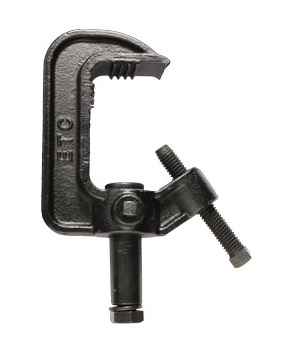
C-WRENCH
US for SPANNER. (Abbreviation of Crescent Wrench).Â
See CRESCENT WRENCH
C.C.T.V. / CCTV
Closed Circuit television. A video relay system, used in the theatre to give a view of the stage to remote technical operators (especially stage managers). Also used to give musical performers a view of the conductor (and vice versa) to help in keeping time. It's called Closed Circuit because the signal is not being broadcast anywhere - there's a direct link between camera and monitor.
CABLE
Wiring, temporarily rigged, to carry electrical current. Depending on the size of the cable (current carrying capacity), cables are used to supply individual lanterns, whole dimmer racks, or carry signals from a microphone etc.
CABLE GRIP
A U-shaped clip and saddle used for terminating wire rope. Also known as a Bulldog, Dog Grip or Wire Rope Clip.
CABLE TIE
Lockable (and sometimes releasable) plastic strap used to tie a bundle of cables together, amongst many other things.
Cable ties are absolutely not to be used to suspend anything (of any size, or at any height). Also known as Zip Ties.
CABOTINAGE
Overacting, hammy performance, playing to the audience (from the French "Cabotin" - a strolling player / charlatan).
CAD
Computer-Aided Design. Using a computer to help with 2D plans and drawings, or increasingly for 3D visualisation of how a set will look, and how lighting will affect it. See also WYSIWYG.
CADENZA
Range of 2000W lanterns by Strand Lighting in the UK.Â
Cadenza in the Backstage Heritage Collection archive
CALL
1) A notification of a working session (eg a Rehearsal Call, Band Call, Photo Call). A rehearsal call for the next day / week used to be posted on a Call Sheet on the stage door noticeboard, but is now often an online document, updated by the stage management team.Â
2) The period of time to which the above call refers. (eg "Your call for tomorrow nights show is 6.55pm")
3) A request for an actor to come to the stage because an entrance is imminent (these are courtesy calls and should not be relied on by actors - eg "This is your call for the finale Mr Smith and Miss Jones")
4) An acknowledgement of applause (eg Curtain Call)
5) The DSM on the book is said to be "calling the cues".
6) The COLOR Call is a list of lighting gel required for the lighting rig.
7) The Final Call is also known as The Half - 35 minutes before the performance starts, and the latest time when the cast and crew should be in the theatre.
CALL BOARD
A noticeboard backstage in the theatre which is used to post the actor call times for the next rehearsal period.
CALL OUT
A notice sent to a mailing list or posted on social media, looking for cast, crew or helpers for a project.Â
CALLBACKS
Following an audition, the director may ask to see a shortlist of actors again - they are called back for an additional audition to enable the director to make her/his decision.
CALLING THE SHOW
The process of giving verbal cues to the lighting, sound, fly operators and stage crew during the performance. Usually done from the prompt corner by the DSM or Stage Manager over cans.
CALLING THE SHOW
The most important person on the technical crew for the show is the DSM (Deputy Stage Manager) who (in the UK at least) calls the show - the involves verbally giving the 'GO' cues to all technical departments (lighting, sound, flies, automation, av etc). The cues are written in the prompt script. A 'STANDBY' (UK) or 'WARN' (US) cue is given first, so that the operators are ready for the actual cue.Â
CALLS
Often regarded as a courtesy to the Artist, they are given by the Stage Management on a 'count back' from the 'Beginners Call'. Prior to 'Beginners' the stage is the domain of the stage crew for setting up etc. After 'Beginners', the stage is the actors domain. On a musical, the Act 1 call is for 'Overture & Beginners', and the Act 2 call is for 'Entr'acte & Beginners'. On a production with a large orchestra, the first 'Members of the Orchestra' Call is for the 'Strings' sections to tune up together, the second call is for the remainder of the orchestra to join them in the pit. The 'leader' if not seated already is then welcomed into the pit followed by 'The Maestro' or 'MD' (depending on his/her status in the music world). The Cue for the Overture to commence is given from the corner, by means of a cue light.
The Half (hour), the quarter (hour), five minutes as well as (Overture) Beginners, are all given five minutes earlier than the actual call as named.
See Calls and Cans
CAMEO
An appearance in a small role in a play, television programme or film by a well-known performer. Celebrities sometimes take cameo roles in projects for their friends, or as a mark of respect to the creative team.Â
CAMLOCK
(Trade Name - Crouse Hinds - CAMLOK) Single pole connector used on professional power distribution & dimming systems. A separate connector is used for each phase/neutral of the supply.Originally developed for touring concerts, as power demands increase it's finding more use in theatres.
CANS
1) Headset earpiece, microphone and beltpack used for communication and co-ordination of technical departments during a performance. (e.g. "Electrics on cans", "Going off cans", "Quiet on cans!").
A commonly used system in the UK is produced by Canford Audio under the TecPro brand. In the USA, ClearCom is commonly used.
As many of the technical operators are tied to expensive pieces of equipment, headsets are often wired. However, stage management (and any other crew who move around) often wear wireless versions, often known as radio cans. There are interfaces between wired and wireless versions enabling both to be part of the same system.
Many headset systems have multiple channels, enabling different sub-groups to communicate separately.
[Named after the well-known usage of two tin cans connected by a piece of string being able to transmit and receive a sound mechanically]
2) Any headphones.
3) Short for PARCANs.
CANTASTORIA
From the Italian for "Sung Story" or "Singing History" this is a theatrical form where a performer tells or sings a story while gesturing to a series of images. These images can be painted, printed or drawn on any sort of material.
CANTATA
(Trade Name) Range of 1200W lanterns produced by Rank Strand (now Strand Lighting) in the UK.
Strand Lighting website
Strand Archive
CANVAS
Used to cover flats as a less heavy alternative to plywood.
CAPACITANCE*
TO BE DEFINED
CARABINER
Spring-loaded clip device used by climbers and also in stage rigging.Â
Named after the carbine gun which had a spring loaded gate.
CARBON ARC LAMP
First demonstrated by Humphrey Davey in the early 1800s, the carbon arc lamp was the first practical electric light. It consisted of two carbon rods in air connected to a power source. To ignite the lamp, the rods are touched together and then slowly drawn apart. The electric current heats the tips of the rods and maintains an arc (originally, an 'arch' of electricity). The carbon at the tips of the rods vapourises, producing an intense bright light. The rods are slowly burnt away in use so constant adjustment of the distance between the rods is necessary to maintain the arc.
CARDOID
See PICK-UP.
CAROUSEL
Circular slide magazine; also refers to a 35mm slide projector using this type of magazine (Kodak trade name). See PROJECTION.
CARPET CUT
Hinged trap running the width of the stage, as far downstage as is practical, to secure the front edge of a painted floor (stage)cloth, or carpet. The other three sides of the floor cloth were 'tacked' down to prevent it being a trip hazard. Large companies (e.g. The Royal Ballet) used to lay a floor cloth for each act. A stage-hand, with spade or shovel, worked round the floor cloth to 'up-end' the tacks that were holding the cloth down. It was then folded in such a way, that for the following show, it was set with the downstage edge ready to go into the Carpet Cut. The floor cloth was always put in the carpet cut first, then pulled out taut by the crew and re-tacked. (becoming obsolete term)
CARTRIDGE or CART
(Sound) An audio tape loop in a box which can cue itself up to the beginning of the recorded track in a cartridge player. Previously used extensively for radio jingles, and sometimes for theatre sound effects, it was superceded by MiniDIsc, and now by computer-based playback.Â
CASSETTE
Originally, Compact Cassette. Popular domestic 1/8' tape format. Difficult to cue up accurately, so awkward for live theatre, but cheap, so often used by small scale touring companies as sound effects source. A different cassette is used for each effect. However, Minidisk prices are coming down to the extent that cassettes are rarely used for sound effects now.
CAST
The members of the acting company. The Cast List contains the names of the actors and the characters they'll be playing.Â
Dramatis Personae is a Latin term for a list of the characters in a play.
CAST LIGHTING
Canadian creators of WYSIWYG software.
Cast Lighting website
CASTING
The process of the director choosing actors to perform the characters in the play.
CASTORS
The wheels on a TRUCK or underneath a REVOLVE.
CASUALS
Part-time temporary technicians (paid by the hour).
CATENARY
Horizontal wire rope under tension (from the Latin 'catena' meaning a chain, the curve associated with a horizontally stretched chain length which is impossible to straighten due to it's self weight).
Submitted by Chris Higgs
CATHARSIS
A catharsis occurs when a moment of high tragedy at the emotional climax of a play is followed by an emotional cleansing for the characters and the audience.
CATTLE CALL
Old term for an open audition for chorus roles in a musical or large entertainment spectacular. The performers tend to be treated as cattle and kept together in a large room and called in groups to audition. The Broadway musical "A Chorus Line" depicts such an audition.
CATWALK
An access walkway to equipment. Unlike a BRIDGE, not necessarily across a void.
CD (Compact Disc)
Digital sound storage medium introduced in 1982. Provides a high quality source of music, sound effects etc. Also used as a playback medium for sound effects etc by large theatres with long running shows, although CDR (Recordable CD) is becoming more affordable by the day.
CEEFORM
(UK / Europe) A range of standard plugs & sockets for power, which are IP rated for outdoor use.
They come in a variety of sizes and colors. Blue is 230V, Red is 415V (3 phase).
Sizes available include 16A, 32A, 63A and 125A. These refer to the current-carrying capacity of the connector.Â
CENTER CENTERÂ (CENTRE CENTRE in AUSTRALIA)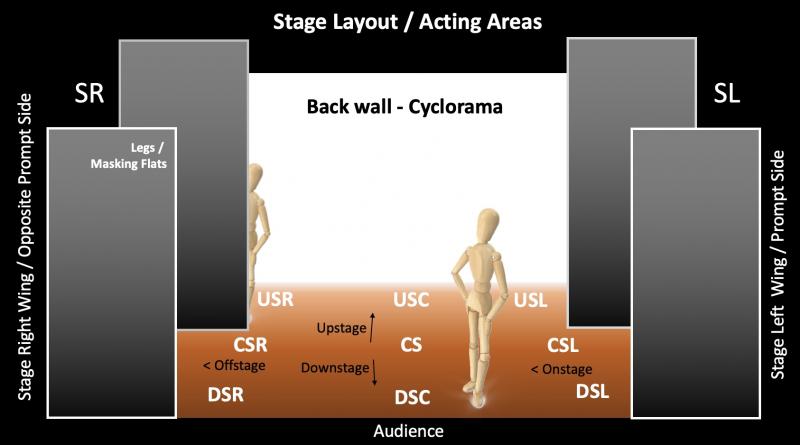
Blocking Notation
CENTER LINE
Imaginary line running down the stage through the exact CENTER of the proscenium opening. Marked as CL on stage plans. Normally marked on the stage floor and used as a reference when marking out or assembling a set. A chalked snap line can be used to mark the line in the rehearsal room and on stage.
Known in the US as CENTER LINE.
House CENTER / House Center is the CENTER line of the auditorium (which is usually the same as that of the stage).
See also SETTING LINE.
CENTER STAGE
Also known as MID STAGE.
CGI
Acronym for Computer Generated Imagery. Any images or special effects sequence in a film / video which is created in computer software such as After Effects, or any motion graphics or special effects compositing software.Â
CHAIN HOIST
Manually operated or electrically driven hoist for lifting scenery and lighting equipment. The chain hoists are rigged to fixed points in the venue. Commonly used to lift lighting truss into position for touring shows or concerts.
CHAIN POCKET
Fabric pocket along the width of the bottom of a cloth or tab holding a chain which weighs the bottom of the cloth down.
CHANNEL
A complete control path for signals in lighting or sound equipment.
In a lighting desk, the channels are directly controllable by the lighting operator. Within the desk, the channels are 'patched' to a dimmer or dimmers which the desk then sends a signal to depending on the level of the channel.
CHAPERONE
Adult who takes responsibility for a group of young people while they're away from their parents. A legal requirement when working with children (and a relief for the stage management team!)
CHARACTER
1. The mental and moral qualities distinctive to an individual within the world of the play.
2. A named individual within the play (e.g. "There are ten characters in scene one, all of whom have speaking parts.").Â
CHARACTERISATION
The art of creating a character. Within the text, characters may be presented by means of description within stage directions or character descriptions which the actor must try to convey or through their actions, speech, or spoken thoughts within the text.
CHASE
A repeated sequence of changing lighting states. A chase can be produced easily by the effects functions of a computerised lighting desk. There are standalone units designed to chase lighting circuits electronically in time to music (sound to light) or mechanically as a repeated sequence (as used in early neon signs).
CHEAT
An actor movement (or lighting change) which happens without the audience being aware of it, or a change to improve the situation even though it may not be totally natural (e.g. "CHEAT OUT").
CHEAT OUT
An actor facing too far upstage (so that he/she is invisible to the audience) may be requested by the director to "cheat out", and turn downstage slightly, to improve audience sightlines. "Out" in this sense means towards the audience, and rather than being a derogatory term, "cheat" simply means to improve the situation (sightline in this case) without anyone realising it's not a totally natural position.
CHEAT SHEET
A smaller version of the lighting plan, used by the lighting designer during the lighting plot. Also known as a Dimmer Layout or Magic Sheet.
CHECK
1) Opposite of Build; a smooth diminishment of light or sound level (e.g. Lighting: 'I think we should check this state down a touch as the song begins')Â
2) See Prefade Listen.
CHEEK WALL
Side wall running up the edge of a set of stairs / treads, perpendicular to the risers.Â
CHERRY PICKER
Piece of access equipment used on larger stages or in other industrial buildings, consisting of a moveable base and an hydraulic arm on the end of which is an enclosed basket containing the operator.Â
CHEWING THE SCENERY
An actor who gives a completely hammy and over-the-top performance is said to be Chewing the Scenery.
See the link below for more.
More about Chewing the Scenery
CHIAROSCURO
(n.) In Lighting or Scenic design (and the Art world), Chiaroscuro means the use of contrasts of light and shade, especially in order to enhance the depiction of character and for general dramatic effect. Many painters are said to be masters of Chiaroscuro (especially Rembrandt, Caravaggio etc.) From the Italian words chiaro 'clear, bright' and oscuro 'dark'. From the Random House Word of the Day website.
CHIEF ELECTRICIAN
The senior member of the theatre's stage lighting team, although not necessarily the lighting designer. Known in the US as MASTER ELECTRICIAN.
In common with many theatre jobs, the actual duties of the Chief Electrician vary from theatre to theatre. Some chiefs are responsible for electrical maintenance of the building, some design the lighting for nearly every in-house production, some design no lighting at all, some have a team of eight staff under them, some have two. Many theatres employ casual staff to assist on lighting rigging sessions. Some theatres have a separate sound department, smaller venues have the lighting team also running sound for shows (and doing sound design for some).
Abbreviated to CLX in some UK venues.
CHINAGRAPH PENCIL
Usually white, wax-based pencil used for marking magnetic tape prior to splicing. Also used for marking identifying numbers on lighting gels.
CHINAMAN
Slang term for a Differential Windlass (also known as a Chinese Windlass) which consists of two drums of different radii, used to gain a large mechanical advantage when lifting heavy loads. The windlass would be on the grid above the stage. The Garrick Theatre in London still has one on it's grid.Â
CHITON
Form of Ancient Greek clothing.
Wikipedia entry
CHOKE
Rigging term: A slinging pattern made by passing one end of a sling through the opposite end's eye or by making a 'lark's head' loop with an endless sling (also CHOKER HITCH (US) or STRANGLE (UK)). Useful, but reduces the SWL/WLL of the sling by 20%.
Submitted by Chris Higgs
CHOOKAS
Australian equivalent to 'Break a Leg'
More on Break A Leg
CHOPPERS
(Followspot term) Two horizontal masking shutters used in followspots to shape the beam above and below.
Submitted by Bert Morris.
CHORD
The main horizontal member(s) in a truss/lattice structure.
Submitted by Chris Higgs
CHOREGOS
(Greek) Individual paying for the tragic chorus for a performance.
CHOREOGRAPHER
Member of the production team responsible for setting dances and movement sequences during the production.
CHOREOGRAPHY
The art and craft of designing the moves, pace, flow, structure and execution of a piece of dance, or any other piece of rehearsed movement. This is usually carried out by a Choreographer, but choreography can be devised by a group of dancers. A stage combat sequence is also choreographed, but by a fight director.Â
CHORUS
1) In Greek theatre, a character (or group) representing an element in the drama which comments on the action, and advances the plot.
2) A sound processing effect which adds 'body' to a sound by overlapping a number of slightly delayed versions of the original sound.
CHORYPHAEUS
(Greek) Chorus leader.
CHROMINANCE
Shortened to Chroma or C. The signal in component video systems that contains the COLOR information for the picture. The monochrome part of the picture is luma or luminance.
CID
(Compact Iodide Daylight) A high intensity discharge lamp that produces a light similar in COLOR temperature to daylight approx. 5500K). A 1000W CID lamp produces 2.5 times more light than a 2000W tungsten halogen source.
CIE
(Commission Internationale d'Eclairage) International lighting forum which has produced (amongst many other things) a series of universally recognised symbols for lighting plans.
CIE website
CINEMOID
Now obsolete term for lighting COLOR gel, produced by Rank Strand / Strand Electric in the UK. A much thicker (and less flexible) gel than that produced nowadays.
CIRCLE
The balcony with tiered seating above the stalls in a traditional proscenium arch theatre. Also known as Dress Circle or Grand Circle. See also UPPER CIRCLE.
CIRCLE FRONTS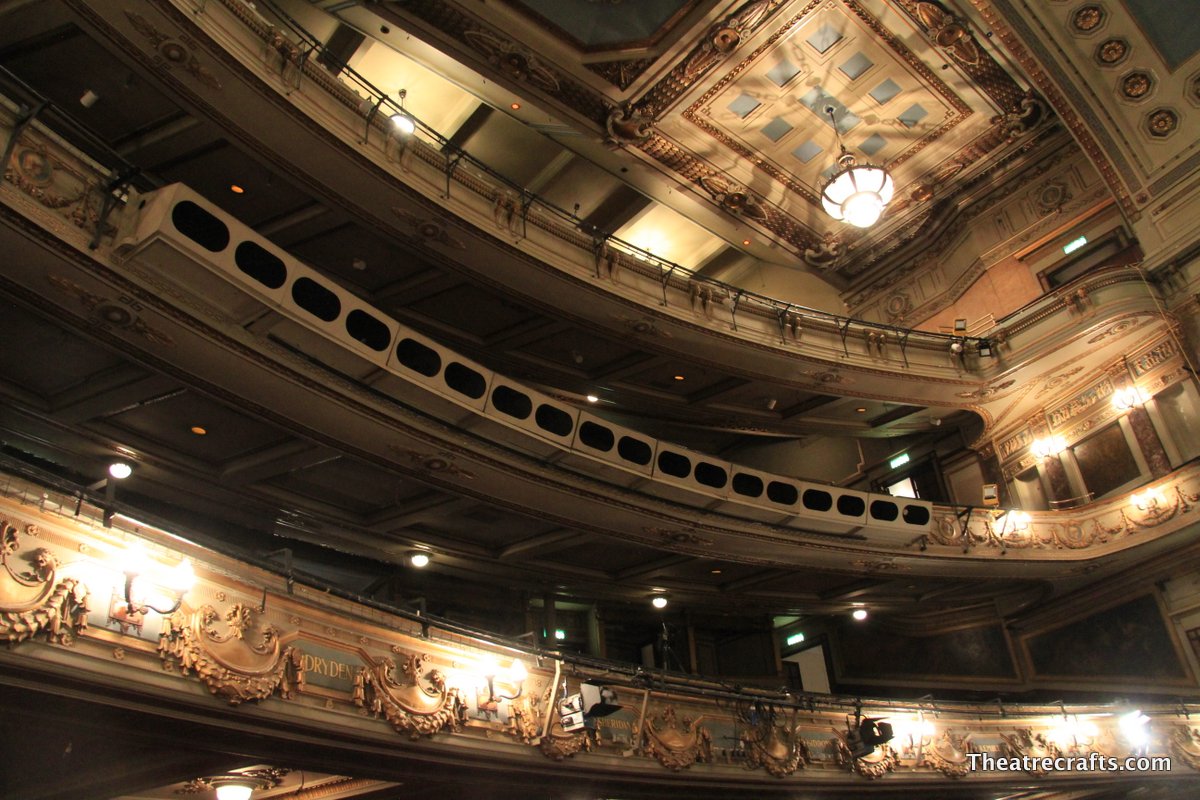
CIRCUIT
1) The means by which a lantern is connected to a dimmer or patch panel. Numbered for reference. In a fully patchable system, the circuit number (also known as socket number) can be connected to any of a wide range of dimmers.Â
The process of allocating circuits to dimmers is sometimes known as circuiting. The process of connecting lanterns to dimmers is sometimes known as plugging up. Abbreviated to 'cct'.
2) A complete electrical 'loop' around which current can flow.
CIRCUIT BREAKER
An electro-mechanical 'fuse' that can be reset, rather than having to be replaced when too much electrical current flows through a circuit.
Available in the same ratings as fuses.
See MCB, RCD.
CITT
Canadian Institute for Theatre Technology.
CITT website
CLAQUE
A claque is an organized body of professional applauders in French theatres and opera houses. Members of a claque are called claqueurs.
CLEANERS
Auditorium working lights. Used for cleaning and setting up the auditorium before the house lights (usually more atmospheric) are switched on.
CLEANING COSTUMES
During the run of a show, costumes need to be regularly cleaned.
A show that uses modern costumes may require no specialised care, and cleaning could be part of the duties of an ASM, or on a larger show, a Costume Assistant, or Wardrobe Manager.
On a show with period costumes, or more delicate costumes, an 'inner shield' or 'costume shield' is sometimes used, which is an easily washable removable inner costume layer, which is worn between the actors underclothing and the main costume. The main costume, which may require dry cleaning, can be cleaned far less frequently.Â
CLEARANCE
Message passed to Stage Management from the Front of House Manager that the house is ready for the performance to begin. (ie everyone is in their correct seat and there are no coach parties coming through the doors). Announced as 'We have Front of House Clearance'.
CLEARING STICK
A long, often bamboo, rod used to rescue flying objects or to prevent them from becoming entangled by guiding flying scenery past obstructions. Often marked out with measurements to aid the levelling or deading of the bottom of a flown drape or masking.
CLEARS / GIVING CLEARS
(Stage Management) A crew member (often an ASM) gives a 'clear' to the DSM on the book to let them know a particular flying piece is safe to fly, or a particular item of scenery has passed a danger point.Â
CLEAT
Piece of timber or metal for tying off a rope line by taking a turn around it, followed by a series of figure eight turns and a locking tuck(s) made in the final turn. Used when flying or for holding scenic pieces together with a cleat line.
Submitted by Chris Higgs
CLEAT LINE
Means of fixing two flats together with one cleat hook and sash line (approx. 18†from the top of the flat) and a lower pair at waist height. It was a challenge to any member of the stage crew to throw the 'cleat line' over the top hook ' in one' i.e. at the first attempt. Many a pint has been won, with the challenge 'bet you a pint you can't throw it in one!' The old hands would loudly count the number of failed throws.
CLEW
A ring of metal which is used to join several flying lines or wires to a single pulling wire.
CLICK TRACK
Technique for reinforcing the live sound of a musical or band with recorded sound from one track of a tape. The other track of the tape consists of a click used by the musical director to keep the live band and cast synchronised with the recorded band or cast.
CLICKS AND POPS
Any miscellaneous problem with a sound system (e.g. 'There are a few clicks and pops with the sound interface, but that should get sorted when we change the driver').Â
CLIMAX
The significant moment in the plot of a play, when things change, or reach a crisis point.
CLIPPING
Distortion in a sound signal caused by an amplifier or mixer being unable to handle the level of signal being fed to it.
CLOAKROOM
Area near the entrance of a theatre (or other public venue) where visitors may leave their coats and bags, in exchange for a small fee. The cloakroom attendant provides a numbered ticket or token, a duplicate of which is kept with the coat / bag to identify it.Â
CLOSED POSITION
An actor who is turned away from the audience is said to be in a 'closed position'. See also OPEN POSITION.
CLOSING NIGHT
The final performance of a show in front of a paying audience.Â
CLOTH
A piece of scenic canvas, painted or plain, that is flown or fixed to hang in a vertical position.
A Backcloth (or Backdrop) hangs at the rear of a scene.
A Floorcloth is a painted canvas sheet placed on the stage floor to mark out the acting area, or to achieve a particular effect.
A Frontcloth hangs well downstage, often to hide a scene change taking place behind.
Cut cloths have cut-away open areas and are normally used as a series, painted in perspective.
A Star Cloth (also Star Drop or Starcloth) (usually black) has a large number of small low-voltage lamps sewn or pinned through it which gives a magical starry sky effect. (See also FIBRE OPTICS).
In the US, a cloth is known as a Drop (from backdrop).
In Spanish, a flown cloth is a Bambalina.
In German, a floor cloth is a Bodentuch
CLOVE HITCH
Invaluable hitch that every technician should know.
Video
CLUSTER
Generic name for a grouping of loudspeakers hung in a performance space. (e.g. The central cluster). Also known as ARRAY.
CLUTCH
1) Purpose designed 'chain system' forging that allows a link of sling chain to be grabbed in order to shorten the reach or length of the chain. The forging ensures the 'grabbed' link is correctly loaded and no link is trapped or damaged.
2) A sailing term for a device that grips a control line or sheet in a modern rigging design.
Submitted by Chris Higgs
CM / C.M.
Manufacturer. (Columbus McKinnon Corporation.) American manufacturer of lifting equipment, including the Lodestar chain hoist range and STAC chain used in entertainment rigging.
Submitted by Chris Higgs
CMY
Cyan / Magenta / Yellow - the three secondary (additive) colors of light which are used in moving lights for COLOR mixing. Some cheaper systems use three graduated COLOR scrolls (one of each COLOR) in front of a standard fixture, but these take a massive amount of intensity out of the beam, resulting in a dim light on stage. Many moving lights use a similar system with dichroic colors which are more efficient and longer-lasting.
COAXIAL CABLE
A shielded copper cable used for satellite TV, analogue TV, video and some digital connections.
Sometimes shortened to 'Coax cable', it consists of an inner solid copper conductor surrounded by a plastic insulator, which is wrapped with a braided copper screen, with an outer protective sheath.
There are different connectors used for coaxial cable, including RF connector, threaded F type satellite TV connectors, or locking BNC connectors. There are also different types of coaxial cable, for different purposes, identified by their electrical impedance. 75 Ohm (written as 75Ω) cable is used for video, while 50 Ohm (50Ω) is used for data and radio signals.Â
COD PANTO
Nowadays believed to be an acronym of Crew On Display, but in fact dating back to Victorian times, when it meant a 'spoof' of something, the Cod Panto is a tradition in many British theatres that have pantomimes over Christmas. Including performances by (sometimes) all of the technical staff and (usually) none of the actual cast, the panto is written and rehearsed towards the end of the run and is performed in the last few days of the panto, and is often followed by a party. It's performed for the actors and any remaining crew and sometimes friends and family, but usually has an 18+ rating. Jokes refer to any incidents during the run of the show, and send everything up with no holds barred.Â
COFFIN LOCK
A slang term for a blind panel connector (also called a Butt-Joint Fastener) often used in the entertainment industry to join together stage decks or scenery in a butt joint or cabinet and lid locks on road cases. These are typically two part connectors (male and female) that draw together and lock.Â
COLD READING
1) A series of techniques used by mentalists, psychics, fortune-tellers, and illusionists to determine or express details about another person, often in order to convince them that the reader knows much more about a subject than they actually do.
2) A readthrough of the play with no preparation.
Cold Reading during an audition
COLOR /Â COLOR
See COLOR FILTER.
COLOR CALL
A list compiled from the lighting plan of all the colors needed for the rig, and their size. This term also applies to the act of preparing COLOR filters and frames from such a listing.
COLOR CHANGER
1)Â Scroller, where a long string of up to 16 colors is passed horizontally in front of a lantern. Remotely controlled by the lighting desk. Some scrollers have cooling fans to prolong the life of the gel string. Stronger colors will burn out faster without cooling, or if the focus of the beam is concentrated on the gel. If colors aren't lasting very long in scrollers, try changing the focus of the lantern. HEAT SHIELD clear gel should be used between the lens and the COLOR scroller to absorb some of the heat.
2) Wheel : Electrically or manually operated disc which is fitted to the front of a lantern with several apertures holding different COLOR filters which can be selected to enable COLOR changes. Can also be selected to run continuously.
3)Â Semaphore, where framed colors are electrically lowered into place in front of the lantern. Remotely controllable. Can perform additive COLOR mixing by lowering two colors into position at the same time.
4) Magazine : Manual semaphore-type device used on the front of a followspot. Known in the USA as a BOOMERANG.
COLOR CORRECTION
The use of COLOR filters to compensate for the different COLOR temperatures of different light sources. Important in lighting for TV and film.
COLOR FILTER
A sheet of plastic usually composed of a COLORed resin sandwiched between two clear pieces. The COLORed filter absorbs all the colors of light except the COLOR of the filter itself, which it allows through. For this reason, denser colors get very hot, and can burn out very quickly.
There are a number of manufacturers of COLOR Filters - Lee (UK), Rosco (US), Gam (Great American Market - US) and Apollo (US) are some of the more popular. Each manufacturer's range has a numbering system for the different colors. It's important to specify which range you're talking about when quoting numbers.
A COLOR filter is sometimes known as a Gel, after the animal material Gelatine, from which filters were originally made.
A COLOR frame is used to hold the COLOR filter, which slots into the COLOR runners in front of the lens of the lantern, just behind the barndoors (for a Fresnel or PC).
COLOR FRAME
(or Gel Frame) A frame which holds the COLOR filter in the guides at the front of a lantern. Many different sizes of frames are needed for different lanterns.
COLOR MIXING
Combining the effects of two or more lighting gels:
1) Additive : Focusing two differently COLORed beams of light onto the same area (eg Cyc Floods). Combining colors in this way adds the colors together, eventually arriving at white. The three primary colors additively mix to form white, as do the complementary colors.
2) Subtractive : Placing two different gels in front of the same lantern. Subtractive mixing is used to obtain a COLOR effect that is not available from stock or from manufacturers. Because the ranges of COLOR are so wide, the need for subtractive mixing is reducing. Combining colors in this way reduces the light towards blackness. The three primary colors mix subtractively to form black (or to block all the light).
More on COLOR Mixing
COLOR RUNNERS
A set of metal guides in front of the lens of a lantern into which a COLOR frame is slotted, containing a COLOR filter or gel. The COLOR runners are sometimes used to hold barndoors (or other accessories including COLOR scrollers) at the front of a lantern, and sometimes these accessories fit onto the lantern using a different method.
COLOR SCROLLER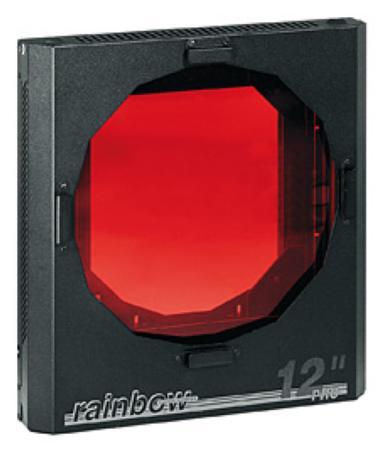
COLOR TEMPERATURE
A measure of the 'warmth' or 'coolness' of light sources and colors. Measured in degrees Kelvin. A higher COLOR temperature light source will appear whiter (colder). The human brain automatically compensates for different COLOR temperatures - a film or video camera cannot, and thus what we see as white may appear to have a blue or green tint when no COLOR correction is used for video. Most video cameras have a 'White Balance' control to make COLOR temperature adjustments, to ensure white looks white on camera.
Daylight is approximately 5600°K, Tungsten Halogen is approx. 3200°K and standard incandescent lamps are 2800°K. Many discharge light sources are in use in modern theatrical productions using discharge followspots or moving lights - COLOR correction filters are used to balance the COLOR temperatures.
See also COLOR CORRECTION.
COLOR THEORY
The science behind the way COLOR works can help lighting, costume and set designers to make their work as vibrant (or dull) as the play requires. See the link below for information.Â
Choosing and Using COLOR
COLOR WHEEL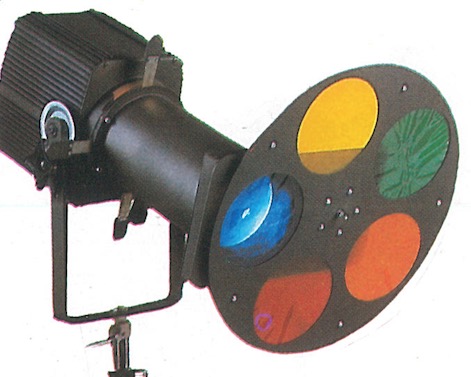
COLOR-BLIND CASTING
Usually known as NON-TRADITIONAL CASTING, this is the casting of ethnic minority and female actors in roles where race, ethnicity, or sex is not specified, or against that specification. (e.g. an adult plays a child, a black actor plays a part previously played by caucasian actors, a woman plays a previously male role).
COLORED SMOKE
COMB FILTERING
An effect caused by the same sound arriving at a given point at slightly different times. This could be the listening position or a microphone. Comb filtering can be reduced in the case of sound from speakers by employing delays, and in the case of microphones by following the three to one rule. See THREE TO ONE RULE and DELAY.
COME ALONG
A lever hoist or tackle set designed for tensioning of pulling, particularly associated with catenary wire and guy rope rigging.
Submitted by Chris Higgs
COME DOWN
The time the show finishes (e.g. 'What time does the show come down this evening?') This relates to the curtain coming down at the end of the show. See also GO UP.
COMIC RELIEF
A comic scene (or line) included in an otherwise straight-faced play to provide a relief from tension for the audience.
COMMAND PERFORMANCE
A Royal Command Performance in the United Kingdom is any performance by actors or musicians that occurs at the direction or request of a reigning monarch.Â
The Royal Variety Performance is a gala evening held annually in the United Kingdom, which is attended by senior members of the British Royal Family, usually the reigning monarch. The reigning monarch either attends in person or is represented by another member of the royal family. Queen Elizabeth II and The Prince of Wales have alternately attended the performance for the last few years. The evening's performance is a variety show consisting of family entertainment, including comedy, singing, dancing, magic and other speciality acts, and many of the performers and hosts are celebrities. The event is organised on behalf of the Entertainment Artistes' Benevolent Fund of which Queen Elizabeth II is patron.
COMMEDIA DELL
Italian comic form - started in the Renaissance, and still has massive influence today. A range of stock characters (Harlequin, Captain, Doctor, Pantaloon, Zanni, the Lovers etc.) were represented by stylized masks. Each character had a series of comic "lazzi" (business). The performances were based on the pre-rehearsed lazzi, but were largely improvised.
COMP
Short for Complimentary ticket. Free of charge ticket issued to company members or special guests. Each venue has their own policy about numbers of comps that cast / crew may be entitled to. There are often House Comps, which are good seats not sold to the public until others are sold out, which are used for VIP guests.Â
In the past it had to be initialled by the General/House/Company Manager to ensure its authority, and a record kept by the Box Office Manager.
COMPANDER
Outboard sound equipment. Combination of a COMPRESSOR and an EXPANDER.
COMPANY
The cast, crew and other staff associated with a show.
COMPANY MANAGER
In a touring theatre company, the Company Manager is responsible for the well-being of the cast and crew of the show; ensuring their arrival at the venue, dealing with their payments, dealing with any disputes, and generally ensuring all is well and happy. The CM is also the representative of the producers in that he/she is responsible for collecting payments from the venue management.
In a building-based theatre company, the role is more administrative, dealing with payroll and other matters connected with the cast and crew of the current production(s).
COMPLEMENTARY colors
Pairs of colors which, when additively mixed, combine to produce white light. Examples are red + cyan, green + magenta, and yellow + blue.
COMPOSITE GOBO
See GOBO.
COMPOSITE VIDEO
Composite video is the format of an analog television (picture only) signal produced by video cameras (camcorder or CCTV). Connectors used are either BNC (pro / semi-pro) or RCA/phono (domestic / semi-pro). A yellow-COLORed RCA/phono socket is used for composite video output or input.Â
Wikipedia entry
COMPRESSOR
A piece of sound processing equipment that ensures all wanted signals are suitably placed between the noise and distortion levels of the recording medium. It evens out the unwanted changes in volume you get with close-miking, and in doing so, adds punch to the sound mix. A Limiter is used to stop a signal from exceeding a preset limit. Beyond this limit, the signal level will not increase, no matter how loud the input becomes. A Limiter is often used to protect speaker systems (and human ears) by preventing a system from becoming too loud.
CONCAVE
Lens shape. Edges are wider than the CENTER of the lens. Useful to remember that 'caves' go inward.
CONCEPTUAL DIRECTOR
A non-traditional style of directing, which involves taking a text (play, musical) only as a starting point to express an idea or opinion, which may be unrelated to that of the original author of the text. Conceptual Directors of note include Jerzy Grotowski, Elizabeth LeCompte, Robert Wilson and Anne Bogarte (list from Theatre in Your Life by Robert Barton, Annie McGregor)
CONCESSION
1) (UK) A reduction in ticket price given to some eligible patrons (e.g. unemployed, students)
2) (US) A merchandising or catering stand in the foyer of the theatre. ('The concession stand').
CONDENSER LENS
Loosely applied to any spotlight lens which condenses diverging rays into a beam, but more correctly to the short focus combination of two or more lenses in a jacket used for illuminating a slide or effect disc. Also used in some profile lanterns and followspots to produce a smoother light (especially for gobo work).
CONDENSER MIC
(Capacitor Mic) A microphone that uses the varying capacitance between two plates with a voltage applied across them to convert sound to electrical pulses. Condenser microphones need a power supply to provide the voltage across the plates, which may be provided by a battery within the case of the microphone, or it may be provided from an external phantom power supply. A condenser mic is more sensitive and has a faster reaction to percussive sounds than a Dynamic mic and produces a more even response. See Electret Mic.
CONDUCTOR
The director of an orchestra. See also MUSICAL DIRECTOR.
CONDUIT
Metal or plastic pipe used to carry electrical conductors as part of a permanent electrical installation. See also Trunking.
Also used to add weight to the bottom of a flown cloth.
CONFLICT
A device setup by the playwright consisting of an argument, disagreement, need or inequality between characters. There are broadly four types of conflict:
1)Â Relational Conflict
This is the predominant type, and consists of a battle between the mutually exclusive goals of characters (often the protagonist & antagonist).
2)Â Societal Conflict
Occurs between an individual character (or small group) and a larger group or society.
3)Â Inner Conflict
A character struggling with her/himself; either trying to escape a mode of behavior (addictive) or a state of mind.
4)Â Situational Conflict
Involving a situation which must be escaped or resolved.
CONSCIENCE ALLEY
A useful technique for exploring any kind of dilemma faced by a character, providing an opportunity to analyse a decisive moment in greater detail. The class forms two lines facing each other. One person (the teacher or a participant) takes the role of the protagonist and walks between the lines as each member of the group speaks their advice. It can be organised so that those on one side give opposing advice to those on the other. When the protagonist reaches the end of the alley, she makes her decision. Sometimes known as Decision Alley or Thought Tunnel.
From DramaResource.com
CONSTANT VOLTAGE SYSTEM
See HUNDRED VOLT LINE.
CONSTRUCTION (DESIGN AND MANAGEMENT) REGULATIONS (CDM)
UK Regulations introduced in 2015 covering any construction project. Many live event construction projects (e.g. building set, raised stages etc) are covered by the regulations.Â
UK Health and Safety Executive website
CONTACT MIC
A microphone that directly picks up the sound transmitted by a solid material. See Boundary Mic, PCC, PZM.
CONTACT SHEET
1) A list of names and contact details (phone numbers, addresses) for cast and crew.
2) A sheet showing all of the frames from a roll of film to enable a choice to be made about which to enlarge properly.
CONTAINER
Refers to an standardized shipping container, used for intermodal freight transport (intermodal means across different modes of transport, from ship or rail to road).
The most common sizes are either 6m (20 feet) or 12m (40 feet) in length, and 2.6m (8 feet 6 inches) or 2.9m (9 feet 6 inches) in height.
They can be hired for very cheap weekly rates, but have high transport costs. They're invaluable for creating dry storage at events, and are also used in the film and events industry as the support skeleton for huge sets / structures.Â
CONTINENTAL SEATING
Auditorium seating layout where there is no central aisle, but wider spacing between rows to allow people to pass those that are already seated.
CONTINGENCY
An alternative plan of action if a piece of technology fails to operate. Large-scale productions have to continue wherever possible to avoid having to give the audience refunds. So if a small piece of the set fails to work or gets stuck (particularly automated scenery) the cast and crew will have rehearsed an alternative choreography to work around it while the crew repair it. For example in The Lord of the Rings The Musical in London, when the revolving stage with multiple lifts had a safety sensor triggered, the automation went into 'E-Stop' mode, a thunderclap sound effect was triggered, the stage lifts went to a flat floor (once it had been found safe to do so) and the actors for the next scene were rushed into new positions, while the actors on stage immediately adopted a new choreography.
It's vital that contingencies are worked out in advance so that as soon as something goes wrong, the show can continue, and the audience will hopefully be unaware.Â
CONTRA
In accounting, a CONTRA is a financial entry indicating a credit instead of a debt, on a debtor's account. It indicates when a debtor (e.g. a production company) has built up a credit, which a creditor (e.g. a hire company) needs to supply goods against.Â
Deduction made by the Bricks & Mortar Management from its final payment to the Visiting Management, for expenditure incurred by the theatre on behalf of the Visiting/Touring Management. The amount charged varied according to the management's contract, but could include electricity used, staff over and above the normal crew, and even the 'first night thank you' reception
CONTROL ROOM
Room at the rear of the auditorium (in a proscenium theatre) where lighting and sometimes sound is operated from. Known in the US as the BOOTH. The stage manager calling the cues is very often at the side of the stage (traditionally stage left) but in some venues he/she may be in the control room also. The control room is usually soundproofed from the auditorium so that communications between operators cannot be heard by the audience. A large viewing window is obviously essential, as is a show relay system so that the performance can be heard by the operators. Obviously if sound is being mixed, the operator should be able to hear the same as the audience, so some control rooms have sliding or removable windows, or a completely separate room for sound mixing. Where possible, the sound desk is moved into the auditorium so that the operator can hear the same as the audience.
Also known as the BOX.
CONVENTIONAL
Standard stage lighting instruments, rather than moving lights, LEDs or other effects. (e.g. 'There are 40 instruments in the rig - 20 moving lights and 20 conventionals').Â
CONVEX
Lens shape. Edges are thinner than the CENTER of the lens.
COOKIE
See GOBO.
CORNER PLATE
Triangular piece of plywood used to hold the stile upright to the top/bottom rails of a wooden flat, when 'butt' joints were used. Sometimes a 'wiggle pin' or corrugated fastener was hammered into the joint before the plate was glued and nailed in place. John Toogood, when the junior apprentice in the workshop, made these plates by the dozen for the 'boss' Roger "Two Hammers" Winkley, (one to cool down while he used the other!).
CORPSING
An actor who collapses into uncontrollable laughter during a rehearsal or performance is said to be Corpsing. There are numerous ways of covering the laughter, mostly involving the actor turning away from the audience and covering his mouth with his hand.
Some British pantomimes have an outbreak of rehearsed corpsing, when something appears to go wrong, but is in fact carefully planned. This helps to lift the audience's spirits and make the show seem more alive.
CORTHUNUS
(Greek) Platform shoes worn by heroes of Greek theater to raise them above other characters.
COSHH
(UK Health and Safety) Acronym for Control of Substances Hazardous to Health Regulations 2002. Requires employers to prevent or reduce their workers' exposure to substances that are hazardous to their health.
As well as dangerous chemicals and solvents, COSHH also covers ANY substance that is hazardous, including dust particles in a set-building environment. Â
HSE COSHH website
COSTUME CONSTRUCTION
Depending on the scale of the production, a whole team of people may be employed to take on different aspects of the construction process, such as STITCHERS and CUTTERS.
COSTUME DESIGNER
Member of the creative team for a show responsible for the clothes worn by the actors throughout the performance. She/he works with the director to discuss the needs of the show before coming up with a series of sketches to illustrate the looks for particular characters. The designer then works with the wardrobe team at the theatre / production company to decide which items are already in stock, which can be adapted from existing stock, which should be hired, which should be bought and which should be made from scratch. Charity shops are useful sources for modern / recent items, and theatre are many theatrical costume hire companies available in larger cities.Â
COSTUME FITTING
First meeting between the actor and his/her costume. Enables wardrobe staff to ensure a correct fit, and to enable the actor to see if all necessary movement is possible.
COSTUME LOFT
(USA) Term for a store of theatre costumes, particularly where there are costume hire facilities.
COSTUME MAKER
Member of the Costume / Wardrobe team that works to make or assemble costumes based on the requirements of the costume designs.Â
COSTUME PARADE
See DRESS PARADE.
COSTUMER
Member of the WARDROBE Department. See also DRESSER.
COSTUMES
Clothes worn by the actors onstage. The responsibility of the WARDROBE DEPARTMENT.
COTTER PIN
USA: A split pin metal fastener with two legs that are bent during installation, used to fasten metal together, like with a staple or rivet.
UK: Cotter; In mechanical engineering, a pin or wedge passing through a hole to fix parts tightly together
COUNT
A measure of time used to add space between cues (for example, LX cue 12 goes on a count of 3 after the actor sits down).
COUNTER RAKE
See ANTI RAKE.
COUNTERWEIGHT
A standard weight (60 or 30 lb.) used in a counterweight flying system. Known in German as KONTERGEWICHT.
COUNTERWEIGHT SYSTEM
Method of flying scenery which uses a cradle containing weights to counterbalance the weight of flown scenery. See Double Purchase, Single Purchase, Flying, Dead.
COUP DE THEATRE
1) A surprising turn of events or spectacular moment during a play.
2) A surprisingly successful theatrical performance.Â
With correct accents: coup de théâtre
COUPLER
Equipment used to join two other items together.
Commonly refers to a SCAFFOLD COUPLER (also known as a SCAFFOLD CLAMP or TUBE CLAMP).
A scaffold clamp is known as a Cheeseborough in the USA, believed to be named after Chesebro-Whitman Company of New York City.Â
COUR
From the French coté cour meaning Stage Left.
More about Cour / Jardin
COVE
US for front of house catwalk lighting positions. Also 'Balcony Rail'.
COVER
Lighting that does a particular job during the show. (e.g. GENERAL COVER is the main actor light on stage, UPSTAGE COVER lights that area etc.)
CP
Lighting Industry Forum code which identifies the (original) recommended usage of different lamp types. CP coded lamps are for Film, Television and Photographic studio use and have a COLOR temperature of 3200°K. See also A1, T, P2, K.
CRACKED OIL
A smoke effect which creates a haze in the air to make light beams visible. This effect is rarely used now, because it has been found to be carcinogenic. See Water Cracker.
CRADLE
Metal frame in which counterweights are carried in a flying system. Known in the US as an Arbor. See also SINGLE PURCHASE and DOUBLE PURCHASE. In German, GEWICHTSSCHLITTEN.
CRASH BOX
Sealed metal box filled with broken crockery which can be dropped or thrown offstage to simulate breaking glass / damage etc.
CRESCENDO
Musical term. An increase in volume (or intensity).Â
CRESCENT WRENCH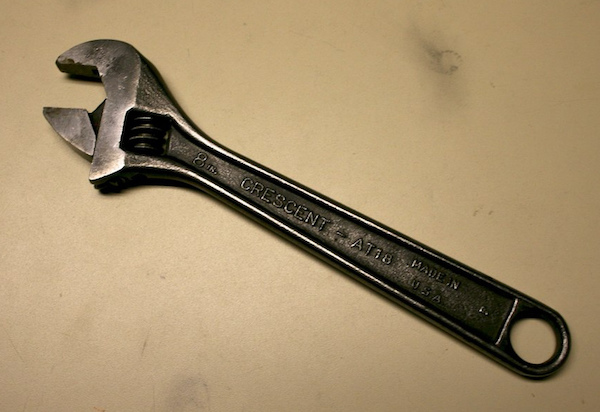
CRI
Abbreviation for COLOR Rendering Index.
A measure of the ability of a light source to reveal the colors of objects faithfully in comparison with an ideal or natural light source. A CRI of 100 for a white light source is equivalent to tungsten light, and is seen as giving an excellent rendering of COLOR across the spectrum.Â
Wikipedia entry
CRITIC
Journalist who writes reviews for theatre productions.
CROSBY
Manufacturer of shackles and lifting hardware (US, Canada and Belgium)
Crosby Group website
Submitted by Chris Higgs
CROSBYS
US for saddle and 'U' cable clamps (from the manufacturers name).
Crosby Group website
CROSS
(Blocking) An actor move from one side of the stage to the other (or from one area to another).Â
A Counter-Cross is a move made by another actor to even out the stage picture.Â
A Straight Cross is a move directly across the stage in a straight line.Â
CROSS FADE / CROSSFADE
Bringing a new lighting state up whilst bringing the previous one down, so that the new one completely replaces the old one. Also applies to sound effects / music. Sometimes abbreviated to Xfade or XF.
A DIPLESS CROSSFADE occurs when the lighting doesn't dip significantly between states, which results in a more subtle transition.Â
CROSSLIGHT
Light coming from the sides of the stage towards the CENTER (i.e. across the stage). Used heavily for dance lighting as it lights the body of the performer without casting shadows upstage, and it is far more sculptural than front light. Also used for additional atmosphere in many other types of performance.Â
See also BACKLIGHT, PIPE ENDS.Â
CROSSOVER
1) A route leading from one side of the stage to the other, out of the audiences view.
2) An electronic filter in a sound system that routes sound of the correct frequency to the correct part of the speaker system. Different speakers handle high frequencies (tweeters) and low frequencies (woofers). Sometimes known as a crossover network.
An active crossover splits the signal from the mixing desk into high, mid and low frequencies which are then sent to three separate amplifiers.
CROSSTALK
A leakage between two audio circuits (e.g. between two channels on a sound mixer).
CROWN
Manufacturer of PA amplifiers and microphones.
Crown website
CROWN-SILVERED LAMP
Type of lamp which has the top part of the envelope / bubble silvered so that the light is reflected backwards (where the reflector of the light fitting / lantern will reflect it forwards). Used in beamlights and other narrow-angle fittings to help produce a near-parallel beam, without glare from the lamp.Â
CRT
Cathode Ray Tube. Refers to a TV/monitor using a traditional tube (rather than a TFT / flat design)
CSI
(Compact Source Iodide) A high intensity discharge lamp. Most often used in followspots, because it has a COLOR temperature (approx. 4000K) close to that of the tungsten halogen lamps.
CSM
Company Stage Manager
CUE
1) The command given to technical departments to carry out a particular operation. E.g. Lighting Cue, Fly Cue or Sound Cue. Normally given by stage management, but may be taken directly from the action (i.e. a Visual Cue).
2) Any signal (spoken line, action or count) that indicates another action should follow (i.e. the actors' cue to enter is when the Maid says "I hear someone coming! Quick - Hide!")
3) A journal published between 1979 and 1988. A complete collection of CUE journals is available on the Backstage Heritage Collection website to read online.Â
CUE LIGHT
System for giving technical staff and actors silent cues by light. Cue lights ensure greater precision when visibility or audibility of actors is limited. Sometimes used for cueing actors onto the set. For technical cues, lights are normally now used just as a backup to cues given over the headset system. In the UK, a flashing Red light means stand-by or warn, green light means go. The actor / technician can acknowledge the standby by pressing a button which makes the light go steady. In the US, a red light means warn, and when the light goes off, it means GO. The UK system seems to be more secure, but it depends what you're used to.
CUE SHEET
Also known as a PLOT SHEET. A tabulated list of actions that must be taken by a technical department at a particular point in the show. Cues are numbered, and called by the DSM on the book from the prompt script.Â
CUE STACK
Section of a lighting desk which allows a list of pre-plotted lighting states to be 'played back' on the push of a button. These lighting states normally have fade times allocated to them. Lighting desks designed for theatrical use will have this as the primary control, but a rock desk will have more 'hands on' control as a priority, only providing a cue stack for occasional use.
CUE TO CUE
(also known as 'Topping and Tailing')
Cutting out action and dialogue between cues during a technical rehearsal, to save time. (e.g. "OK, can I stop you there - we'll now jump to the end of this scene. We'll pick it up from Simon's line "And from then on it was all downhill" in a moment. OK - we're all set - when you're ready please.")
CUEING
There is a standard sequence for giving verbal cues:
Stand-by 'Sound Cue 19' (Stand-by first)
'Sound Cue 19Â Go' (Go last).
CURRENT
The flow of electricity (electrical charge) through a circuit. Measured in Amperes (Amps)
CURTAIN CALL
At the end of a performance, the acknowledgement of applause by actors - the bows.
Hungarian:Â tapsrend.
CURTAIN LINE
1) Imaginary line across the performance space marking the point where the front tabs / curtain is flown. See also SETTING LINE, CENTER LINE.
2) The final spoken line of the play.
CURTAIN SPEECH
Introduction given by director or theatre owner (etc.) from the stage just before the performance starts. Often replaced with a recorded announcement 'Good Evening Ladies and Gentlemen and welcome to the (insert name) Theatre. May I remind you to please switch off mobile phones and pagers as they can prove distracting to other members of the audience and the performers. Flash photography is also not permitted. We hope you enjoy the show!'.
CURTAIN TIME
The advertised start time of the performance. This may be delayed by the late arrival of a large party, but regularly starting late because of box office queues should be avoided.
CURTAIN UP
Call made by Stage Management to the rear of house PA system to say that the performance has started. (e.g. "Curtain Up on Act One"). An alternative call is "Lights Up on Act One".
CUT CLOTH
See CLOTH.
CUT LIST
A list of the COLORed lighting gels that are needed for a particular show, including the size of the COLOR required. There are many different sizes of COLOR frames for lighting equipment.
CUT-OUT
See PROFILE.
CUTTER
Member of the costume team that supervises the construction of costumes that are made from patterns. She/he is also responsible for creating the patterns from the Costume Designers' sketches / designs.Â
CYC FLOOD
A floodlight, usually with an asymmetrical reflector, designed to light a cyc or backcloth from the top or bottom. The asymmetric reflector helps to throw light further down the cloth, producing a more even cover. In the US, a flood at the top of the cyc is a CYC OVER, and a flood at the bottom is a CYC UNDER.
French: Cycliode
Types of lantern
CYC STRETCHER
A wooden block with a tightenable bolt through it, threaded-through by a rope, used to clamp to the offstage edges of a cyclorama cloth with the rope tied to an offstage fixing, ideally above head-height. Enables wrinkles in the cloth to be removed, and also helps to minimise cloth movements caused by air currents (doors opening, actors walking past etc).Â
CYCLORAMA
Usually shortened to just cyc (pronounced sike). The Cyclorama is a curved plain cloth or plastered wall filling the rear of the stage or TV studio. Often used as a sky backing to a traditional set, or as the main backing for a dance piece etc. The term is often loosely applied to a blue skycloth, or any flattage at the rear of the stage. Although strictly a cyc should be curved, most cycs are flat with curved wraparound ends. A more effective backing can be obtained by hanging a sharkstooth gauze just in front of the plain white cyc which gives a hazy effect of distance.
From Greek Cyclos (circle) and Horama (view or vision).
The first plaster cyclorama in the UK is believed to be at the Festival Theatre, Cambridge (1929)
See also BOUNCE, ISORA. The German equivalent term is operafolie.
CYRO
Short for Cyro Acrylite, this is an acrylic sheet product (trade name Acrylite).
D54
See MULTIPLEX.
DAIS
A low raised platform or stage for several people, above the rest of the stage area.
DAISY-CHAINING
Connecting items of equipment together by linking from one to the next in a chain. Used for connecting demux boxes to dimmers etc.
DANCE CAPTAIN
Member of a group of dancers in a show who is responsible for leading rehearsals and warm-ups prior to the performance.
DANCE FLOOR
1) A vinyl floor covering, usually kept on a plastic or cardboard tube, which is rolled out and taped to the stage floor to create a surface suitable for dance. Dance floor should be left to adjust to room temperature before being taped otherwise it will not lay flat. Many different types of floor are available, including different colors and degrees of cushioning, and the product may be known by it's manufacturer's name (e.g. Marley Floor, Harlequin Floor).
2) A wooden floor which is either naturally springy or has been constructed with rubber pads under it which absorb impact, and create a surface which performers are able to jump on without damaging knees or other joints, as the floor absorbs the impact.
German: Tanzteppich
DANCE LIGHTING
Lighting design for Dance is reliant on a great deal of sidelight from BOOMS at the side of the stage. There are normally at least three lanterns on each boom, and three heights - SHINS (to light feet and lower legs), MIDS and HEADS.
DANCER
Member of the company whose role is choreographed, and who has no spoken words.
DARK
A venue that has been closed to the public. Some theatres go dark temporarily during production periods, when the next show is in preparation on stage. To keep the audience (and their money)Â coming in, some venues show films or have other activities not involving the stage.
DARK RIDE
A themed attraction taking place in an indoor environment where the ride designers have total control over light and sound. Often incorporates a mechanical ride system to move the guests through the attraction at a known rate, and may also include special effects and animatronic elements.Â
More about Dark Rides
DAT (Digital Audio Tape)
See DIGITAL RECORDING.
DATA PROJECTOR
As prices are dropping, the use of a data projector connected to a laptop or PC/Mac is within the budget of almost every performance.
See link below for more information.Â
Known in parts of Europe as a BEAMER.
See Multimedia Projection for Drama for more information.
DAYMAN
A member of the backstage staff who is hired or paid by the day, for the specific hours worked. Prefixed by the appropriate technical area (e.g. Stage Daymen, Electrics Dayman / LX Dayman etc). May also be required to work shows (Show Dayman).Â
DEBRIEF
Following a rehearsal (or an early performance in a run) the director/producer/actors captain or a senior supervisor will give notes to the cast and crew about where to make changes, improvements, cuts etc.
DÉNOUEMENT
The moment in a drama when the essential plot point is unravelled or explained. (e.g. "So you see I couldn't have killed the gardener. Because I AM the gardener" (Loud organ music etc.)).
DBO (Dead Blackout)
See BLACKOUT.
DBX
A tape-recording noise reduction process.
DC
Short for DIRECT CURRENT.
DCC
(Digital Compact Cassette) Manufactured by Philips in the Netherlands, this format was supposed to be the successor to the compact cassette, but Mini Disk won the marketing war. DCC was discontinued for mass market use in 1996. See DIGITAL RECORDING.
DDA
Acronym for the Disability Discrimination Act (DDA) which became law in 1995 in the UK. It covers similar ground to the Americans with Disabilities Act, which became law in 1990. Both Acts are designed to outlaw any kind of discrimination against people with any form of disability.Â
The acronyms ADA and DDA are used also to describe the amendments that are made to procedures, buildings and resources to comply with the Act.Â
DE-RIG
The process of removing lanterns & cabling from flying bars or grid - returning the venue to it's normal state, or as preparation for the next production.
DEAD
1) A pre-plotted height for a piece of scenery or lighting bar - 'that bar's on its dead'. The positional indicators on the rope (either PVC tape, or more traditionally cotton tape passed through the strands of the rope) are called DEADS. Sometimes flying pieces are given a number of extra deads, that may be COLOR coded, in addition to the 'in dead' (lower) and 'out dead' (higher - out of view). In the US, TRIM has the same meaning. Fluorescent ribbon is often used, through the fibres of the rope. The fluorescent COLOR shows very clearly under UV light, which is often used to light fly floors.Â
2) Scenery or equipment not needed for current production - 'that table's dead'.
3) An electric circuit that has been switched off or has failed - 'the circuit's dead, you can change the lamp now'
Submitted by Chris Higgs
DEAD HANG
A rigging point direct to the grid / beams above the stage, not to a flying bar.
DEAD HINGE
A hinge used as a right-angle bracket.
DEAD LINE
A static suspension, 'drop wire' or bracing line. A suspension without any lifting power.
Submitted by Chris Higgs
DEAD MAN
Also known as DEADMAN'S BUTTON (DMB). This is a handle that has to be squeezed by a technician in order for a pre-programmed automation sequence to take place. If for any reason the relevant technician is not in position, the system does not allow the sequence to run.Â
DEAD OUT
To replace a hoist or winch suspension with a dead line. Once the truss or piece is at trim, to tranfer the load onto 'dead lines' and remove the hoists or lifting devices.
Submitted by Chris Higgs
DEAD ROOM
A room with very thick sound absorbers, causing a very dull sound with no reverberation.
DECIBEL (dB)
Relative measurement for the volume (loudness) of sound. One dB is the smallest variation in loudness that the human ear can detect. Also used to measure the difference between two voltages, or two currents. See ZERO DB.
DECK
1) Stage/Rostrum Floor (e.g. "Fly that flat in to the deck") [known in German as bühnenboden]
2) Tape deck/Record deck.
3) A steel-framed platform with a wooden top used with replaceable scaffold legs (Trade names include Steeldeck, Metrodeck (made by Maltbury), ProDeck).
DECOR
See SET DESIGNER.
DELAY
Outboard sound equipment that can momentarily stores a signal being sent to part of a P.A. system so that delayed reinforced sound reaches the audience at the same time (or just after) the live sound from the stage. Using the 'Haas Effect' the audience cannot detect the sound as amplified.
DEMUX BOX
Short for De-Multiplex. Interface unit between the serial digital output of a memory lighting control desk to the parallel analogue signal understood by a non-digital dimmer. See MULTIPLEX SIGNAL for more.
DEPUTY STAGE MANAGER (DSM)
Usually shortened to DSM, this is a member of the Stage Management team. In the UK, the DSM is often "on the book" - that is, they are in charge of calling all of the technical and actor cues during the show, usually using a headset communications system and/or a system of cue lights. The DSM is often also in rehearsal working with the director to prepare the prompt book. Known in some places as a Stage Director.
See also PROMPT BOOK, STAGE MANAGER.
German:Â Inspizient
DESIGNER
See SET DESIGNER, COSTUME DESIGNER, LIGHTING DESIGNER, SCENOGRAPHER.
DESIGNERS CONTROL
See RIGGERS CONTROL.
DEUS EX MACHINA
Latin for God in the Machine. A mechanical device used in Greek classical and medieval drama to lower an actor playing God from the flies above the stage to resolve the conflict in a play.
The mechanical crane that carried the DEUS EX MACHINA was known as MECHANE.
The term sometimes refers to a character which has a similar function in a more modern drama.
DEVISED THEATRE
Also known as Collaborative Creation (especially in the USA). Devised Theatre is a form of theatre where the script originates not from a writer or writers, but from collaborative, usually improvisatory, work by a group of people (usually, but not necessarily, the performers). The devising process can start from an idea, a theme, an existing story, a historical event, or from a visual image.Â
DFR (Durably Flame-Retardant)
A description of cloth which has been treated to be flame retardant, and can withstand a number of washes before needing any re-treatment. See manufacturer for full details. See also NDFR and IFR.
DI BOX / D.I.BOX
Interface unit to convert the high impedance unbalanced output of an instrument (e.g. Electric guitar) into a low impedance balanced signal of low level suitable for connection to the microphone input of a mixing desk. Usually has an output jack socket so that the instruments unprocessed signal can be passed direct to the musicians amplifier. DI = Direct Injection.
DIALECT COACH
Specialist who's bought into a production to train actors in a specific dialect / accent.
DIALOGUE
The spoken text of a play - conversations between characters is dialogue. See MONOLOGUE and DUOLOGUE.
DIAPHRAGM
1) Lighting: See IRIS.
2) Sound: The part of a microphone which responds to sound waves.
3) Human Biology:Â (from WIkipedia) a dome-shaped muscular partition separating the thorax from the abdomen in mammals. It plays a major role in breathing, as its contraction increases the volume of the thorax and so inflates the lungs.
DICHROIC FILTER
Glass COLOR filters which reflect all light except that which is the COLOR of the filter, which passes through. Normal plastic gels absorb the unwanted colors, turning the light into heat. Dichroic filters run cooler, and produce a much cooler beam of light. Longer lasting, but a lot more expensive, they are predominantly used in moving lights or architectural applications.
DICHROIC LAMP
A low voltage display lamp with a reflector that lets heat pass through it, rather than reflecting it. Results in a much 'cooler' light.
DICTION
The quality or style of speaking of a character within the play, consisting of components such as accent, inflection, intonation and enunciation. An actor whose words are clearly intelligible and audible is said to have good diction.Â
DIDACTIC
Didacticism is a philosophy that emphasizes instructional and informative qualities in literature and other types of art. The term has its origin in the Ancient Greek word διδακτικός (didaktikos), "related to education and teaching", and signified learning in a fascinating and intriguing manner.
Didactic art was meant both to entertain and to instruct.
Didactic plays, for instance, were intended to convey a moral theme or other rich truth to the audience. An example of didactic writing is Alexander Pope's An Essay on Criticism (1711), which offers a range of advice about critics and criticism. An example of didactism in music is the chant Ut queant laxis, which was used by Guido of Arezzo to teach solfege syllables. (from Wikipedia)
Wikipedia entry
DIEGETIC
Music or sound that is heard by the characters on stage (rather than just being for the audience to hear) is said to be DIEGETIC. (e.g. a piece of music played on a radio on the set).
The opposite (NON-DIEGETIC) sound or music is specifically NOT heard by the actors (e.g. scene change music, or an emotional underscore).
A piece of music can be both diegetic and non-diegetic, if it starts out at low-volume, coming from a radio on the set (diegetic), and then swells in volume and expands to fill the whole sound system (non-diegetic). It obviously cannot be both simultaneously, however!Â
DIFFUSION
See FROST.
DIGITAL
Many electronic devices use digital logic. Information is handled in separate bits (either ON or OFF) rather than continuously variable analogue signals. Most computer lighting boards give a digital multiplexed output, and more and more sound equipment is going digital.
DIGITAL DIMMER
The new generation of dimmers that can respond directly to the digital multiplexed output of the lighting desk. The technology also permits the dimmer to report faults and other data back to the control board.
DIGITAL EFFECTS
Reverb, Delay, Phasing, Flanging, Harmonising, Chorusing. More information coming soon !
DIGITAL LIGHT CURTAIN / DLC / D.L.C.
A remotely controllable motorised batten fitted with an integral COLOR changer. The DLC can now be controlled via DMX (via an interface) although it originally used software called Light Moves running on a Mac. The effect produced by this lantern is a wall of light (when used with a HAZE MACHINE). See also LIGHT CURTAIN.
DHA Lighting website - Digital Light Curtains
DIGITAL RECORDING
1)Â ADAMÂ : (Akai Digital Audio Multitrack). 12 track recording onto Video 8 tape. 16 bit, 44.1 or 48kHz sampling rate.
2)Â ADATÂ (Alesis Digital Audio Tape) Digital 8 track multitrack recording format introduced in 1991. There are two formats of recording: Type 1 (16 bit) Type 2 (20 bit) at two sample rates (44.1kHz and 48 kHz) onto standard SVHS video tapes.
3)Â DATÂ (Digital Audio Tape) Cassette-like system which has much higher quality than standard audio cassettes. Introduced in 1987, and widely used in gathering sound effects, for news gathering, and for playback of music.
4)Â DCCÂ (Digital Compact Cassette) Rival to DAT which also plays standard audio cassettes. DCC was discontinued in 1996.
5)Â MiniDisc (MD)Â : Uses magnetic disk technology, rather than tape. A laser heats an area of magnetic disk which is then written to by a magnetic head. When cooled, the magnetic information is read from the disk by laser. Tracks can be named, and are instant start. Very theatre-friendly system.
6) Direct to Disk : Uses the hard disk present in most PCs as the recording medium.
Alesis Website
DIGS
Colloquial term for short-term accommodation for actors during the run of a show. Originally short for diggings, the term appeared in the UK publication The Stage in 1893.
DIM OUT
Reduction of lighting level for a scene change, that isn't quite a BLACKOUT.
DIMMER
Electrical or electronic device which controls the amount of electricity passed to a lantern, and therefore the intensity of the lamp.
Dimmers in the Backstage Heritage Collection Archive
DIMMER BEACH
Area near or on the stage occupied by the dimmer racks and associated power distribution equipment of a touring or festival performance (i.e. a temporary venue).Â
DIMMER DOUBLING
A system designed by ETC where two ETC lanterns can be connected to a single ETC dimmer, and have different intensities. It only works with 115V / 60Hz supplies (e.g. USA). A special adapter ('twofer') is connected to the dimmer output. This contains a series of diodes which split the AC sine wave into two halves (positive and negative). Each half is sent to a separate socket on the adaptor and from there to a modified ETC Source Four lantern with a 77 volt lamp. Using these lower voltage lamps means that full intensity is achievable using only half the AC wave. The system will not work in the UK or other countries with 50Hz power supplies as the flickering of the lamps is too noticeable.
Dimmer Doubling information on ETC website
DIMMER LAW (CONTROL DESK)
The dimmer law in a lighting desk defines the relationship between the control value (fader position) and the console output value (outgoing DMX level).
Submitted by Andre Broucke
DIMMER LAW (Dimmer)
The dimmer law defines the relationship between the incoming DMX control value and the dimmer output RMS voltage. Common dimmer laws are 'linear RMS voltage' and 'linear light output'. Around the rated lamp voltage the light output is quite sensitive to voltage variations (a slightly lower voltage can also improve lamp life). If the dimmer is set to 'linear light' and you fade from 100% to 95%, the light output will be reduced by 5%. If you set the dimmer to 'linear RMS voltage' and you fade from 100% to 95%, the light output will be reduced by more than 5%.
Submitted by Andre Broucke
DIMMER LAYOUT
See CHEAT SHEET.
DIMMER PER CIRCUIT
A lighting installation where there is no patching system. Each lighting circuit / socket has a dimmer always connected to it. This has advantages in that you never run out of dimmers, but allows no flexibility and can have cost disadvantages in a large space.
DIMMER RACK
A number of individual lighting dimmer circuits built into a single case. Consists of a single power input, a lighting control (DMX512) input and sockets to connect lanterns. A dimmer rack can be set to respond to any control channel by setting its start address (known as "addressing" the rack).Â
DIMMING SHUTTER
Mechanical way of dimming the light output from a discharge lamp or projector when dimming the lamp is not possible. Consists of a series of horizontal blades which are rotated to reduce and then cut the light completely. See also DOWSER/DOUSER.
DIN
Deutscher Industrie Normen. European standard covering audio connectors and tape equalisation characteristics.
DINNER THEATRE
A theatre performance that includes a meal, either at the same venue or at an adjacent restaurant.Â
Although it was popular in the 1950s in the USA (as Dinner Theater), there are still many venues worldwide where a live performance is accompanied by a meal, usually in a tourist-focussed themed attraction. Examples run daily in Las Vegas or Orlando, Florida, and include murder-mystery themes, medieval themes, or magic shows with dinner served.Â
DIP
1) Small covered trap at stage level containing electrical outlets. (US equivalent is FLOORPOCKET)
2) Any dimmer outlets at floor level around the stage (e.g. 'What's the nearest dip circuit to downstage left so I can plug the birdie in?')
3) Lighting equipment on stands at stage level. (e.g. 'We're just focussing the dips now')
4) Low lighting intensity when cross fading between two higher states - 'there's a dip between these two states'.
5) Transparent lacquer for COLORing lamp bulbs - known as 'Lamp Dip'.
DIP SWITCH
Small plastic switch used to configure the functions of a piece of equipment. Most often used for setting the DMX address of either a moving light, COLOR scroller, or LED unit.
DIP stands for Dual In-line Package.
DIPLESS CROSSFADE
See CROSSFADE.
DIPOLE
Aerial used with radio microphone systems. A relatively long aerial in two parts, with an insulator at each end, connected in the middle to a coaxial cable which then connects to the receiver.
DIRECT CURRENT
Electric current that flows in one direction only (e.g. from a battery). Abbreviated to DC. See also ALTERNATING CURRENT.
DIRECT INJECTION BOX
See DI BOX.
DIRECTOR
There are many types of director.
Broadly, the role involves being responsible for the overall artistic vision of a production.
ARTISTIC DIRECTOR - Normally in charge of the programming of a venue. May also direct shows.
EXECUTIVE DIRECTOR - Manager in charge of the administration of a venue.
TECHNICAL DIRECTOR - In charge of the technical requirements of a production.
(The term LIGHTING DIRECTOR is used in the UK for a TV Lighting Designer).
DISCHARGE LAMP
A high-powered source of light produced by means of an electrical discharge between two electrodes. An arc light, for example uses a discharge between two carbon rods which are manually or automatically fed together as they are burnt up. The use of this type of lighting is restricted to non-dimming applications such as followspots and projection, where dimming is achieved by mechanical means. Many of the new generation of moving lights use discharge lamps, dichroic filters and mechanical dimming shutters.
See BALLAST, CSI, CID, MSR, HMI, HTI, Xenon, MBI.
DISCONNECT
(US) Also known as a COMPANY SWITCH, this is a large capacity power connection point on/near the stage which touring companies can use to connect their equipment.
DISSOLVE UNIT
Interface connected between two or more slide projectors and a tape player. Synchronisation signals recorded onto the tape are detected by the dissolve unit and fade up the lamp in one slide projector while changing the slide in the other, and then vice versa, producing a dipless crossfade between the two images.
DISTORTION
Usually undesirable result of overloading sound equipment. Reducing the levels can remedy the situation.
DISTRIBUTION BOARD
System of interconnected fuse carriers and cabling that routes an incoming power supply to a number of different outputs. Known colloquially as DISTRO.
DISTRO / POWER DISTRO
See DISTRIBUTION BOARD.
DITHYRAMB
The dithyramb was an ancient Greek hymn sung and danced in honor of Dionysus, the god of wine and fertility; the term was also used as an epithet of the god.
DIVERSITY
A way of maximising the quality of received radio signal by using two receivers and aerials tuned to the same frequency - the circuitry automatically silently switches to the strongest signal.
DIVERTISSEMENT
(from the French 'diversion' or 'amusement') is used, in a similar sense to the Italian 'divertimento', for a light piece of music for a small group of players, however the French term has additional meanings.
During the 17th and 18th century, the term implied incidental aspects of an entertainment (usually involving singing and dancing) that might be inserted in an opera or ballet or other stage performance. In the operas of Lully these 'divertissements' were sometimes linked to the main plot, or performed at the close of the performance. (Similar examples during the 19th century include Charles Gounod's opera Faust and Delibes's ballet Coppélia.) Special entertainments of a similar kind given between the acts of an opera were called 'intermèdes'.
The term is also sometimes used for a ballet suite of loosely-connected dances. One 20th-century example is Jacques Ibert's Divertissement. Jean Françaix named four of his compositions Divertissement.
DLP / D.L.P.
Digital Light Processing. Digital technology licenced from Texas Instruments which enables video projectors to deliver a brighter, sharper, more detailed digital image. The first DLP projectors arrived in 1996.
DLP technology
DMX BUFFER
Powered device which is used to boost a DMX512 signal so that it can reliably travel over a long distance.
The maximum distance for a DMX512 signal is 300m - using a buffer you can send the signal an additional 300m.Â
DMX MERGE
Lighting control accessory which accepts multiple DMX inputs (e.g. from a number of lighting controllers) and merges them together to a single DMX feed to control dimmers or moving lights etc.Â
DMX TERMINATOR
A DMX terminator is a 3 or 5 pin XLR connector which is used at the end of a DMX run to absorb the data signal to stop it being reflected back along the DMX cable. The terminator is very easy to make, and consists of a 120 Ohm half-watt resistor soldered between pins 2 and 3 of the XLR connector. A DMX run should always be terminated, and although the system may work without one, continued operation cannot be guaranteed. A system with poor quality DMX cable (or cable of a long run) will require termination in order to operate correctly.
DMX512
Short for Digital Multiplex. See MULTIPLEXED (MUX) SIGNAL.
DMX512-A
See MULTIPLEXED SIGNAL.
DOCK
See SCENE DOCK.
DOCUMENTARY THEATRE
Documentary theatre, or theatre of fact, is theatre that wholly or in part uses pre-existing documentary material (such as newspapers, government reports, interviews, etc.) as source material for the script, ideally without altering its wording.
Where it's featured solely on the words of others, usually members of the public in a particular situation, it's known as VERBATIM THEATRE.
DOG
Colloquial term for a wire rope grip. Occasional a rope 'dog' or a girder 'dog' - a device that clamps.
Submitted by Chris Higgs
DOGBOX
Channel at the rear of a mixing desk flight case used to contain cables and adaptors to enable some cabling to remain connected whilst in the case. Some cases have a hinged removable dogbox cover to hide the cables during operation where the appearance of the desk is important.Â
DOLBY
Trade name for a series of noise reduction systems that have become standard on many tape playback machines. Most film soundtracks are produced using this process. Different varieties are found from Dolby B on most personal cassette players, to Dolby SR and Digital, the current state of the art for cinema.
Dolby Labs Website
DOLLY
A small wheeled platform used to move heavy items. (E.g. a piano dolly).Â
Also refers to a wheeled camera trolley running on tracks used in the film industry.
DOME
1) (Aus) Follow spot location usually at rear of the upper gallery. Sometimes referred to as BIOBOX, where the control booth and followspot position are the same.
2) (Aus) A Followspot in any location (from the above).
DOME OP
Australian term for the followspot operator. See DOME.
Submitted by Mac Calder
DONGLE
1) A device which connects into the USB port of a computer, which activates a software licence on the computer, allowing software to run. 2) An adaptor with on-board conversion hardware, which plugs into the USB or other serial port of a computer and enables you to connect, for example, a microphone (to record onto the computer) or a DMX cable (to control lighting etc equipment using software on the computer).Â
DONUT
A metal plate with a hole in the middle inserted in the COLOR runners of a lantern to sharpen focus (in the case of a profile) or reduce spill.
DOOFER
An object or tool that you're not sure of the correct name for. For example, 'Pass me the doofer so I can sort this thingy'.
DOOR FLAT
Scenery item consisting of a wall containing a working (practical) door.
DOOR SLAM
A small wooden box with a heavy door and various bolts and locks used to simulate slamming and other door sound effects offstage.
DOUBLE HANDLING
Moving scenery and other equipment more than necessary because it wasn't properly sorted or positioned in the first place.
DOUBLE PURCHASE
Counterweighted flying system where the cradle/arbor travels half the distance of the fly bar, leaving the side wall of the stage under the fly floors clear of flying equipment. The cradle of a double purchase system needs twice as many counterweights as that of a single purchase system balancing the same weight.
The wire running between the cradle and the flying bar is the purchase line.Â
DOUGHNUT
See DONUT.
DOUGHNUT REVOLVE
See REVOLVE.
DOWN TOOLS
An instruction from a manager (or team leader) to stop work, usually as a form of protest, or as part of union-led industrial action.Â
DOWNLIGHT
A light from directly above the acting area. A downlight could be a spot or a wash of light.
See also BACKLIGHTÂ
DOWNSTAGE
2) A movement towards the audience (in a proscenium theatre).
DOWSER (UK) / DOUSER (US)
A metal flag used in larger followspots and projection equipment to cut off the light beam without cutting off the electrical supply. Discharge lamps cannot be dimmed, so this is the only way of stopping light. Discharge lamps need a period of cooling down when they are turned off before they can be turned on again, so they should not be switched off if needed again within about two hours.
See also DIMMING SHUTTER.
DPI
Dots per inch. A measure of the resolution of a printed or computer image.
DRAMA
The academic subject area into which theatre falls.
DRAMA TEACHER
Teacher of Drama.
DRAMATIC IRONY
A dramatic device whereby the audience is aware of something that one or more characters are not, and action onstage reflects the effect of this lack of knowledge (frequently comic, but also tragic). Dramatic Irony is often used to underline plot points for the audience.
Submitted by Gregg Shanks
DRAMATIC PAUSE
A brief pause (a few beats) in an actors' delivery of a line to emphasise a moment or to heighten anticipation.Â
It's important that the DSM does not shout out the next line, while the lead actor is pausing dramatically.Â
DRAMATIC TIME
This refers to the compressed timescale that occurs within a play, when compared to the actual running time of the show. A 2 to 3 hour timeslot can cover the same amount of dramatic time (when the action of the play occurs in 2 to 3 hours) or it can cover a hundred years (or anywhere in between).Â
DRAMATIS PERSONAE
Latin for the persons (characters) in a play. The list on the front page of a script which lists the characters in the text, and sometimes their relationship to each other.
DRAMATIST
A playwright, composer or lyrisist who takes an existing story and transforms it into a play or musical.
Dramatists Guild of America
DRAMATURG
Works as an advisor/assistant to the director on the background and historical relevance of the play being produced. Also can act as a liaison between director and playwright, and can work on the text of the play (editing & revising scripts). Also advises the theatre management staff on the suitability of plays for the theatre's audience and artistic policy. See link below for more information.
What is Dramaturgy?
DRAPES
Stage Curtains. See also TABS.
DRENCHER
System of pipes arranged at the top of a safety curtain (aka Iron) to drench it with water in the event of fire. The water prevents it buckling as it descends.Â
DRESS CIRCLE
See CIRCLE.
DRESS LIGHTING
Providing a low level of lights to an open stage while the audience enter the house up until the performance starts. Also known as PRESET.
DRESS PARADE
Review by director/designer/wardrobe staff of all costumes worn by cast and paraded under stage lighting. Any defects, misfits etc. are noted or corrected before the first Dress Rehearsal.
Also known as a Costume Parade.
DRESS REHEARSAL
A full rehearsal, with all technical and creative elements brought together. The performance as it will be 'on the night'.
German: hauptprobe (final rehearsal)Â
DRESSER
Member of the WARDROBE Department who helps actors with costume care and costume changes during the performance.
DRESSING (the set)
Decorative props (some practical) and furnishings added to a stage setting are known as Set Dressing. See also TAB DRESSING.
DRESSING ROOMS
Rooms containing clothes rails and mirrors (often surrounded with lights) in which actors change into their costumes and apply make-up. Dressing Room doors have a list of the actors contained within.
See also GREEN ROOM.
DRIFT
1) The effective travelling distance of a suspension barrel between the lowest it can reach with the scenic piece attached and the underside of the grid. The drift will be variable depending on the depth of a scenic piece suspended beneath the barrel. ie the comment 'there isn't enough drift' will usually mean that a piece cannot be flown out sufficently high to mask.
2) The wire that is used to achieve the drift (e.g. 'pass me a 2 metre drift, please').
DRIFT WIRE
A length of suspension wire of standard length with eyelets at each end between the counterweight bar and the top of the scenic piece flown from it.
DROP
1) See CLOTH.
2) A mechanism for dropping items from the fly tower onto the stage (e.g. Petal Drop, Leaf Drop etc.) Normally consists of a bag or box with a lid / section which can be released either by removing a pin via a control line (piece of string) or electrically using a solenoid (electromagnet).
DROP AND SLIDE DOOR
Mechanised cover for a scenic automation trapdoor. Also known as a SUNROOF.
DROP BOX
A wooden box with a lid which can be opened remotely, which is used to drop (lightweight) objects (e.g. paper) onto the stage on a specific cue. The lid usually opens downwards, and can be secured by a hinge pin. The pin can be pulled out with a piece of string through a small loop or eye, which stops the pin being lost. An electric release can also be used, involving an electromagnetic device called a solenoid to either pull out the pin. See also DROP BAG.
DROP SHACKLE
The other bow shackle in a 'basket' assembly, the one that is actually screwed in use (unscrew it and the load drops!)
Submitted by Chris Higgs
DROP WIRE
The vertical wire rope used for rigging or suspending an object from a 'rigging point'. Often provided by a venue for their client to fix to (to maintain control over rigging practices). Also known as a DROPPER.
Submitted by Chris Higgs
DRUGGET
Canvas or cloth used to mask and/or protect a floor.
DRY
1) An actor forgetting the words of his script.
2) To record a sound without using any effect or other processing is to record it 'dry'. Recording with an effect is recording 'wet'.
DRY ICE
Frozen solid carbon dioxide (CO2) at a temperature of -78.5° centigrade which produces clouds of steam-loaded CO2 gas forming a low-lying mist or fog when dropped into boiling water. Although non-toxic, caution is required in the storage and handling of dry ice because of its extreme cold. Water is boiled in a large tank offstage, into which the dry ice is lowered in a basket. Fans and ducts then direct the gas onto the stage. Dry ice does not support life, so care should be taken that small animals, actors etc.are not below the level of the dry ice for more than a few seconds.
See also LOW SMOKE.
DRY RUN
A practice run, usually a Technical run without actors. Also known as a Dry Tech.
DRY TECH
See TECHNICAL REHEARSAL.
DS
Abbreviation for DOWNSTAGE.Â
DSC or DC
Short for DOWNSTAGE CENTER - the prime location in the middle of the stage, nearest the audience.Â
DSOP
DUBBING
The analogue process of copying a sound or video from one source to another for backup purposes, or for mass distribution.
DUOLOGUE
Part of a scene in a drama which is a scripted conversation between only two characters. See also MONOLOGUE and DIALOGUE.
DUTCHMAN
Tape or material used to cover the seams between flats or to cover hinges, prior to painting.
DUTY ELECTRICIAN
The member of the lighting team on duty for a particular event. Also known as DUTY LX.Â
DUVETYNE
See MOLTON.
DV
Digital Video. Professional video format.
DVCAM
TO BE DEFINED.
DVD
Digital Versatile Disc.
DVD FAQ
DVI
Digital Visual Interface. New interface connection standard between computer and display device.
PDF article about DVI
DWG
File type for a CAD file (short for DraWinG). The format is used for storing two and three dimensional design data and metadata. It is the native format for several CAD packages including AutoCAD, IntelliCAD (and its variants) and Caddie. In addition, DWG is supported non-natively by many other CAD applications. The .bak (drawing backup), .dws (drawing standards), .dwt (drawing template) and .sv$ (temporary automatic save) files are also DWG files.
DYNAMIC
1) A DYNAMIC LOAD employs powered lifting equipment that magnifies the loading on the supporting equipment and structure due to the need to overcome the force of gravity.
2) A DYNAMIC ROPE is one that will absorb energy by stretching.
3) DYNAMIC BRAKING is a technique where progressively firmer braking is applied, as opposed to a sudden braking force. See also STATIC.
Submitted by Chris Higgs.
DYNAMIC MIC
Robust type of microphone which picks up the sound on a diaphragm connected to a coil of wire which moves within a magnet. An alternating current is induced into the wire which provides the electrical output. Most dynamic mics have low output impedances of 200 Ohms. See CONDENSER MIC and ELECTRET MIC.
 E.R.S.
(ERS) Ellipsoidal Reflector Spotlight (US)
EARTH LOOP
Normally refers to audio interference resulting from a situation where two pieces of sound equipment are connected together over a long distance. The earths of the equipment are at different potential, and this results in an audible hum or buzz. Can be cured by removing the screen connection on one end of the signal cable. Electrical earth connections must never be removed.
EARTH SPIKE
Copper rod inserted into the ground to maintain earth continuity (especially when using generators etc.)
EARTHING
Electrical safety requirement that metal parts of electrical equipment are connected to a common earth or ground point so that in the event of a fault, excess current can be carried away, causing the fuse to blow. Known in the USA as Ground. Some sound problems (such as hums) can be cured by altering the earthing / grounding arrangements of the system, but this should never involve removing the earth connections to equipment, only by adding an earth connection where none exists, or by adjusting the way audio cables are wired. Seek professional advice to avoid safety problems.
ECHO
A repeated sound received late enough to be heard as distinct from the source. See REVERB.
EDISON PLUG
Standard domestic power connector in the USA - a plastic body with two parallel metal contacts.
EDISON SCREW (ES)
Circular threaded lamp holder which is one of the standard fittings for domestic light bulbs. Other common types are BC (Bayonet Cap) and SES (Small Edison Screw). GES (Giant Edison Screw) is used for large wattage lamps.
EDM
Acronym for Electronic Dance Music. Repetitive beats and an awesome light show.Â
EDUCATION DIRECTOR
Member of the theatre staff who develops work for schools, or provides resources on current productions and runs workshops for students / school groups.
EFFECTS PROJECTOR
See also:Â Lighting Effects
EFFECTS, LIGHTING
Animation Disc: A slotted or perforated metal disc which rotates in front of a lantern to provide 'movement' in the light. Most effective when used in front of a profile carrying a gobo.
Effect Disc: A painted glass disc rotating in front of an effects projector with an objective lens to focus the image (eg Flames, Rain, Snow).
Flicker Flame: Irregularly slotted rotating metal disc through which light is shone onto a prism-type piece of glass which scatters the beam of light and adds the 'dancing' effect of firelight to a scene.
Gobo Rotator: Motorised device inserted into the gate of a profile lantern that can be remotely controlled to rotate a gobo, usually with variable speed and direction.
KK Wheel: Slotted metal disc which rotates in front of a lantern to break up the light and provide movement. (Flicker Wheel)
Lightning: Created through the use of strobe sources or LED floods. Photoflood lamps were used in the past, but have a very short life, and aren't as bright as the other options.
Tubular Wave Ripple: Horizontal linear lamp around which a slotted cylinder is rotated providing a rising light (as reflected from water onto the side of a ship).
See also:Â Pyrotechnics
Lighting Effects
Fog, Smoke & Haze On Stage
EFFECTS, SOUND
1) Recorded : Often abbreviated to FX. There are many sources for recorded sound effects, from Compact Discs, to downloading from the internet. May form an obvious part of the action (train arriving at station) or may be in the background throughout a scene (e.g. birds chirping).
2) Live : Gunshots, door slams, and offstage voices (amongst many others) are most effective when done live.
See Door slam, Thunder Sheet, Rain box.
See also Compressor, Digital Effects, Exciter, Noise Gate, Reverb.
EGGS
Slang term used for Strand Pattern 123's, due to their shape.
Strand Archive
EIGHT ASPECTS OF THEATRE
Refers to a book entitled The Theatre of Bertolt Brecht: A Study from Eight Aspects by John Willetts (1959). The eight aspects of Brecht's work that are analysed in the book are:
1) The Subject Matter
2) The Language
3) Theatrical Influences
4) The Music
5) Theatrical Practice
6) The Theory
7) Politics
8) The English Aspect.
EKKYKLEMA / ECCYCLEMA
(Greek) Moveable platform used to move items on and off the Greek stage. The forerunner of the modern WAGON or TRUCK.
EL WIRE
Electro-luminescent Wire. Requires an alternating current power supply of between 90-120 volts, but this is usually generated by an oscillator circuit powered by a few AA batteries. The wire is very efficient and robust. The weak points tend to be the connections between the wire and the power supply, so ensure these are well-protected if the wire is being used in/on a prop or costume.Â
ELECTRET MIC
A condenser microphone where the capacitor plates are given a charge during manufacture which they retain, therefore requiring no external power supply.
ELECTRIC
In the US, LX bars are ELECTRICs bars.
LX1 in the UK (first bar upstage of the proscenium arch) is FIRST ELECTRIC in the US.
In the UK, the bars front-of-house (audience side of the proscenium arch) are usually given names (e.g. Advance Bar, Front Perch, Circle Front) and upstage of the proscenium are numbered, with LX1 as the most downstage.Â
ELECTRICS
See LX.
ELEVATION
A working drawing usually drawn to scale, showing the side view of a set or lighting rig. See PLAN.
In the US, the term "elevation" refers to a Front elevation. A Rear elevation shows backs of scenic elements. A side view of a set is known as a "section".
See also PAINTERS' ELEVATION.
ELEVATOR STAGE
A type of mechanised stage which has sections that can be raised or lowered.
ELLIPSOIDAL
A common type was the LEKO, made by Strand, but this has been eclipsed by the Source Four range, made by ETC.
EMERGENCY LIGHTING
A self-contained lighting system for a public space that provides enough illumination for the public to leave the area and to locate exits in the event of a power cut.
Emergency Lighting systems should be checked regularly (as required by local licencing authorities).
It's especially important to consider power cuts when using non-theatre spaces (especially outdoor spaces) for performances.Â
EMERGENCY STOP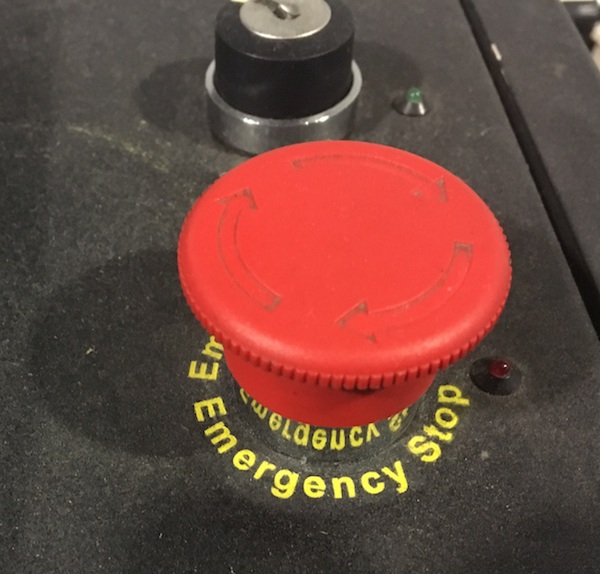
EMF
Abbreviation for Electromotive Force, or VOLTAGE.
ENCODER WHEEL
A flat disc with an indentation used to control certain functions of (often) moving lights on a lighting control desk.Â
ENCORE
An extension of the performance due to audience demand. This usually applies to music concerts or stand-up comedy shows, where the performer will have an extra song or routine ready if there is a lot of applause. From the French which means "again" or "more".
END ON
Also known as Proscenium Staging.
The end-on stage can be split into 9 areas: upstage right, upstage CENTER, upstage left, CENTER stage right, CENTER stage, CENTER stage left, downstage right, downstage CENTER, downstage left.
See also THRUST, IN THE ROUND, TRAVERSE.
ENHANCER
Sound processing equipment which increases the presence of the vocal track in a mix by adding to the treble information in the signal. Also known as an Exciter.
ENSEMBLE
An acting group. Normally used to describe a group of actors who work well together, with no-one outshining the others. A performance where the emphasis is on group work, and there are no star performers, is an ensemble performance.Â
ENTERTAINMENT TECHNOLOGY
Any technical or practical craft used in the creation of live events or experiences. As the definition of 'live events or experiences' includes music concerts, theatre, theme parks, visitor attractions, museums and sports events, the skills needed are very broad. It's not necessary for anyone to be highly skilled in all of the crafts, but an understanding of the whole picture is very helpful, and knowing when to call in a specialist (and where to find them) is vital.
The crafts involved in entertainment technology include, but are not limited to:
Lighting (stage lighting and architectural lighting)
Sound (live and recorded)
Video and Media (projection or display)
Scenic Construction and Automation
Show Control
Animatronics
Costume
Props and Masks
Make-Up and Prosthetics
ENTR
An 'overture' to begin the second part or act of a performance. Often used now to describe any interval music.
ENTRANCE
1) A part of the set through which actors can walk onto the stage.
2) The act of an actor walking onto the stage (e.g. The ghosts entrance is from upstage left).
ENVIRONMENTAL SOUND
A sound that is not specifically mentioned in the text of the play, but helps to create a feeling of reality / appearance of truth. Examples include dripping water in a cave, distant organ music heard in a church graveyard, traffic heard passing outside an office. Â
See also MOTIVATED SOUND.Â
EPIC THEATRE
Epic theatre is a theatrical movement arising in the early to mid-20th century from the theories and practice of a number of theatre practitioners who responded to the political climate of the time through the creation of a new political theatre.
Epic theatre is not meant to refer to the scale or the scope of the work, but rather to the form that it takes. Epic theatre emphasizes the audience's perspective and reaction to the piece through a variety of techniques that deliberately cause them to individually engage in a different way The purpose of epic theatre is not to encourage an audience to suspend their disbelief, but rather to force them to see their world as it is. (from Wikipedia)
Wikipedia entry
EPILOGUE
Scene or speech which follows the main action of the play and provides some insight or comment on the action. See also PROLOGUE.
EQUALISATION
The process of adjusting the tonal quality of a sound. A graphic equaliser provides adjustment for a wide range of frequency bands, and is normally inserted in the signal path after the mixing desk, before the amplifier. See FEEDBACK.
(Equalisation is the British English spelling. American English uses Equalization)
EQUITY
Short for British Actors' Equity (or American Actor's Equity Association, founded in 1913, is the labor union representing actors and stage managers in the legitimate theatre in the United States). The trade union of actors, directors, designers and stage managers.
Shortened to AEA in the USA, and usually just Equity in the UK.
Equity website (UK)
Actors Equity (USA)
EQUITY LIGHT
See GHOST LIGHT.
More on Ghost Light
EQUITY SHOWCASE
A limited-run of a small-scale show (Off-Broadway or Off-Off-Broadway in New York) where actors can work outside a standard Equity contract, and be paid little (or, rarely, no) money. The Equity Showcase status requires that the production is a limited run and has a small production budget. Actors should be, at the minimum, reimbursed expenses, and any volunteering should have benefits (free workshops) and producers should make every effort to get publicity and agents to see the show.Â
Casting an Equity Showcase
ER / E.R.
(US) Short for Ellipsoidal Reflector - type of fixed beam profile lantern common in the US. Also known as ERS / E.R.S. See also LEKO.
ERF / E.R.F.
(US) Short for Ellipsoidal Reflector Floodlight. See also ERS.
ERS / E.R.S.
(US) Short for Ellipsoidal Reflector Spot. See ER, also ERF.
ESCAPE ROOM
An Escape Room is an interactive live game where your team is trapped in a room (or series of rooms) until you can solve a number of puzzles. Typical Escape Rooms have a time limit of around 60 minutes.
They may involve live actors, but often there are multimedia elements, as well as lighting & sound effects and a vast array of props which act as clues (or containers for clues).
They have a great deal in common with immersive theatrical experiences, and are wildly popular world-wide.
Escape Room page
ESCAPE STAIRS
American equivalent of Get-Off treads.
ESTA
(US) Entertainment Services and Technology Association. See PLASA for the UK equivalent.
ESTA website
ETC
(Manufacturer) US/UK based manufacturer of lanterns and lighting control equipment.
ETC website
ETHERNET
Computer networking protocol which is installed on many new lighting desks, to allow networking between the main desk, dimmers, and remote desks around the theatre.
EULOGY
A speech in praise of a person or thing, often a person who has recently died or moved on to a different role / job.
EXCITER
1) See ENHANCER.Â
2) Exciter Lamp - the lamp in a film projector that shines through the optical soundtrack and enables it to be read by a light sensor.
EXEUNT
(Latin) Stage direction meaning 'they leave'. Used to indicate that more than one person leaves the stage. The direction for a single person is simply Exit.Â
EXIT
1) A part of the set through which actors can leave the stage.
2) The act of an actor walking off the stage (e.g. The fireman exits downstage right).Â
3) A stage direction making it clear when a character should leave the scene. One of the most memorable is from Shakespeare's A Winter's Tale'Exit, pursued by a bear'. The character being pursued is Antigonus, a lord of Sicilia, who has been ordered to abandon the baby Princess Perdita.
EXIT SIGN
Usually illuminated sign, of standard size, which should always be visible, showing an audience member and the company the nearest exit.New legislation in Europe means that the word 'EXIT' has been removed from these signs to be replaced by 'Running Man', known more politically correctly as 'Person moving purposefully'.
EXODOS
(Ancient Greek) The final exit of song of a performance.Â
EXPANDER
See Noise Gate.
EXPOSITION
The section of plot at the start of a play which provides essential background information about the characters, their situation, and their relationships to each other.
EXPRESSIONISM
Theatre design and performance style which places greater value on emotion than realism. The trademark Expressionist effects were often achieved through distortion.
EXTRA
A member of the cast with no speaking role who provides background interest in a crowd scene.
Term originally derived from the film industry.
EYE CANDY
Lighting equipment used (especially at live music events) to look good to the audience or the camera, rather than being used to light the performers. This is distinct from equipment used to light the air above / around the band (when haze or smoke is in use) as this has a scenographic function. Eye Candy equipment provides limited functional light.Â
EYELINE
The horizon line on a piece of painted scenery.
F.B.O.
Abbreviation for Fade to Blackout.
FACING
*to be defined
FADE
A fade is an increase, diminishment or change in lighting or sound level.
A snap fade is an instant change. A slow fade could be anything from 5 seconds to a few minutes (or even more, for a naturalistic sunset lighting effect). A quick fade is a couple of seconds long.
A fade out takes the lighting state to blackout (or a particular sound to silence). A fade in does the opposite.
A crossfade smoothly transitions from one state to another, without going through darkness (or silence for sound).Â
FADE DOWN
A slow dimming of the lights to a lower level, but not all the way to blackout. See also FADE OUT.
FADE OUT
A slow dimming of the lights, ending in blackout. See also FADE DOWN.
FADE TIMES
On computerised memory lighting control desks, a lighting fade can have two times - an up fade and a down fade. The Up fade time refers to the time it takes dimmer levels to rise to their new positions. The Down fade time refers to the time for dimmer levels falling to their new positions.
FADE UP
An increase in lighting or sound level, over a given time period. An increase in level from an existing state is known as a BUILD.
FADER
A vertical slider which is used to remotely set the level of a lighting or sound channel.
FALLING ACTION
The events in a play that occur after the climax has been reached, but before the final part.Â
FALSE PERSPECTIVE
A scenic design technique that makes a building or set appear larger than it actually is. The scale of objects that are supposed to be further from the observer is reduced to make them appear further away, even if they're not.
FALSE PROSCENIUM
A temporary frame formed by scenic canvas or vertical flattage within the proscenium arch. Used to reduce the size of the opening when putting a small set onto a large stage.
See PROSCENIUM ARCH.
FALSE STAGE
A special stage floor laid for a production. For example to allow trucks guided by tracks cut into this false floor, to be moved by steel wires running in the shallow (2 or 3 inch) void between the false floor and the original stage floor. A false stage is also required for putting a revolve onto a stage.
FAR CYC
(US) Lighting instrument used to light cycloramas or drops (see also CYC FLOOD).
FARCE
Form of comedy play originated in France, using fast-paced physical action and visual comedy more than humour based on language.
FARM
In certain Russian-speaking countries, FARM is used to mean Truss. (So Back Farm is Back Truss).Â
FAT FINGER
A common problem among lighting & sound operators, when two buttons are accidentally pressed at the same time by a finger that's too large for the buttons.Â
FAZER
A combined fogger and hazer, which can produce thick or thin smoke / haze.Â
FEED
1) A power supply to a piece of equipment or installation is termed a 'feed'. Sound equipment and sensitive computer equipment should have a clean feed - that is, a supply that is free from interference from other equipment.
2) A signal from one system to another is also known as a feed (for example, an audio signal from the FOH desk to a TV company videoing a concert is known as a feed. A video relay of the conductor to screens in the wings is known as a Conductor Feed, etc.)
FEEDBACK
(Automation) Process by which information about the position of a piece of scenery is fed back into an automation system to ensure it's running correctly.
FEEDBACK / HOWLROUND
(Sound) A loud whistle or rumble heard emanating from a sound system. It is caused by a sound being amplified many times. (E.g. a sound is picked up by a microphone and amplified through the speaker. The microphone picks up this amplified sound and it is sent through the system again). Feedback can be avoided by careful microphone positioning, and can be reduced by use of Equalisation to reduce the level of the frequency band causing the feedback.
FEEDER
In the US, a main power cable to an installation is known as a feeder.
FEL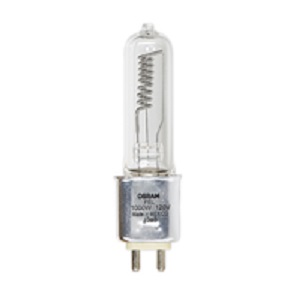
FERRULE
The metal sleeve used to form an eye termination in steel wire rope which is pressed onto the rope under pressure from a hydraulic tool. Usually made from aluminium alloy, copper or steel.
Submitted by Chris Higgs
FESTOON
1) See SwagÂ
2) Describes tabs which adopt a sculpted shape.Â
3) A length of cable incorporating a number of lamp holders used for outdoor party lighting etc. Available in multi-circuit form so that the lamps can be 'chased'.
FEV
Short for French Enamel Varnish, a stain which is a mixture of shellac and dye, diluted in methylated spirit.
FIBRE FRAME
A COLOR frame made from heat resistant fibres, which doesn't get as hot to the touch as a standard metal frame.
FIBRE OPTICS / OPTICAL FIBRE
A method of directing light down a very thin glass fibre. Fibre Optics are used mostly in communication, but find theatre applications in star cloths which are black backcloths with the ends of optical fibres poked through, to create a mass of pin pricks of light. A large bundle or harness of fibres may be fed from one light source, sometimes with a motorised COLOR or flicker wheel.Â
New technology enables digital sound signals to be sent down optical fibres, replacing heavy and expensive multicore cables.
FIELD
Refers to the spread of light intensity across a beam. Most profile lanterns have an adjustable field. A Flat field has an even distribution, a peak field has a 'hot spot' in the CENTER of the beam. A flat field is essential when using gobos. See Profile.
FIFTH BUSINESS
Now obsolete term for an actor who is neither the hero, heroine, villain or confidante in a traditional drama, but is nonetheless essential for revealing important plot points. She/he is known as Fifth Business.
FIGHT CALL
A warm-up and rehearsal of fight choreography held before each performance.
FIGHT DIRECTORÂ
Responsible for choreographing any fight sequences during a show (whether they involve weapons or not), and for ensuring the safety of actors involved in the sequence, and anyone on stage at the same time. They are a Choreographer of fight scenes on stage. Works intensively with actors training them how to avoid hitting (and hurting) each other, how to use weapons safely etc. Fight directors are highly skilled and trained and should not be substituted for someone 'who once saw Gladiator' and thinks they can repeat it!!
Society of American Fight Directors
Fightdirector.com
British Academy of Stage and Screen Combat
FILL LIGHT
(especially TV and Film lighting) Light which fills the shadows that key light creates.
FILLS
Term for speakers additional to the main PA to improve the sound in particular locations (e.g. 'Front fills' add sound at the front of the auditorium which might be just out of range of the main PA stacks at the sides of the stage).
FILTER
1) See COLOR. 2) Electronic device to isolate and redirect specific frequencies in a speaker system.
FINAL CUT
1) Apple video editing software (originally developed by Macromedia).Â
2) The final (finished) edit of a film / TV programme, which the director / producer has approved.Â
FINALE
The last section of a variety / pantomime / musical performance, where spectacular effects, music or revelations are used to end the show 'with a bang' and make the audience applaud wildly. In a musical, this often involves a reprise of earlier music / songs.Â
FINANCIAL BACKER
See ANGEL.
FIRE CURTAIN
See SAFETY CURTAIN.
FIRE EXIT
Particular exit(s) from a building designated by local authority fire officer to be the correct means of escape from a part of the building in case of fire. It is the responsibility of all staff and performers to ensure that all fire exits are kept clear, unlocked and accessible at all times.
FIRE EXTINGUISHER
Essential tools of the pyrotechnician's trade ! In the UK, they used to be COLOR-coded according to content (Carbon Dioxide (Black), Water (Red), Foam (Cream), Halon Gas (Green) Powder (Blue)) but now, they're all red with a small label saying what they are. Another great leap forward !.
FIRE PROOFING
Treatment given to fabric, timber, drapes etc. to retard flammability. Many scenic materials require regular re-application of fire proofing treatment.
FIREPLACE FLAT
Scenery item consisting of a partial wall and a fireplace. Another BACKING FLAT is placed behind the fireplace to mask sightlines.
FIREWIRE
FireWire is another name for IEEE 1394, a high speed data transmission protocol developed in the mid 1990s by Apple which is used extensively on digital video and audio equipment and on PCs.
The FireWire 800 (IEEE 1394b) operates at 800Mb per second and can transmit data over 100m cables.
Apple stopped using Firewire on Macs in 2012, and have replaced it with Thunderbolt and/or USB 3.0.
FIRST ELECTRIC
(US) The first LX bar upstage of the proscenium arch. (Known in the UK as LX1). The next bar is known as Second Electric, and so on.Â
FIRST NIGHT
The opening night of a theatre performance often has a largely invited audience of people connected with the show but not directly involved in it (financial backers, contractors etc.)
FIT-UP
Initial assembly on stage of a production's hardware, including hanging scenery, building trucks etc.
FITCH
A natural hair paint brush, used for mottling or other faux finish painting techniques.Â
FIXTURE
A single moving light unit. Used instead of "instrument", "lantern" or "luminaire" due to the added complexity of the equipment and the need for additional control connections.
FLAGGING
When focussing lighting, flagging means waving your hand in and out of the beam of a lantern/instrument in order to see where the beam is hitting on stage. Flagging is particularly useful in high ambient light levels. (e.g. 'Can you flag that please ?') Term probably originates from a FRENCH FLAG.
FLAMBEAUX
A flaming torch, often handheld and used in a procession.
A silk-effect flame (with light and fan) is much safer, and can give an excellent effect if the rest of the lighting is suitably dim / atmospheric.
See also SILK FLAME, SCONCE.Â
FLAME-RETARDANT
A treatment which can make props, costumes, drapes and any other porous materials suitable for use on stage by reducing the fire risk. An item treated with a flame retardant will limit or inhibit the spread of fire by not supporting combustion.Â
FLAMECHECK is a commonly used treatment, suitable for a wide range of materials.Â
FLASH BOX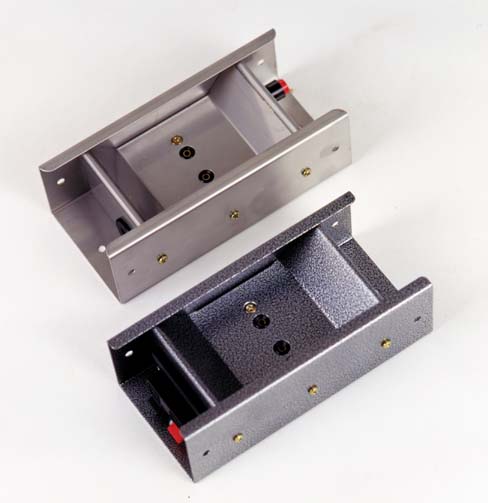
German: Startbox
FLASH BUTTON
A push switch on a lighting desk which flashes selected channels / memories / submasters to full (100%) while pressed. Some Flash buttons on submasters can be set to latch (ie they stay on when pushed, until they are pushed again).
Sometimes known as a Bump Button.
FLASH COTTON
Similar to FLASH PAPER, however it has a faster burn of the cotton and more light is emitted.
FLASH OUT / THROUGH
Method of checking whether lanterns are functioning properly by flashing them on one at a time. It is good practice to flash lanterns to 70%, rather than Full to preserve lamp life.
FLASH PAPER
Flash paper is fast-burning nitrocellulose (Cellulose Nitrate) which is used by stage magicians to produce a flash of flame safely. The paper (or cotton) made from nitrocellulose burns almost instantly leaving no ash or residue.Â
Flash Cotton is cotton wool / string impregnated with nitrocellulose. It should be stored wet, and allowed to dry out just before use.Â
Wikipedia entry
FLASH POT
A generic term for a pyrotechnic device consisting of a small cylindrical container into which pyrotechnic powder has been loaded. At the bottom of the container is an electric match or igniter which, when a large enough electrical current flows through it, produces a spark which ignites the powder. Many companies (such as Le Maitre and Theatre Effects) produce cartridge flash pots which are pre-loaded and sealed, reducing the likelihood of incorrect usage.
FLASHBACK
A moment during the action of a play when the natural flow of time is interrupted so that a moment from the past can be presented. This can help to explain the situation characters find themselves in, or can give the audience additional insight into the characters' minds.
FLAT
A lightweight timber frame covered with scenic canvas, or plywood. Flats are used to provide a lightweight and easy to move and re-configure backdrop to a stage set. Flats sometimes have windows or doors built into them to provide extra flexibility, for use in realistic settings. Masking flats are used to hide areas the designer does not want the audience to see, or to provide actors with an exit, or somewhere to store props. Â
(UK) A flat is supported by a stage brace and brace weight, connected to the flat using a screw eye.Â
Hardboard is sometimes used, but is unnecessarily heavy and will lose it's shape in time. Most theatres have a range of stock flattage made to a standard size, and re-used many times.
A Rail is a horizontal batten within a flat.
A Stile is a side or vertical piece within a flat.
A Sill is the bottom rail of a flat.
See also BOOK FLAT, HOLLYWOOD.
[French: Flat =Â panneau]
FLEMISH EYE
Quick eyesplice in six strand wire ropes. Three adjacent strands are unlaid in order and laid up again in balance. The rope's core is removed. Strands 1 - 3 are then laid against strands 4 - 6 and re laid to form a six strand rope eye. The loose ends are tidied and a serving applied over the ends to prevent them unlaying. The splice is as strong as the rope.
Submitted by Chris Higgs
FLIES
The flying system above the stage of the theatre, consisting of the FLY TOWER, FLY FLOORS, COUNTERWEIGHT systems, PULLEYs, LINES etc.Â
See FLY TOWER.
FLIGHTCASE / FLIGHT CASE
Metal framed wooden box on wheels with a removable lid used for transporting equipment between venues. Flightcases are very strong, and have reinforced corners and edges. Care should be taken when lifting flightcases as they can be very heavy.
The term comes from their original use in protecting delicate equipment when being loaded into air transport and being both very strong and relatively lightweight.
Additional information by Chris Higgs
FLIPPER
Narrow flat hinged to a wider one.
FLOAT
1) The action of letting a large flat fall from vertical onto it's face so that it's cushioned by the air it displaces. Care must be taken when floating flats on dusty stages, as particles can get blown around as the flat lands.Â
2) See Floats.
FLOAT FLATS
A technique to get a set of flats to a horizontal position on the stage floor by removing weights and braces, ensuring the area is clear and that people are wearing safety goggles if there's danger of flying dust, then footing the flats, and pushing them over so they are cushioned by air pressure and land safely on the deck.Â
Known as Deixar caure in Catalan, souffler un decor in French, Op de wind in Dutch.
FLOAT MIC
See FLOATS.
FLOATS
Early form of footlights using burning wicks floating in oil across the front of the stage. Now applies to anything rigged on the front edge of the stage (eg Float microphones, Uplights / footlights etc.)
FLOGGER
Strips of canvas attached to a handle for dusting flats or scenic pieces prior to painting.
FLOOD / FLOOD LIGHT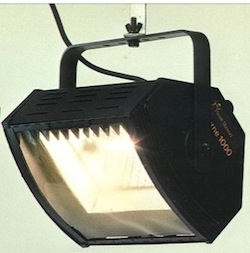
See also CYC FLOOD.
2) To increase the beam angle of a Fresnel or PC by moving the lamp and reflector towards the lens. 'Flood that a bit, please!'. The opposite movement is called Spotting.
Types of lantern
FLOOR LIGHT
Lanterns mounted on low stands at stage level so they provide uplight, casting shadows across the stage.Â
FLOOR PLAN
See PLAN.
FLOOR STAND
A low mount for a lantern so that it can sit at stage level.Â
A floor stand consisting of a sheet of metal and a central support is known as a FLOOR PLATE.Â
Stage Rigging Positions
FLOORCANS
A PARCAN with an extra trunnion arm / yoke, and often a short nose, which is designed to sit on the floor.
FLOORCLOTH
See Cloth.
FLOORPOCKET / FLOOR POCKET
(US) A electrical socket mounted under a flap in the stage floor (UK equivalent is DIP).
FLUFF
To hesitate - to nearly forget or fumble one's lines.
FLUORESCENCE
The property of some materials to glow when subjected to light. This normally refers to ultraviolet light, although blue visible light (along with many other colors) can cause fluorescence. The materials degrade the UV wavelengths into longer and therefore visible reflected rays. See also Phosphorescence.
FLY
Verb - the action of lifting an item up (out) or down (in) when attached to the Flying system.
A FLY CUE is given by stage management to a flyman or fly operator to fly an item in or out. In the US this is known as a RAIL CUE.Â
A flying piece of scenery can be flown in (down) or out (up) on a particular cue given by the DSM to the fly operator on the fly floor above the stage.Â
Czech: provaziště
FLY BARS
The metal bars to which scenery and lanterns are attached for flying above the stage.Â
FLY FLOOR(S) / FLY GALLERY
High working platform at the side(s) of the stage from which the flying lines are handled. Often are also the site for socket panels for connecting flown lighting apparatus to dimmers, and also sometimes a lighting position. Known in the US as Fly Gallery.
FLY LINE
The cables and ropes which form part of the flying system.
FLY RAIL / FLYRAIL
Originally, this was the structure where the flying lines / ropes were tied off to hold scenery and other flown equipment in position. With the advent of counterweighted systems, this refers to the area where the flying system is operated. Also known as PIN RAIL or, in the UK, FLY FLOOR.
FLY TOWER
Extension of the stage walls up to allow scenery to be flown up until it is out of sight of the audience, and to support the GRID. Known as the "flies". The ideal fly tower should be more than twice the height of the pros. arch, and is said to have "full flying height". The load on the grid is transferred to the ground via the walls of the theatre. Known in the US as the Fly Loft, and in Europe as the Stage Tower.
FLYING
See FLYMAN, FLYING HARNESS, KIRBY WIRE, HEMP SET, COUNTERWEIGHT SYSTEM, SPOTTER, DOUBLE PURCHASE, SINGLE PURCHASE.
FLYING HARNESS
Worn by actors who have to 'fly' as part of the action of the play (typically Peter Pan or pantomimes). The flying harness is expertly fitted to the actor, and is fully tested and certified as safe before use. Cables attach to the harness normally at the hip, or the middle of the back, via a quick release locking snap hook mechanism. There are companies who specialise in this sort of wire work, and there's no excuse for not using the professionals at all times. See also KIRBY WIRE.
Flying by Foy website
Kirby's Flying
Aerial Effects website
FLYING IRON
Rigging hardware - a metal strip designed to screw into the lower rail of a flat or other piece of scenery with a ring attached to which flying wires can be connected using a shackle.Â
FLYING PIG SYSTEMS
(Manufacturer) Makers of the Wholehog / Hog range of lighting control desks.
Flying Pig Systems website
FLYMAN
Term for the operator of the theatre's flying system. Can be male or female, and now usually referred to as FLYPERSON.
FOCAL LENGTH
The focal length (property of a lens) is the point at which parallel rays from the sun will converge on passing through the lens. It follows that if a light source is placed at the focal point, the lens will produce parallel rays. If a light source is placed between the lens and the focal point, diverging beams will result. If a light source is placed beyond the focal point away from the lens, converging beams will result.
FOCUS
1) The session when all the lanterns / instruments in the rig are angled in the correct direction, with the correct beam size.
2) Description of how sharply defined a light beam is ('give that profile a sharp focus')
3) Control on projection equipment used to change the focus.
FOCUS CHART
Documentation produced by the lighting designer which shows graphically the exact focus of a particular lantern in the rig. Essential for long-running shows where the crew can use it as a reference when replacing lanterns or checking focus after cleaning etc. The charts can also be used to do a 'rough' focus before a lighting designer arrives at the venue. Touring shows sometimes use a floorcloth marked out with focus information to aid speedy focussing in a new venue.
FOCUS POINT
Function on some computerised lighting desks which allows the operator to specify a place on the stage to which moving lights can be made to move on cue. Once defined, the focus point can easily be recalled and used in multiple cues. If the location of that item is moved (e.g. the chair is moved to the right) all moving lights will automatically focus on the new location.
FOCUS SPOT
Term for both Fresnel and PC type lanterns with adjustable beam size.
Types of lantern
FOCUSING
The process of adjusting the direction and beam size of lanterns. Does not necessarily result in a 'sharply focused' image.
FOG
See SMOKE MACHINE
FOG MACHINE
See SMOKE MACHINE.
FOH
See FRONT OF HOUSE.
FOH MANAGER
See FRONT OF HOUSE MANAGER.
FOIL
1) A fencing blade, rectangular in cross-section (the Épée has a triangular cross-section, with a groove running down the length of the blade, and is heavier).
2) A subsidiary character who emphasizes the traits of a main character.
FOLDBACK
Means by which musicians can part of the rest of the sound mix (including voices) and how their instruments sound after being amplified. Also enables actors on stage to hear musicians or effects when they cannot hear the output of the auditorium sound system.
FOLEY
Named after Jack Foley, a sound technician at Universal Studios Hollywood, Foley is the art of creating and recording sounds that mimic actor or prop moves on a movie screen. During the filming on set, only dialogue is recorded. The detailed recording and building up of layered soundtracks takes place in post-production. A Foley Artist is skilled in the creation of sounds such as footsteps, fight sounds, clothes rustling etc.
The recording of Foley sounds takes place on a Foley Stage, where there are hundreds of different props and many different floor surfaces (e.g. pebbled beach, wooden floor, carpet, vinyl) so that footsteps match the on-screen environment exactly.
FOLLOW-ON CUE / FOLLOW CUE
A cue that happens so soon after a previous cue, that it doesn't need to be cued separately. The follow-on can be taken by the operator once a previous cue is complete, or a lighting or sound cue can be programmed to happen a specific time after a previous cue. Fly follow-on cues are often taken as soon as the operator has completed a previous cue. Often abbreviated to F/O.
FOLLOWSPOT
Usually, a powerful profile lantern usually fitted with its own dimmer, iris, COLOR magazine and shutters mounted in or above the auditorium, used with an operator so that the light beam can be moved around the stage to follow an actor. Sometimes a beam light or other lantern may be used in the same way.
Powerful followspots use discharge lamps which cannot be dimmed, so these followspots have mechanical dimming shutters to dim the light output.
See LIMES, PICK-UP.
Followspotting Tips and Tricks
FOOT
1) The action of bracing the bottom of a ladder while a colleague climbs it (e.g. 'Can you foot this for me please? I'll only be a couple of minutes').
2) Holding the bottom edge of a flat with your foot while a colleague raises the top of it to a vertical position.
FOOT MARKS
Marking on lighting bar each foot (12 inches) to make rigging more accurate. The CENTER line (C/L) is marked on the bar, then each foot outwards from CENTER to stage left and stage right is marked (and sometimes numbered for ease).Â
FOOT-CANDLES
An non-SI unit of illuminance (or light) used in film, TV and architectural lighting industries. The unit is defined as the amount of illumination the inside surface of a 1-foot radius sphere would be receiving if there were a uniform point source of one candela in the exact center of the sphere. Alternatively, it can be defined as the illuminance on a 1-square foot surface of which there is a uniformly distributed flux of one lumen. This can be thought of as the amount of light that actually falls on a given surface. The foot-candle is equal to one lumen per square foot.Â
The SI derived unit of illuminance is the lux. One footcandle is equal to approximately 10.764 lux, although in the lighting industry, typically this is approximated as 1 footcandle being equal to 10 lux.Â
In the lighting industry, footcandles are a common unit of measurement used to calculate adequate lighting levels of workspaces in buildings or outdoor spaces. Footcandles are also commonly used in the museum and gallery fields, where lighting levels must be carefully controlled to conserve light-sensitive objects such as prints, photographs, and paintings, the colors of which fade when exposed to bright light for a lengthy period.
FOOTLIGHTS
A compartmentalised flood batten sometimes recessed into the front edge of the stage, used to neutralise shadows cast by overhead lighting. Before battens were used, individual light bulbs with ornate shades to shield the glare from the audience were used. Modern lighting equipment renders footlights virtually obsolete except for period/special effects. See also FLOATS.Â
FORCED PERSPECTIVE
Set design technique. As identical objects are moved further from the viewer, they appear smaller. Objects that are further away from the viewer appear smaller, and set designers can make use of this effect, by designing sets with reduced size elements to convey height or distance. The castle at Disneyland Resort in Anaheim, California is a classic example.Â
See also TROMPE L'OEIL
FORELOOK
Term not used in UK theatre - currently searching for a definition.
FORESHADOWING
Foreshadowing or adumbrating is a literary device in which an author indistinctly suggests certain plot developments that might come later in the story.
Wikipedia entry
FORESHORTENING
The visual effect of a 3 dimensional object appearing shorter (foreshortened) when viewed at a shallow angle.
The technique can be used in scenic painting to give an enhanced effect of dimensionality, along with other techniques such as Forced Perspective.Â
FORESTAGE
That part of the stage which projects from the proscenium into the auditorium. See Apron.
FORUM THEATRE
Forum theatre is a type of theatre created by the influential practitioner Augusto Boal as part of what he calls his "Theatre of the Oppressed." While practicing earlier in his career, Boal would apply simultaneous dramaturgy. In this process the actors or audience members could stop a performance, often a short scene in which a character was being oppressed in some way. The audience would suggest different actions for the actors to carry out on-stage in an attempt to change the outcome of what they were seeing. This was an attempt to undo the traditional actor/audience divide and to bring audience members into the performance, to have an input into the dramatic action they were watching.
FOUND SOUND
Refers to an audio composition created using sounds that have been recorded for the project, sometimes all from the same location, to which the project relates.
See also MUSIQUE CONCRETE.
FOUND SPACE
A performance space that wasn't designed to be one. Performances that take place outside the theatre (e.g. in historic buildings, factories, public areas) are said to be using found spaces.
FOUNDATION
A base layer of make-up.
FOURTH WALL
The imaginary wall of a box set through which the audience see the stage. The fourth wall convention is an established convention of modern realistic theatre, where the actors carry out their actions unaware of the audience.
Where the cast addresses the audience directly, this is said to be 'Breaking the Fourth Wall'. See also ASIDE.
FOYER
Part of the front of house area of the theatre into which the audience first arrive on entering the theatre. The foyer normally contains: Box Office, Toilets, Entrance to auditorium, Bar, Concession / merchandising stand.
FPS
Frames per second. The UK standard is 24 fps for film, and 25 fps for television. In the USA, the TV standard is 30 fps.
FREEZE FRAME
A technique for allowing a character to 'step out' of a scene and reveal something to the audience, while the rest of the action freezes. The name comes from a film technique where the images is frozen in time.
FRENCH BRACE
See BRACE.
FRENCH DRAPE
A stage curtain / drape which opens from the CENTER in a diagonal direction, resulting in an attractive swagged appearance. The style of movement of the curtain is known as FRENCH ACTION.
FRENCH FLAG
Film/Video term. A card or metal panel fitted to an adjustable arm used to stop unwanted light from directly entering the lens of a camera.
FRENCH FLAT
A scenic flat which is flown into position, usually with French braces. Consists of a number of flats fixed together with battens. Also known as a Frenchman.
FRENCH SCENE
A scene division within a play marked (as in French drama) by the entrance / exit of an actor. These divisions can be useful in splitting up rehearsal schedules, and for marking lighting changes etc.
FREQUENCY
(measured in Hertz - Hz - cycles per second) The number of times a sound source vibrates each second. A high frequency (HF) sound has a higher pitch and is uni-directional. A low frequency (LF) sound has a lower pitch and is omnidirectional.
FRESNEL
A type of lantern which produces an even, soft-edged beam of light through a Fresnel lens. The lens is a series of stepped concentric circles on the front and pebbled on the back and is named after its French inventor, Augustin Jean Fresnel (1788-1827). He developed the lens for French lighthouses so that they could be seen further out to sea and could achieve a longer focal length with a lot less glass than a standard plano-convex lens.
Sometimes shortened to just 'F' (e.g. 'Can you tighten the focus on the downstage Fs so there's less spill on the front of the stage').Â
Types of lantern
FRONT CLOTH
A cloth flown well downstage in front of which short scenes are played while big scene changes are 'silently' carried out upstage. (Common in musicals and pantomime).
FRONT LIGHTING
The direction of light that's most useful for ensuring the audience can see the actors clearly. Front lighting is an essential part of GENERAL COVER lighting.
FRONT OF HOUSE (FOH)
1) Every part of the theatre in front of the proscenium arch. Includes foyer areas open to the general public.
2) All lanterns which are on the audience side of the proscenium and are focussed towards the stage.
The backstage areas of the theatre are known as Rear of House (ROH).
FRONT OF HOUSE CALLS
Announcements made by stage management or FOH staff calling the audience into the auditorium, or informing them when the performance begins. Calls are normally made at the Half (35 mins. before curtain up), the Quarter (20 mins before), the Five (10 mins), and calls normally accompanied by bar bells at 3, 2 and 1 minutes before the performance begins.
UK: "Ladies and gentlemen (boys & girls) Welcome to the __ theatre. This evenings (afternoons) performance of ____ will begin at 7.30pm (2.30pm). There will be one interval of 15 minutes, and drinks can be ordered at the bar prior to the performance."
FRONT OF HOUSE MANAGER
Member of theatre management who is responsible for the day to day running of the front of house (FOH) area (as opposed to the backstage areas). He or she may oversee the running of the box office, any merchandising / catering stands as well as the ushers and any part of the building the public may enter during their visit to the theatre.
Often shortened to FOH Manager.
FRONT TABS
House curtains.
FROST
A diffusing filter used to soften the edges of a light beam. Frosts are commonly used in profiles in front of house positions to achieve the same beam edge quality in all lanterns. Different strengths of diffusion frost are available from many COLOR filter manufacturers.
Rosco make a range called Hamburg Frost - see link below.
See also SILK.
Rosco Hamburg Frost range
FTP
1) See also HIGHEST TAKES PRECEDENCE (HTP) and LATEST TAKES PRECEDENCE (LTP).
2) File Transfer Protocol - a method of transferring files across the internet.
FULL BLACKS
A set of black tabs (curtains) that cover the entire width of the stage (or set).
FULL FRONT
Actor position - facing the audience.
FULL UP
A bright lighting state with general cover lanterns at 'full' (100%) intensity. See also FULL UP FINISH.
FULL UP FINISH (FUF)
A shorthand note for manual desk lighting operators to bring all relevant dimmers to full for the end of a song / finale of a show to 'draw the applause'. Still applies for the snap build on the last beat of a song. See also LIGHTS UP
FULLERS EARTH
Hydrous aluminium silicate, used in chemistry as a filter and as a binder when mixing powder paint for use on textiles. Also used by the printing industry, and for theatre, flim and TV to age and dust-down sets and costumes.Â
FULLNESS
Draperies made up with deep 'gatherings' have fullness - usually requiring not less than 50% additional fabric, measured at head and foot.
FUSE
Protective device for electrical equipment (E.g. dimmers). The fuse link will melt when excess current flows, preventing damage to people or equipment. Every piece of electrical equipment has at least one fuse in its associated circuit.
FUTURISM
An artistic and social movement that started in Italy in the early 20th century. In art, it celebrated technologies of the time - air travel, machinery, industrialisation. Futurist ideas helped to form Art Deco, Vorticism, Constructivism, Surrealism, Dada, and much later Neo-Futurism. In theatre, it fought against classical forms of theatre and celebrated the youthful, spontaneous, and satirical, encouraging vaudeville and music hall forms.Â
Wikipedia entry
FUZZ LIGHT
A lamp with a revolving mirror and a COLORed plastic dome. Gives a 'police light' effect. Usually 12 Volt or 240 Volt operation.
FX (aka SFX)
Abbreviation for Effect, usually referring to Sound Effects, but can also mean special stage effects.
G-CLAMP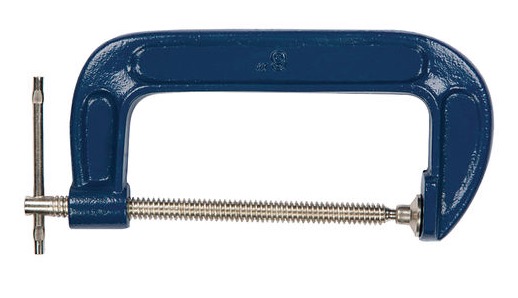
GAC-FLEX
A spanset with a metal wire running through it instead of a nylon core. Â
GAC stands for Galvanised Aircraft Cable.
GAFFER TAPE / GAFFA TAPE
Ubiquitous sticky cloth tape. Most common widths are .5 inch for marking out areas and 2 inch (usually black) for everything else. Used for temporarily securing almost anything. Should not be used on coiled cables or equipment. Originally known as Gaffer's Tape, from the Gaffer (Master Electrician) on a film set. Also known as Duct Tape. See PVC Tape.
GAIN
1) The level of amplification given to a signal or of a system.
2) A control of the amount of pre-amplification given to a sound signal on its way into a mixer. Particularly important for microphone inputs - a quiet vocal will require a lot of gain, a loud singer less so.
GAIT
The gait is the way an actor (or anyone) walks.Â
GAK
(US slang) Anything on stage that isn't of interest to the technical staff (e.g. music stands, chairs, water bottles).
GALAXY
(Trade Name) Large computerised memory lighting desk. Previously manufactured by Rank Strand (now Strand Lighting)
Strand Lighting website
Strand Archive
GALLERY
1) One or more raised seating platforms towards the rear of the auditorium.
2) See LOADING GALLERY.
GAM
(Manufacturer) USA based manufacturer of lighting gels, gobos and accessories. GAM stands for Great American Market. See COLOR FILTER, GOBO.
GAM website
GANTRY
A walkway at high level inside a building.Â
GAS TABLE
Distribution point for gas used in theatre lighting (from around 1816 - 1890). Various valves and wheels controlled the flow of gas from the central point to each part of the stage, so that by using a team of people, complex lighting fades could be achieved, before the advent of electricity for lighting. According to Richard Pilbrow (Stage Lighting Design: The Art, The Craft, The Life 1997) the gas table was the first stage lighting switchboard.
GATE
1) The point of focus in a profile spot where the shutters are positioned and where an iris or gobo can be inserted.Â
2) A single base section of a folding rostrum system.Â
3) See NOISE GATE.
GAUZE
Cloth with a relatively coarse weave. Used unpainted to diffuse a scene played behind it. When painted, a gauze is opaque when lit obliquely from the front and becomes transparent when the scene behind it is lit . Many different types of gauze are available;
Sharkstooth gauze is the most effective for transformations, because it is the most opaque.
Vision gauze is used for diffusing a scene and for supporting cut cloths.
Holo-Gauzeâ„¢ is a metallised gauze optimised for front projection holographic illusions.
Also known as a Scrim.
Holo-Gauze
See also Lighting With A Gauze / Scrim
GEL or Gelatine
See COLOR FILTER.
GEMINI
(Trade Name) Medium size computerised memory lighting desk with 180 channels. Previously manufactured by Rank Strand (now Strand Lighting)
Strand Lighting website
Strand Archive
GENDER CHANGE
As audio connectors are usually referred to as male or female versions, a gender changer is used to change a male connector to a female etc.Â
GENERAL COVER
Those lanterns in a rig which are set aside purely to light the acting areas.
The stage is normally split into a number of areas for this purpose, which can then be isolated or blended together as required by the director. ~
See Special.
Designing and Focussing a General Cover
GENERATOR
Fuel-powered engine which drives a dynamo to convert mechanical energy into electricity. Also known as a GENNY.Â
Generators are used as back-up power supplies in the event of failure of the mains electricity, or to supplement the power available in a venue for a specific show that requires a large amount of electrical power.
Also used on outdoor events to provide all power (including sound system, lighting rig, catering, emergency lighting etc). A large event will have a number of generators and back-up generators to power different zones of the site.Â
GENERIC
Standard stage lighting instruments, rather than moving lights or other effects. (e.g. 'There are 40 instruments in the rig - 20 moving lights and 20 generics').Â
GENIE
(Trade Name) A range of mobile access platforms or lifting devices with either hand-cranked or compressed air lifting mechanisms.
Genie Industries website
Access Equipment
GENRE
A style of performance - a way of categorising different types of drama.
GERB
See PYROTECHNICS.
GERMAN MASKING
See MASKING.
GESTURE
Body or facial movements of a character during a play. Gesture can be described by the author, or suggested by the director or actor.
GET-IN
The process of moving set, props and other hardware into a theatre prior to the fit-up. (aka LOAD IN (US) and BUMP IN (Aus.) and PACK IN (NZ.))
GET-OFFS
A means for an actor to get off a rostrum, high level etc. out of view of the audience. Usually treads. Also known as ESCAPE STAIRS
GET-OUT
Moving an entire production out of the venue, and back into storage or into transport. Usually preceded by the strike (where the set is disassembled back into component parts.
The Get Out is also known as Load Out (USA) or Bump Out (AUS.) or Pack Out (NZ).
GFI / G.F.I.
(US) Ground Fault Interruptor. See RCD.
GHOST LIGHT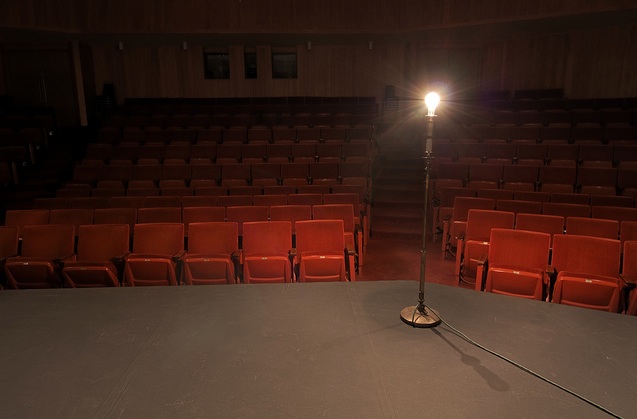
The ghost light consists of a vertical pole with a bare light bulb on it, and is placed on stage. Care should be taken that the cable doesn't create a trip hazard, and that the light bulb is protected with a metal cage.Â
The type of bulb is not critical - it should be chosen so that enough light is emitted to enable people on stage to see furniture / other items to stop them tripping over. Where possible an energy-saving lamp should be used.Â
Also known as the 'Equity Light'. See link below for more information.
Could also refers to the light emitted by a lantern when a dimmer has not been 'trimmed' correctly, and is leaking.
More information about Ghost Light
GHOST LOAD
A lamp plugged into a dimmer which is also being used to dim an inductive load (e.g. transformers) rather than a resistive load (filament lamps). Most dimmers (and certainly all cheap dimmers) are designed for resistive loads, so adding a load lamp onto each dimmer circuit that's not being used for resistive loads enables the dimmer electronics to work correctly.
A ghost load is also used to increase the load on a dimmer when using very low wattage equipment. The ghost load is positioned next to the dimmers out of view of the audience and connected via a parallel splitter (e.g Grelco).Â
Also known as a LOAD LAMP.Â
GHOSTING
A method of determining the exact position of a followspot's beam by faintly exposing it on a darker area of the stage or upon the drapes. Often done just before a 'pick up' so the operator can have the lantern aimed and ready. A more professional practice is to use sights to line up a followspot.
Submitted by Jayson Bowles
GLASS FIBRE
A combination of a glass mat and a resin which can be formed into a strong shell. Used in prop-making.
GLASS GOBO
GLAZE
Glossy finish applied as a final coat to a painted stage floor (also available as a Matt / Flat finish).
GLOBE
1) (especially TV and Film) Jargon for a replacement lamp.
2) The glass part of a lamp.
3) The Globe Theatre in London.
See also BUBBLE, LAMP.
GLOVES
Used when lifting heavier lanterns or other equipment.
GLOW TAPE
Luminous yellow self-adhesive tape used to mark floors so that positions can be found in blackouts. A staple is often used to secure the tape to a floor where it might move.
GLS
General Lighting Service. Lamps designed for general everyday use.
GO
The action word used by stage managers to cue other technical departments. The word GO shouldn't be spoken by others on headsets (especially when the crew is on STANDBY) as they may assume it's the stage manager speaking.
GO UP
The time the show starts (e.g. 'What time does the show go up this afternoon?') This relates to the curtain going up at the start of the show (even if the theatre doesn't have a curtain). See also COME DOWN, LIGHTS UP.
GOBO
Origin of the term 'gobo'
There are a few possible origins for the word GOBO but nothing definitive yet.
Although it's tempting to believe it's an acronym or abbreviation for 'Graphical Optical BlackOut' or 'Goes Before Objective lens' this is not true, as the term is also used in connection with sound recording (a microphone gobo blocks sound from adjacent sources) and also in the film industry, where it's a piece of equipment to block light from the lens or an area. .
It could be short for Go-Between, as the gobo goes between the lamp and the lens.
Material from 1967 uses the word 'MASK', and no mention is made of 'GOBO', so we can assume the word wasn't in widespread use then for stage lighting. In the US TV/Film industry, a Gobo is a piece of material used to mask or block light, placed in front of a lantern (also known as a SHADOW MASK) and a Cookie (short for Cucaloris(from the Greek kukaloris: the breaking up of light)) is the same as a UK Gobo. PATTERN and TEMPLATE can also refer to a gobo in some areas.
In the film industry, the word gobo can be used as a verb (e.g. 'We need to gobo off that light so the camera doesn't see it').
Gobos are available in a wide range of sizes, for use in different profile lanterns and other projectors (e.g. moving lights).Â
A size - 100mm outside diameter / 75mm image diameter
B size - 86mm / 64.5mm
D size - 53mm outside diameter
M size - 66mm / 48mm
E size - 37.5mm / 28mm
Moving lights use a range of different gobo sizes, so check the manufacturers website.Â
Lighting Effects
GOBO HOLDER
GOBO ROTATOR
See EFFECTS.
GOD MIC
A PA system setup for a director to use in a large venue to talk to everyone on stage without shouting, during rehearsals and technical periods. Also used in some small or experimental spaces for tech crew to talk to actors or other crew, if no headset comms system or radios are available.Â
GODS
Colloquial term for the Upper Circle of the auditorium.
GOFER
Colloquial name sometimes given to a junior member of the crew, who is given instructions to fetch and carry equipment / tools etc. (i.e. 'Go For a wrench')
GOING DARK
1) See DARK.
2) Warning to people on stage that the lights are about to be switched off. Normally said during lighting plotting sessions or technical rehearsals. Obviously should not be done if there is any risky work on stage, or if anyone is up a ladder / using power tools / working on platforms / rehearsing choreography etc.
GONDOLA
(Costume) An enclosed easily transportable costume rail with removable side which enables large shows to manage huge quantities of costumes, wigs etc easily.
GPC
(US only) Grounded Pin Connector. A 3 pin plug used to connect instruments to cables / lighting circuits. Â Also known as Stage Pin Connector.Â
GPO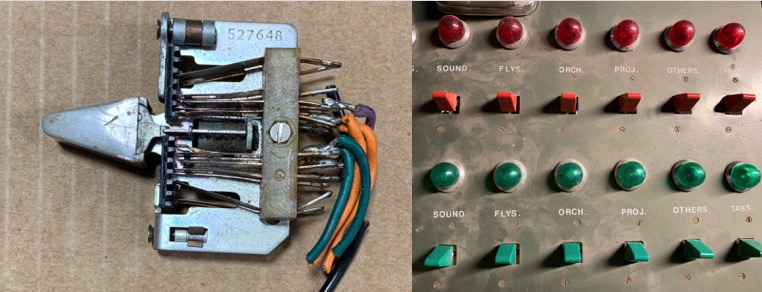
GRAMS
Refers to a Gramophone, originally the only way of playing back sound effects from vinyl or shellac record discs. A Grams cue, then, is a cue to play back recorded sound. Some TV productions (particularly shows that are shot "as live" or broadcast live) list GRAMS OPERATOR in the credits. The term is rarely used in theatre nowadays.
GRAND CIRCLE
See CIRCLE.
GRAND CURTAIN
(US) The main house tabs in a venue. Normally a variation of blue or red in COLOR, although a more neutral grey is often better for scenes played in front of it, or for taking colors and gobos as tab warmers.
GRAND DRAPE
See GRAND CURTAIN.
GRAND GUIGNOL
Shock theatre form originally from Le Grand Guignol theatre in Montmartre, Paris (opened in 1897). Specialised in portraying the macabre & gruesome to the delight and horror of the audience.
GRAND MASTER
See MASTER.
GRANDSTANDING
An actor who seeks applause and attention from the audience, regardless of how the character is supposed to behave. Also used in politics for a politician who says whatever a particular audience wants to hear, to get more applause and support from them.Â
GRAPEVINE
The theatre community is very close, and news/rumours often spread via unofficial routes. This so-called GRAPEVINE means that people are often well-informed about latest news. It is also very important to make a good impression on everyone you meet in the business, as bad impressions will be spread around the grapevine very quickly. Modern tools such as Twitter have made the grapevine even more widely spread, and great care must be taken to not publish anything on Twitter that you wouldn't say to someones face.Â
GRAPHIC
Short for GRAPHIC EQUALISER.
GRAPHIC EQUALISER
See EQUALISATION.
GREASEPAINT
Name refers to make up supplied in stick form, for application to the face or body. Needs special removing cream.
GREEN
(obsolete term) The part of the stage visible to the audience.
GREEN BAIZE
Prior to 17th century actors dying on stage, a green baize cloth was laid down on the stage to save their costumes from needing cleaning. This was also a useful anticipation builder for the audience, especially if the cloth was laid during the interval halfway into the performance.Â
See also GREEN ROOM.
GREEN ROOM
Room close to the stage (i.e. the green) for the actors to meet and relax before or after going on stage. See the link below for some possible derivations of the term.
More about Green Room
GRELCO
(UK) A 2 way 5A or 15A electrical splitter, originally manufactured in the UK by Grafton Electric Company (hence the name Gr el co). Another name is SNAPPER (brand name) or in the US "TWOFER". Sometimes shortened to GRELLY. A three way splitter is known as a TRELCO, TRELLY (or THREEFER in the US). These splitters are always wired parallel (voltage equal, current shared).
See SERIES SPLITTER which enables (for example) two 115V lamps to be connected to a 230V supply.
[updated courtesy John Creed, 2017]
Museum of Old Electrical Items - Grelco
GRID / GRIDIRON
1) The support structure close to the top of the fly tower on which the pulleys of the flying system are supported. Constructed from metal or wooden beams. (Italian:Â gratticia / graticciata / graticcio)
2) Arrangement of scaffolding from which lanterns are hung in a performance space with no flying facilities. Grid is short for GRIDIRON.
GRIDDED
Any flying piece raised as high as possible into the flys, i.e.to the limit of travel of the flying lines, is said to have been gridded.
GRIP
(US) Member of stage crew responsible for moving items of scenery during the show. Usually wears black. A group of grips is a GRIP CREW. This term is borrowed from the film/tv industry, where a grip handles and sets up camera equipment and lighting.
GRIPPLE
Proprietary device designed originally for agricultural use that can be used to form eye terminations in wire rope for non lifting applications.
Submitted by Chris Higgs
GROUNDLING
Poorer members of the audience in an Elizabethan theatre who occupied the open-air sections of the theatre at ground level, just in front of the performance space.
GROUNDPLAN
A scaled plan (overhead) view of the theatre stage area or of a set design, to enable all technical departments to ensure that everything will fit correctly into the space available. The groundplan shows all items standing on the stage floor and any permanent items which will affect the production, and the position of any flown pieces. The set design groundplan enables the lighting designer to be clear about exact location of all items, and will have the walls of the stage drawn on it so that the stage management team and production manager can plan furniture and set moves offstage.
Typical scales are 1:24 (.5' to 1 foot) or, metrically 1:25 (1cm to .25m). Venues have a base plan showing proscenium, walls, seating etc on which individual set and lighting plans can be drawn.
GROUNDROW
1) A long piece of scenery positioned at the base of a backcloth usually to mask the very bottom of a cloth or lanterns lighting a cloth.
2) Compartmentalised floodlight battens at floor level used to light the bottom of skycloths etc.
GROUP
A subdivision, permanent or optional, of a lighting board control preset, or a sound desk.
GUN MIC
A highly directional condenser microphone.
HAAS EFFECT
A psychoacoustic phenomenon whereby an audience will focus on an actual sound source if the reinforced sound from speakers arrives 10 - 15 milliseconds later. The setting up of delays can be time-consuming but the Haas Effect can make a vast difference to the perceived quality of the sound in a show. The delays are set up by experimentation rather than by using distance/speed/time formulae.
HALF
1) The Half is a call given to the actors half an hour before they will be called to the stage for the beginning of a performance. It is given 35 minutes before the advertised time of commencement (in the UK). On Broadway, the Half is given 30 minutes before the start time.
Subsequent calls given are the 'quarter' at 20 minutes (UK), 'the five' at 10 minutes (UK) and 'beginners to the stage' at 5 minutes before curtain up (UK). See also FRONT OF HOUSE CALLS, QUARTER.
Also known as Final Call.
2) Lighting - half of full intensity, or 50%.Â
See Calls and Cans
HALF K
A 500W lantern (usually Fresnel or PC) - K refers to Kilowatt (1000 Watts).
HALOGEN CYCLE
Chemical process occurring in Tungsten Halogen lamps which makes them possible. During the lamps life, Tungsten evaporates from the filament, and would normally deposit itself on the glass wall of a Tungsten lamp, causing it to blacken, and causing the output of the lamp to reduce until it finally blew. In a Tungsten Halogen lamp, the Tungsten combines with the Halogen gas elements present in the lamp envelope and is re-deposited back onto the filament. This process needs a very high temperature to operate, so Tungsten Halogen lamps are able to be a lot smaller, and run a lot hotter, than their Tungsten equivalents. See also Tungsten Halogen.
HAM
Exaggerated over-acting.
HAMARTIA
From Ancient Greek. In connection with Greek Tragedy, Hamartia is often defined as the hero's fatal flaw.
Wikipedia entry
HAND
(US) Short for Stage Hand (member of Stage Crew).
HANG / HANGING SESSION
The 'hang' is the American equivalent of the lighting rigging session in the UK - the time when the lighting equipment is rigged.
HANGING AN ACTOR
A difficult effect to pull off successfully on stage, and must absolutely not be attempted without professional supervision, for obvious reasons.Â
Harnesses can be obtained which are designed for this effect, but standard safety harnesses are not suitable. The rope must have a safety-rated rope built into it, which is suitable for suspending the shock load of the actors' weight, which must be attached to the harness in such a way that it's not possible for the fake noose to ever tighten around the actors' neck. The hanging must take place with other members of the company present, who have been trained in how the system works under professional supervision.Â
Simply using a rope with a weak point (e.g. using weak cotton to connect the noose to the rest of the suspending rope) is no longer recommended as there are situations where it may not break, and any chance of this will not be acceptable to a risk assessment process.Â
A far safer way to hang an actor is to do it offstage, or use a blackout or blinding light along with a sound effect to misdirect the audience into thinking they've just seen a hanging.Â
HANGING IRON
Ironmongery fitting fixed at the bottom of the back of a flown flat to which the suspension wire is secured.
HAPPY TRAILS
(US) Good wishes given to a member of cast leaving a long-running show, or to an entire cast when a show is closing.
The phrase comes from the 1950s Roy Rogers television show, where it was the title of the closing theme song:
"Happy Trails to you!
Until we meet again
Happy Trails to you
Keep smiling until then
Happy Trails to you
Till we meet again!"
The song was written by Dale Evans (the wife of Roy Rogers, and his co-star in the TV series).
Roy Rogers TV show closing credits (Youtube)
HARD POWER
A non-dimmed power supply to a lighting rig (or part of a rig).Â
HARDBOARD
An engineered wood product made from highly-compressed wood fibres. It's cheap and hard-wearing. Oil-tempered hardboard is more resistant to wear and tear and is more waterproof, and is used as a stage floor surface. One brand name in the US is Masonite.Â
Wikipedia entry
HARMONICS
High notes that are achieved on instruments of the musical instrument families when the performer lightly places his finger exactly in the middle of the vibrating string.The harmonictones produced by a vibration that go to make up the aural spectrum of any particular note, or grouping of notes.
HARMONY
(Trade Name) Range of 1000W lanterns produced by Rank Strand (now Strand Lighting) in the UK.
Strand Lighting website
Strand Archive
HARTING
Family-owned and run technology company, founded in 1945 and headquartered in Germany.Â
The brand is known in technical theatre for their heavy-duty multipin connectors used as 'Lectriflex'.Â
Harting Website
HAZER
See SMOKE MACHINE.
HD-TV
Widescreen (16:9) high-resolution digital TV format.
HD-TV basics website
HDBaseT
HDBaseT is a standard for connection and transmission of high-definition video, audio and control / data signals using a Cat6 cable. The standard was launched in 2010, and can transmit up to 100m using good quality cable.Â
HDBaseT website
HDMI
High Definition Multimedia Interface. HDMI is a proprietary audio/video interface for transferring uncompressed digital video data and compressed or uncompressed digital audio data from an HDMI-compliant source device, such as a display controller, to a compatible computer monitor, video projector, digital television, or digital audio device.Â
Wikipedia entry
HEAD
See RADIO MIC.
HEAD CARPENTER
The head of the carpentry team that builds the wooden portions of the set.The team are sometimes known as the 'Carps'.
HEAD ELECTRICAN
US equivalent of the UK CHIEF ELECTRICIAN
HEAD FLY
The head of the fly crew who are responsibly for lifting scenery or other objects above the stage.
HEAD SOUND
The head of the sound department, which deals with any recorded music, sound effects, vocal reinforcement and music amplification required in the production.
See also NO.1 SOUND.
HEADS
The top lantern on a lighting boom. See SHINS and MIDS.
HEADS ON STAGE
A shouted warning (often just 'Heads!') for staff to be aware of activity above them. Also used when an object is being dropped from above.
HEADSET
1) General term for theatre communication equipment.
2) A headphone and microphone combination used in such communications systems with a beltpack.
See also CANS.
HEADSHOT
A photograph of an actor, distributed to agents, directors or casting directors. Headshots are not the same as portrait photos, and are designed to show the actors' face clearly in even lighting.Â
HEALTH AND SAFETY / OHS / WORK HEALTH AND SAFETY
UK and AUS term to cover a range of legislation and guidance on how to work safely, and to reduce accidents or incidents.Â
The legal component is the Health and Safety at Work Act (1974), but there are a number of regulations which relate to safe working.Â
See COSHH, SAFE SYSTEM OF WORK, LOLER, PPE, PUWER, RIDDOR.
Safety in Live Entertainment on Theatrecrafts.com
HEATSHIELD
Made by Rosco, Heat Shield is a special clear gel which when placed between a lamp and a COLORed gel, dissipates a large amount of heat to give the gel a longer life. There must be an air gap between the Heat Shield and the gel, or it will not be effective.
Rosco website
HEAVENS
The roof or canopy over an Elizabethan stage (such as Shakespeare's Globe in London), often painted with a representation of the night sky with stars, moon, zodiac signs etc.Â
HEMP
A type of rope used for flying, made from fibres found within the bark of the cannabis plant.
HEMP SET
The simplest flying system consisting of a series of hemp ropes threaded through pulleys on the grid, and tied off on the fly floor on a cleat. The usual arrangement is for three ropes to be attached to a flying piece, named by their position relative to the fly floor (short, CENTER and long). These names are used when levelling the flying piece, and giving it a dead. The three ropes are pulled or let in together, sometimes requiring more than one person to operate. A theatre using a hemp flying system is known as a Hemp House.
HERAS FENCING
A temporary fencing system consisting of interlinkable panels with heavy base weights, used at festivals and other events. Can be lined with a plastic scrim to improve the appearance. Some large events use custom-printed scrims to tie in with design or sponsorship deals.Â
Heras UK website
HESSIAN
Coarse loose-weave cloth used to cover flats, as a scenic element, and to strengthen and give form to moulded objects (e.g masks) as they cure and harden.
HI-8
Camcorder video format designed by Sony as a follow on to its lower-quality Video 8. Uses 8mm-wide tape.
HIGH HAT
See TOP HAT.
HIGHEST TAKES PRECEDENCE*
Abbreviated to HTP, this is the standard by which some lighting desks operate.
If there is more than one control on the desk affecting a particular channel, then the highest level of the controls will take priority and affect the output of the desk and the dimmers.
This system is universal on manual lighting desks, but there are problems with the control of moving lights, scrollers etc.
See LATEST TAKES PRECEDENCE.
HINGE
See PIN HINGE, BACKFLAP HINGE, MARIE TEMPEST HINGE.
HIT YOUR MARK
When an actor stands in the correct position (usually with regard to lighting) she/he is said to have Hit the Mark.
HMI (Hydragyrum Medium arc-length Iodide)
A mercury-halide discharge lamp with a COLOR temperature of 5600K (daylight).
HOIST
Generic term for a lifting machine.
Submitted by Chris Higgs
HOLDING FOR A LAUGH
A risky practice, this involves the actors and director pre-planning where the audience will laugh, and inserting suitable pauses in the action, or ensuring that nothing important will be missed if the audience is in stitches. However, if the audience fails to laugh, the pause will slow the pace of the performance. The actors must learn to react to the audience as they react. An even more dangerous practice is to assume that the audience of the show tonight will laugh at the same points as the audience of the previous show.Â
HOLLYWOOD FLAT
A Hollywood is a double-sided timber flat with a much wider edge than normal. Hollywood flats are mainly used in the film/tv business. The thicker edge gives the flat extra stability, can be easily clamped to adjacent flats, and looks more like a real wall on camera. Also known as a TV Flat.Â
HOOFER
Slightly derogatory term for a dancer.Â
HOOK CLAMP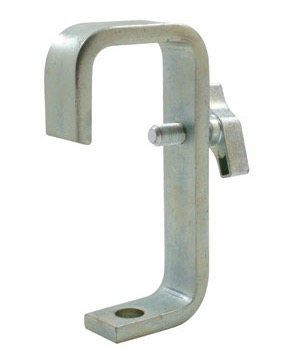
Introduced in the UK in 1959 by Strand, replacing the 2-bolt and 2-nut L Clamp.
Hook Clamps should not be used to overhang items above a lighting bar. A BOOM ARM can be rigged on a lighting bar (horizontal) or a boom (vertical) to rig a lantern adjacent from the bar / boom.Â
Alternative clamps are available from companies such as Doughty to rig a lantern above a bar.Â
See SAFETY CHAIN and BOOM ARM.
HOOK UP / HOOKUP
A Hook Up is paperwork generated by the Lighting Designer for a show. It lists connections or layouts between number systems. For example, a Channel Hook Up lists the channel numbers used on the lighting plan alongside the dimmer numbers into which they're connected, and a brief text description of that channels function.
HOSPITALITY SEAT
Seating in a VIP area, or the best seats in the house, sold to corporate (business) clients for them to offer as incentives or gifts to employees or suppliers etc. Hospitality packages are available to many large music or sports events.
HOT SEATING
A technique used in interactive theatre when an actor, in character, is questioned by the audience about her/his actions.
HOT SPOT
The brightest part of the beam from a lantern, usually showing the CENTER. Profile lanterns have a Field control which enables a beam to be flattened so it has no hot spot.
HOUSE
1) The audience (eg 'How big is the house tonight ?')
2) The auditorium (eg 'The house is now open, please do not cross the stage')
HOUSE CURTAIN
Same as HOUSE TABS. The house curtain is the main set of curtains ('tabs') in the venue. Not every show will use the tabs, but it's often nice to save the audiences' first view of the set for a special moment as the show starts, not as 'wallpaper' while they're coming into the auditorium. However, this entirely depends on the nature of the show. Known as GRAND CURTAIN in the US. See also TAB WARMERS.
Spanish: Bambalinón
HOUSE IS OPEN
Announcement made over backstage communication system to let cast and crew know that the auditorium is open to the audience and that if there is no curtain, they should stay off the stage.Â
It is good practice for no-one (crew, cast or management) to walk onto or off the stage while the house is open (unless it's part of the show of course!).
HOUSE LIGHTS
The auditorium lighting which is commonly faded out when the performance starts.
HOUSE MANAGER
Duty member of theatre staff who is responsible for the Front of House staff and organisation for a particular performance. She/he is also responsible for the health and safety of the audience while they are in the theatre. See FRONT OF HOUSE MANAGER.
HOUSE RIGHT / HOUSE LEFT
Alternative way of describing each side of the stage, from the audiences' perspective. Stage Directions are usually given from the actors' perspective (e.g. Stage Left / Stage Right). Stage Left is House Right and vice versa.Â
Sometimes abbreviated to HR / HL.
If an actor enters from the auditorium, then House directions are usually given (for example, "You enter House right, walk down the auditorium steps, onto the stage, then walk upstage and exit upstage left")
HOUSE TABS
The main set of curtains ('tabs') in the venue. Not every show will use the tabs, but it's often nice to save the audiences' first view of the set for a special moment as the show starts, not as 'wallpaper' while they're coming into the auditorium. However, this entirely depends on the nature of the show. Known as GRAND CURTAIN or HOUSE CURTAIN in the US. See also TAB WARMERS.
Spanish: Bambalinón
HOWIE BATTEN
(After Howard Eaton) This is a two circuit (two COLOR) 120V per circuit MR16 (PAR 16) batten developed by Howard for lighting cloths at close proximity. A row of these hung above a cloth allow you to light the cloth where there is little space. They have also become popular as footlights. The battens are designed to be used in pairs on a 240V (UK) power supply, connected via a series splitter to share the 240V down to 2 x 120V battens. They are also known as MR16 Battens or L&E Battens (after the manufacturer).Â
Howard Eaton Lighting Ltd. website
HOWLROUND
See FEEDBACK.
HRTF
Head-Related Transfer Function. A way of measuring how each pair of human ears responds to sound, based on the size and shape of the head, ears, ear canal, density of the head, and the size and shape of nasal and oral cavities.
HTI
See DISCHARGE LAMP.
HTP
See HIGHEST TAKES PRECEDENCE.
HUBRIS
From Greek. Hubris is extreme pride or arrogance. Hubris often indicates a loss of contact with reality and an overestimation of one's own competence or capabilities, especially when the person exhibiting it is in a position of power.Â
HUE
The COLOR of a light, costume or piece of scenery (etc.).Â
The term is usually linked to Saturation, which is the amount of that COLOR.Â
HUM HEAD
See NOISE BOY. Term popular around the Edinburgh Festival.
HUNDRED (100) VOLT LINE
Way of sending speaker signals over long distances without losing signal strength. Transformers are used in each speaker cabinet to convert the signal from 100 Volts to a more usable level. (100V is used in the UK, 70.7V in the USA)
HVAC
Acronym for Heating, Ventilation, and Air Conditioning. This describes the venue system for keeping the company and audience comfortable.
HYDRAULIC
A system of controlling machinery or moving scenery using oil or water under pressure to move a piston or 'ram'. Used in many large-scale shows to automate scene changes.
HYPERCARDOID
See PICK-UP
IAMBIC PENTAMETER
(from Greek - having five 'iambs') A commonly used metrical line in traditional verse or verse drama. The term describes the particular rhythm that the words establish in that line, which can be described as a 'tick tock' rhythm. The rhythm is measured in small groups of syllables; these small groups of syllables are called "feet". The word "iambic" describes the type of foot that is used (in English, an unstressed syllable followed by a stressed syllable). The word "pentameter" indicates that a line has five of these "feet."
IATSE / I.A.T.S.E.
International Alliance of Theatrical Stage Employees (USA) Stage employees union.
IATSE website
ICOPER
Acronym for International Code of Practice for Entertainment Rigging.
A new standard, published in 2017.Â
Download ICOPER at PLASA
IEC / I.E.C.
International Electrotechnical Commission. The UK mains inlet connector / 'kettle lead' is known as an IEC LEAD.
IEC website
IEM / I.E.M.
See IN EAR MONITORS
IFCB
Acronym for the four palettes used to control moving lights. Intensity (brightness of the beam), Focus (position of the beam), COLOR, Beam (focus quality of the beam - hard-edged, soft-edged, or split through a prism).
IFR (Inherently Flame-Retardant)
A description of cloth which is inherently flame-retardant and will remain so for the life of the cloth. The flame retardant qualities are a feature of the material, not a treatment applied afterwards. See manufacturer for full details. See also NDFR and DFR.
IGBT
Acronym for Insulated-Gate Bipolar Transistor. Electronic component used in later generation lighting dimmers.Â
Wikipedia entry
ILDA
International Laser Display Association
ILDA website
IMAG
Short for Image Magnification - the use of live feed video cameras and huge video screens to bring the details of an artists' performance to a huge stadium-sized audience.Â
IMPEDANCE
A term for the electrical resistance found in a/c circuits. Affects the ability of a cable to transmit low level (e.g. sound) signals over a long distance. Measured in Ohms. Speakers are rated according to power handling capabilities (Watts, W) and impedance (Ohms).
IMPRESSARIO
1) Now more likely to be called a Producer, the Impresario organised and financed the performing arts. Term originated in the Italian opera, in the mid 18th Century.
2) Automation control console and system by AVW Controls in London, UK.Â
AVW Controls website
IMPROVISATION
A comment or behaviour by an actor or group of actors that is not rehearsed or prepared (or, sometimes, authorised by the director). If the improvisation helps the performance move forward, appropriately, due to a technical or other issue, then improvisation can be helpful. If, however, it's put in to raise a laugh or breaks character or the mood of the scene, it is frowned on.Â
See also AD LIB.Â
IMPULSE RESPONSE
(Sound) Abbreviated to IR. An Impulse Response is a digital recording of a burst of a full range of frequencies (known as an impulse) across the audible spectrum, which is used to create a digital 'acoustic autograph' of a space. The impuise response recording is analysed by software which can then be used to recreate the acoustic of the original space digitally.
This enables a precise match to how a recording sounded in the space when trying to recreate it in the studio.Â
IN
(Flying) To fly a piece of scenery / lighting bar down towards the stage from the flies. The opposite is OUT.Â
IN EAR MONITORS
Small headphones worn inside the ear by members of a pop band so they can hear the monitor mix (or the backing track they're miming to) without having lots of monitor speakers onstage. The advent of in-ear monitoring has improved the sound quality of the monitoring for these band members as they no longer have to try to hear the monitors over screaming from the audience. Each member of the group can have their own monitor mix which is guaranteed to be the same in every venue on the tour. Known as I.E.M.s or IEMs for short.
IN IS DOWN, DOWN IS FRONT
First line of a poem called Theatrical Logic, designed to highlight the complexity of technical theatre jargon!
Theatrical Logic
IN THE CAN
(Film Industry) A scene or sequence has finished being filmed. (e.g. "Thanks everybody - that scene is in the can now"). Refers to a roll of film being taken out of a movie camera and put into a metal film can to be taken for processing.
IN THE ROUND
Theatre in the Round is a form of audience seating layout where the acting area is surrounded on all sides by seating. There are often a number of entrances through the seating. Special consideration needs to be given to onstage furniture and scenery as audience sightlines can easily be blocked.
Stage managers and directors often use the idea of a clock face to describe actor positions on stage (e.g. the aisle nearest the technical point is described as the 12 O'clock position, with other aisles described as 3, 6 and 9 O'clock.)
See also ARENA, THRUST, END ON, TRAVERSE.
INCANDESCENT
Light source consisting of a metal filament (Tungsten) which glows white hot when current is passed through. See also Discharge Lamp.
How do Incandescent Light Bulbs Work?
INCIDENTAL MUSIC
Music heard by the audience in a non-musical performance, either as background atmosphere as underscore, or between scenes or to set the mood. Incidental music is not heard by the characters in the play, so is non-diegetic.
INDEPENDENT
1) An electrical power supply that is totally separate from the stage lighting control. Used for testing lanterns prior to connection to the lighting system and also for powering non-lighting equipment on stage and working lights. See NON DIM.Â
2) A channel within the stage lighting control which has been temporarily switched to become independent from the rest of the channels which remain under the control of the operator.
INDUCTION LOOP
System which amplifies audio frequency currents (from a microphone over the stage) around a large loop of cable (around the auditorium) to generate a magnetic field which can be picked up by a hearing aid switched to the 'T' position.
INDUSTRIAL
Also known as a CORPORATE. An event or performance staged by a manufacturer or company in order to launch a product or celebrate a milestone of some kind. Such events are often spectacular.Â
INFRA-RED
Invisible part of the electromagnetic spectrum with a longer wavelength than visible light. Infra-red remote controls are used for lighting desks and practicals. An infra-red-sensitive CCTV camera can pick up body heat activity even in a 'blackout'.
INFRASOUND
Very low frequency sound which is not normally audible by the human ear. Usually describes sound waves below 20Hz. At high enough volumes (sound pressure levels) sound waves as low as 12 Hz can be perceived by some ears. When they can't be perceived as sound, the waves can be felt as pressure either in the ear drums, or elsewhere on the body. Some scientists have linked the presence of infrasound in buildings (produced by air conditioning systems or large empty rooms) with feelings of unease, nervousness, or even perceptions of supernatural presences by visitors.Â
INGENUE
The ingénue is a stock character in literature, film, and a role type in the theatre; generally a girl or a young woman who is endearingly innocent and wholesome. Ingénue may also refer to a new young actress or one typecast in such roles.Â
INHIBIT
A way of taking control of a rogue lantern (or lanterns) at the lighting desk during the operation of a show and removing them from any further lighting states, until the inhibit is removed. Can also be used for removing the front of house lighting from a curtain call state. See also SUBMASTER.
INHIBITIVE SUBMASTER
See SUBMASTER.
INSERT
1) An additional route into a sound desk.Â
2) An extra lighting state added into the sequence later. See POINT CUE.
INSET
A small scene set inside a larger one.
INSTALLATION
1) An electrical system in a particular building (e.g. "the stage lighting installation was tested last year")
2) A piece of art designed to transform a particular room or building into something other than a room in an art gallery. Installations often use complex audio-visual equipment and can be intensely immersive experiences. (e.g. "In the studio space this week we have an installation by John Doe entitled 'Space'")
INSTRUMENT
(US) Same as a LANTERN or LUMINAIRE in the UK/Europe.
INSTRUMENT SCHEDULE
A list of the instruments / lanterns used on a show.
Usually sorted by hanging position (e.g. Front of House, First Electric etc.).
INTELLIGENT LIGHT
See MOVING LIGHT.
INTENSITY
(Lighting) A way of describing the brightness of a stage lantern. A lantern supplied with the maximum amount of electrical power a dimmer is able to produce is described at being 'at full intensity' - this is often called '100%' or just 'Full'.Â
As the electrical supply is reduced, the light gets dimmer (lower intensity). When the dimmer has been faded down (or 'faded out') the intensity is said to be '0%' or 'Zero' or 'Out' or 'Off'.Â
INTENTION
Intention is an character's specific purpose in performing an action or series of actions, the end or goal that is aimed at. Outcomes that are unanticipated or unforeseen are known as unintended consequences.
INTERCOM
Usually refers to microphone/headset communications equipment. Abbreviated to 'comms'. Also known as 'cans'.
INTERIOR MONOLOGUE
The interior (or internal) monologue is the stream of consciousness discussion a character has with her/himself whilst working through problems or issues confronting them. It can be delivered as a recorded voiceover, or possibly as an aside spoken direct to the audience.Â
INTERMISSION
See INTERVAL.
INTERNALLY WIRED BAR (IWB)
A Scaffolding bar (aluminium) which has a number of sockets (usually 15A) positioned along its length, the wiring for which is contained within the bar. See SIX LAMP BAR.
INTERRUPTIBLE FOLDBACK (IFB)
IFB is monitoring and cueing system used in live events, television, filmmaking, video production, and radio broadcast for one-way communication from the director or assistant director to on-air talent or a remote location. It is also known as Interrupt for Broadcast. The foldback normally contains a feed of production audio, which can then be interrupted by the director microphone to give specific information or instructions.
INTERVAL
Break between sections of a performance. During a play, the interval is normally half way through a standard length performance (approx 1 hour each half) and is usually 15 or 20 minutes in duration. Known in the US as an INTERMISSION.
For a full house, a 20 minute interval may be necessary. However, if there are no refreshments available, the interval can be shorter.Â
A performance of less than 90 minutes in length could run straight through with no interval, although this wlil affect the theatres' takings for the night.Â
INTERVAL MUSIC
Music played in the foyer and/or auditorium during intervals. Most usually Vivaldi's Four Seasons.
INTONATION
The way in which words are emphasised during a speech.
INVENTORY
A numbered packing list which itemises all single pieces travelling on a tour; all cartons, flightcases, crates, baskets together with quantities and descriptions of contents. Extremely important if touring abroad to satisfy customs. Dimensions/weight/value may also require recording.
INVERSE SQUARE LAW
The Inverse Square Law, when applied to light, states that as light loses energy as it travels, the further you are from a light source, the dimmer the light source becomes.Â
IRIS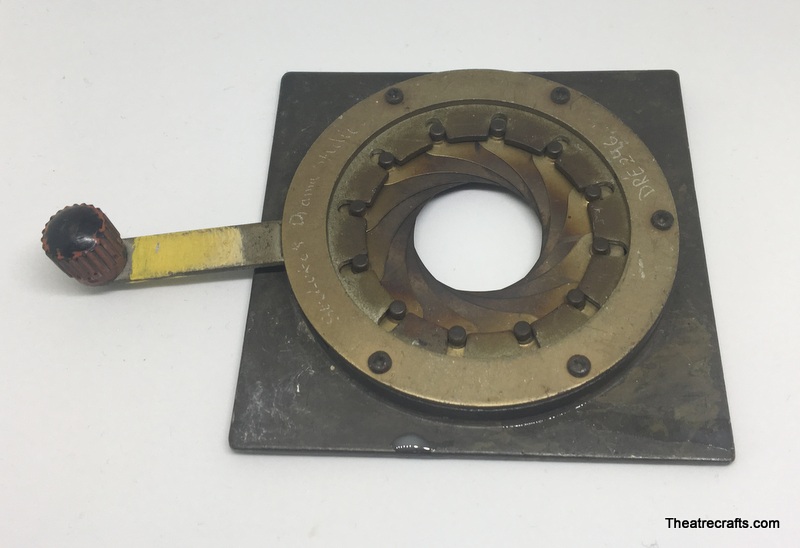
Most followspots have an iris permanently installed.
IRON
See SAFETY CURTAIN.
ISIS
ADB software used on high-end ADB lighting desks. Uses a 32-bit operating system with a very short boot-up time.
ADB website
ISORA*
A plastic CYCLORAMA, used because of it's light transmission properties. When lit from behind, the source of light is not visible through the plastic, making complex silhouette work possible.
When used in conjunction with a BOUNCE cloth (light directed onto the bounce is reflected onto the rear of the isora) very smooth coverage is possible.
ITALIAN MASKING
See MASKING.
ITALIAN REHEARSAL
(Colloquial) A speed run where lines and action are delivered at a much faster pace than usual. It's a good way to help with pacing problems, and to help actors to get back into the swing of a fast-paced show (comedy / farce) or to break the ice for a more dramatic show.Â
Also known as a 'Russian Run'.
ITC
Independent Theatre Council (UK)
ITC website
JACK
1) Segmented audio connector. Mono Jacks have two connections - tip and sleeve, and are unbalanced. Stereo jacks have three connections - tip, ring and sleeve.
B-type jacks (also known as Bantam jacks) were originally designed for use in telephone exchanges and provide a high quality (and expensive) connection in jackfields.
A-type jacks are cheaper and more common, but more fragile. A type jacks are available in 2 sizes : quarter inch and eighth inch.
2) (US) A hinged brace. In the open position, it holds up a flat or other unit of scenery. A Tip Jack is a combinaton of a jack and castors so scenery can be supported or rolled. When it is in position, it is tipped to vertical. When rolling, it leans backwards.
JACKFIELD
An array of jack sockets ('jills'), providing connections to equipment/outlets etc. A patch panel.
JACKKNIFE STAGE
A type of set consisting of one or more wheeled rostra, which are fixed at one corner point, enabling the platform to pivot to reveal a different set / scene or to appear on stage or move offstage. See also WAGON STAGE, REVOLVE.
JAFIE
(Colloquial) Term of affection used by stage crew and sound folk, making disparaging comments about the Electrics (Lighting) team. 'Just Another F****** Ignorant Electrician'. Rarely used nowadays.Â
JARDIN
French for Garden. See STAGE RIGHT.
More about Cour / Jardin
JONES PLUG / JONES SOCKET
Type of multipin connector used on some lighting desks for analogue outputs.
CINCH website
JONES, INIGO
Inigo Jones (July 15, 1573 - June 21, 1652) is the first significant British architect of the modern period, and the first to bring Italianate Renaissance architecture to England. He left his mark on London by single buildings, such as the Banqueting House, Whitehall, and in area design for Covent Garden square which became a model for future developments in the West End. He also made major contributions to stage design by his work as theatrical designer for several dozen masques, most by royal command and many in collaboration with Ben Jonson.
He is credited with introducing movable scenery and the proscenium arch to English theatre.Â
JOSEF SVOBODA
Czech scenographer (1920 - 2002)
Josef Svoboda in the Backstage Heritage Collection Archive
JUKEBOX MUSICAL
A stage musical show that has been constructed from pre-released existing songs, usually from one artist or genre. Examples are The Buddy Holly Story, Mamma Mia and We Will Rock You.
JULIET BALCONY
A high level platform in a theatre or on a stage set that would work for the balcony scene in Romeo and Juliet.Â
JUMPER
An adaptor from one type of electrical connector to another. For example, a 13 - 15A jumper has a 13A plug and a 15A socket at either end of a short cable. Also applicable to sound cables.
JUVENILE LEAD
The most significant role in a play or film that is performed by a young actor / actress.Â
JUVES
Short for 'Juveniles' - child members of the company.
K
Lighting Industry Forum code which identifies the (original) recommended usage of different lamp types. K coded lamps are for use in general purpose flood lighting, and have a COLOR temperature of 2850°K. See also CP, A1, T, P2.
K1 HAZER
The Jem K1 Hazer is a high-performance hazer produced by Martin. It provides the combination of continuous operation, long hang time, and low fluid consumption for greater economy.
Martin Website
KABUKI
Traditional Japanese dance-drama.Â
Japan Guide to Kabuki
KABUKI DROP
Method for dropping a cloth from a flying bar. It consists of a bar which attaches to a standard flying bar, and is able to spin around. The bar has prongs welded to it on which the drop is hung (drop has grommetted holes in the top which hook onto the prongs). Normally these prongs are above horizontal, so the drop stays hung. On cue, the pole is rotated so that the prongs point downwards, and the drop consequently falls.
KADER CLAMP
Metal clamp designed to fit onto the kader grooved roof beams of a clear span marquee. Typically, the clamps are rated with a safe working load around 150kg each, but the marquee supplier must provide you with information about what the roof beams are rated to support. Extra care should be taken if there are unusual loads on the roof (rain / snow / wind).Â
KELVIN
See COLOR TEMPERATURE.
KENSINGTON GORE
KERF
The total width of the incision in a piece of wood or metal (etc.) made by a saw blade.Â
KEY LIGHT
(Esp. TV & Film lighting) The dominant light source/direction in a naturalistic lighting state. In a sunny drawing room, the key light would be through the window, for a naturalistic exterior scene the direction of the key light could change as the sun progressed across the sky. See FILL LIGHT.
KEYSTONE
A function available on data projectors which allows the selective stretching of the horizontal component of the projected image so that it appears to be rectangular when projected from an angle above or below the projection surface. More advanced (expensive) projectors can also keystone the vertical component of the image, and some recent projectors can automatically detect the projection surface and can automatically keystone the image to fit.Â
Before data projectors, special lenses were available for slide or film projectors to apply the keystone effect.Â
The term comes from the wedge-shape of the stone placed at the top of an arch to spread the load of the wall above equally down both sides of the arch.Â
KICKER LIGHT
Lanterns placed to the side of the actor to maximise the sculptural quality of the light are sometimes known as KICKERS.
KILL
To switch off (a light/sound effect); to strike/remove (a prop).
(e.g. Kill channel 6 please)
KILOWATT
1 kilowatt (1kW) is equal to 1000 Watts. The WATT is a measure of electrical power. The single letter 'k' is often used to represent 'kilowatt'. "2k fixture" means a 2000 Watt (or 2kW) lantern etc.
KIRBY WIRE
Wire used to fly an actor.
Named after George Kirby, who devised the first pendulum artiste flying system (in 1898). His company Kirby's Flying Ballet is still supplying flying equipment now.
See also FLYING HARNESS.
Kirby Flying - History page
KIT
1) General name for equipment, especially nice shiny equipment, leading to the comment 'That's a nice bit of kit'Â
2) Short for Drum kit.
KK WHEEL
A type of animation disk which fits into the COLOR runners at the front of a lantern which rotates and breaks up the light beam to make it appear to be moving. Best used on a profile lantern containing a gobo. A KK Wheel is known in the US as LOBSTERSCOPE.
KLEIN BAG
A canvas tool bucket originally designed for 'utility' contractors in the US, stout canvas with a rope handle and plastic or leather base. Ideally suited to and adopted for collecting hoist chain. Available as strong and large enough for up to 30m lengths of 7mm / 5/16' hoist chain.
Submitted by Chris Higgs
KLEIN TOOL
Klein Tools Inc. have been making tools since 1857, the 'tool' referred to is a generic term for two items, the 'Chicago' or 'Haven' grip, which are self gripping wire rope pulling tools, useful for tensioning catenary wires and general wire rope gripping jobs in rigging.
Submitted by Chris Higgs
KLIEG LIGHT
Named after brothers John and Anton Kliegl, the Klieg Light was originally an intense carbon arc lamp especially used in filmmaking. Modern Klieg lights use Tungsten Halogen lamps. Klieg lights are either fitted with a fresnel lens and spherical reflector (for a wash of light) or a single or pair of plank-convex lenses and an ellipsoidal reflector for a spot light.
KNAP
(Stage Combat) The technique to create the sound of a hit when engaging in a stage fight scene where no hit took place.Â
KOTHURNOS
(Greek) High shoes worn by tragic actors to increase their stature.
KVA
Kilo-Volt Amps. Unit of electrical power.
LADDER
1) Climbable piece of access equipment to reach a working platform or for short light-duty work at height. See ZARGES.
2) Non-climbable structure in the shape of a ladder from which lanterns can be hung in a vertical 'stack'.
LADY AND THE TRAMP
A Lady and the Tramp moment occurs when two people clearing and coiling LX or sound cables end up both coiling the same one. Named after the Disney classic animation where two dogs end up eating the same piece of spaghetti.
LAMP
A light bulb is used in domestic situations (i.e. in the home). In the industry, we only use LAMPS. As the saying goes, 'Bulbs is what you put in the ground'.
Example usage: 'The lamp in the DSC fresnel has blown'. In the TV/Film world, a lamp is called a BUBBLE or GLOBE.
LAMP ROUND
Periodic inspection of all light fittings around the theatre, to replace dead lamps / bulbs. Usually takes place before opening night.
LAMP TRAY
Lower section of the body of a theatre lantern on which the lamp holder is mounted. Some lamp trays are hinged, some are removable from the rest of the body. Modern safety legislation (UK) requires that the lamp tray cannot be opened until power is disconnected.
LAMPY
(colloquial term) Theatre / Rock & Roll lighting technician. Distinct from a 'Techie' who may also be a carpenter or stage crew member. A lampy only concerns him/herself with lighting.
A more generic electrician might also be called a Sparky, or Sparks.
See also JAFIE, TECHIE and NOISE BOY.
LANTERN
1) General term for unit of lighting equipment including spotlight, flood etc. Term now being replaced by the internationally recognised "luminaire" (esp. Europe) or "instrument" in the US.
See also FIXTURE.
2) Glazed section of roof usually in haystack form over the fly tower that automatically opens in the case of fire. An updraught is created which inhibits fire from spreading quickly into the auditorium, and prevents build-up of smoke at stage level.
LASER
Acronym of Light Amplification by Stimulated Emission of Radiation. A very high energy beam of light that remains virtually parallel throughout its length. Visible in the air only when a haze of smoke or dust is introduced. Great care is required when using lasers as this energy can cause permanent damage to the retina of the eye.
How Lasers Work
LATENCY
In digital live sound systems there are tiny time delays due to the processing time required to convert sound from analogue to digital and back again. This time period is known as the LATENCY of the system.Â
LATEST TAKES PRECEDENCE (aka LTP)*
Abbreviated to LTP, this is a standard by which some lighting desks operate.
If there is more than one control on the desk affecting a particular channel, then the latest control to operate will be the one to affect the output on stage.
This system is used on desks with moving light functionality
See also HIGHEST TAKES PRECEDENCE.
LAUAN (US) /Â LUAN (US)
A three layer plywood made from coarse grained tropical woods. Suitable for backing, filler or light duty bracing; not suitable for structural uses or where a smooth paintable finish is desired. Also known as Phillipine Mahogany.
LAVALIER MICROPHONE
Originally, a mic worn around the neck on a string. Now applies to a small 'tieclip' microphone. These microphones are used for TV and also in musical productions requiring the amplification to be 'invisible'. The mic is worn in clothing, in hair / wigs, over the ear or on the face (heavily made-up).
LAY
The direction and angle in which strands are 'twisted' in rope making) which in turn determines the 'hardness' of the lay (flexibility) in fibre ropes and the 'pitch' (frequency with which a strand appears when viewed along one side) of any rope.
Submitted by Chris Higgs
LBO
Acronym for Light Board Operator. Also known as the Board Operation (or Board Op).Â
LCD / L.C.D.
Liquid Crystal Display. LCD displays are in use on electrical and electronic equipment across the world, and LCD technology is also used in video projectors.
See also TFT.
How LCDs work
LCL
Abbreviation for Light CENTER Length. This measurement (in mm) is the distance between the top of the lamp base and the optical CENTER of the filament. This measurement is critical as it ensures that for a particular lantern, the filament is at exactly the correct position for maximum light output and efficiency. Many different lamp types exist, but there are far fewer lamp-base types, meaning it's possible to insert the wrong lamp into a lantern very easily, resulting in poor output and efficiency.
See also MOL.
LD / L.D.
Lighting Designer.
LE MAITRE
(Manufacturer) UK based manufacturer of pyrotechnic devices (Pyroflash brand name), smoke machines and other theatre effects
Le Maitre website
LEADER TAPE
Non-magnetic plastic tape used to begin and end sound tapes and to separate cues on tape. Clear leader tape is used to activate the automatic stop on some playback machines. Leader tape is available in a variety of colors.
LECTRIFLEX
Multipin connector for carrying multiple lighting circuits down a multicore cable. See also SOCAPEX.
LED / L.E.D.
Light Emitting Diode. LED technology is becoming extremely useful in the areas of architectural lighting and video walls. LED light sources are becoming brighter and cheaper. They are extremely efficient, and give off very little heat, making them ideal for display or architectural work. LED video walls are in use all over the world - they are more efficient and lighter in weight than projection alternatives.
The LED Museum
How LEDs work
LEE
(Manufacturer) UK based manufacturer of lighting gels. See COLOR FILTER.
Lee Filters website
LEG
1) Each sling used as part of a multiple sling, e.g. a 'two leg sling' has two slings used as the 'legs' of the sling. A bridle 'leg' is therefore one half of a two 'leg' bridle, or one third of a three way bridle, etc.
2) See LEGS.
Submitted by Chris Higgs
LEGIT VOICE
Singing term - refers to a classically trained voice (see also BELT VOICE)
LEGITIMATE THEATRE (US term)
The term "legitimate theater" dates back to the Licensing Act of 1737, which restricted "serious" theatre performances to the two patent theatres licensed[1] to perform "spoken drama" after the English Restoration in 1662. Other theatres were permitted to show comedy, pantomime or melodrama, but were ranked as "illegitimate theatre". For more information click here.
LEGS
Vertical drape set as masking piece at the side of an end-on acting area. Usually set up in pairs across the stage and used in conjunction with borders to frame the audiences view. Legs are hung from flying bars, and are usually fairly narrow in width (1.5m - 3m).Â
One of many possible origins of the phrase 'Break a Leg', meaning to take an extra encore from the legs after a successful performance.
French: Pendrillon (also used for wider tabs, but not full-width stage curtains)
More information on Break A Leg
LEKO
Leko in the Backstage Heritage Collection archive
LEMO
A small metal multipin connector used for connecting radio microphone heads into the transmitter pack.
LENS
Optical glass with one or both sides curved, the purpose of which is to direct light by concentrating or dispersing light beams.
LEVEL
1) The setting of a light or sound control channel. On a lighting desk, levels range from 0% to 100% (also known as FULL). On a sound desk, the bottom of the fader is ∞ (infinity) and the top may be +20. The fader is designed to be operated at it's optimal position which is labelled 0dB. The decibel (dB) scale is a measure of sound intensity.Â
2) A platform used to change the height of an actor. Interesting dynamics between different characters in the play can be explored using various levels.Â
LIBRETTO
Text of an opera, or other long musical vocal composition. The script of a musical.
The writer of the Libretto is the Librettist.Â
LICENCE
1) Permission must be obtained (and paid for) from the representatives of the author(s) of the piece of work / play before it is performed (or even rehearsed). This Performing Rights Licence grants the applicant permission to perform the work on specified dates, at a specified location. The licence requires the applicant to purchase individual copies of the play text, and it does not give permission to photocopy the text. It often also stipulates that the play must be performed in full, as written, without edits. It does not give permission to adapt, edit or rewrite any part of the work.Â
In the UK and USA, Samuel French is a major publisher and rights processor for many play texts. Many other publishers exist. You can usually find out how to apply for rights in the first few pages of the play text, or using search engines (type 'Name of play' +'Performing Rights').Â
2) Licences are also required for child or animal performers, or for guns or other types of weapons in some locations. If in any doubt which licences you need, check with the venue or other local theatre professionals.Â
LIFT
The orchestra pit and/or sections of the stage may be mounted on lifts to make moving of heavy items (e.g. piano etc.) easier. Sometimes the forestage doubles as the orchestra pit by use of a lift.
LIFT CALL
An additional rehearsal session, often before a performance, to go over tricky choreography which includes lifts (where one performer lifts another). See also Fight Call.Â
LIGHTS
How Light Works
LIGHT BOARD
See BOARD.
LIGHT CURTAIN
A lighting effect which, when an area is diffused with smoke, produces a wall of light. Produced (usually) by a batten of low voltage lamps wired in series.
Automated versions are available which have COLOR changers built-in and are able to tilt up and down. The original Light Curtain designed by Josef Svoboda is still made by ADB. (See SVOBODA, DIGITAL LIGHT CURTAIN)
Light Curtains in the Backstage Heritage Collection
LIGHT JOCKEY or LJ
Danish slang for Lighting Designer.
Submitted by Erling Larsen
LIGHTING DESIGNER
Member of the production team for a show who is responsible for the overall look of the lighting. He or she may have an Assistant Lighting Designer who concentrates on the necessary paperwork for the lighting design. The Lighting Designer (or LD) is responsible for liaising with the director about style and with the set and costume designers about COLOR and decides on the position, type, focus direction and COLOR of every lighting instrument in the rig. She/he draws a lighting plan to communicate this to other members of his team (and to the theatre staff who are rigging the lighting). During a lighting plot, the lighting states are built.
LIGHTING DIRECTOR
A lighting designer for television is known as a lighting director.
LIGHTING PLAN
A scale drawing detailing the exact location of each lantern used in a production and any other pertinent information (E.g. its dimmer number, focus position and COLOR number). Often drawn from the theatres' groundplan.
LIGHTING PLOT
1) The process of recording information about each lighting state either onto paper or into the memory of a computerised lighting board for subsequent playback. (in USA, this term is used for a lighting plan and a lights session is when lighting states are set up.)
2) See also LIGHTING PLAN.Â
LIGHTING STAND
Usually three-legged telescopic stand on which lighting equipment can be mounted. The stand will have a socket on the top into which a spigot can be inserted, which is bolted onto a single lantern. Or, a spigot can be attached to a scaffold clamp or a T bar to enable multiple lanterns to be rigged. Ensure the lighting stand you are using is strong enough for the lanterns you want to rig.Â
LIGHTING STATE
The format of lighting used at a particular point in the production; a lighting 'picture'. A lighting cue is given by the stage manager which initiates the change from one lighting state to the next.
LIGHTING STENCIL
Plastic stencil containing a range of scale symbols for current lighting equipment. Greatly facilitates the drawing of lighting plans.
Lighting Stencils on the Backstage Heritage Collection
LIGHTJOCKEY
Club / DJ control and visualisation software by Martin.
Martin website
LIGHTLOCK
Lighting rigging accessory originally designed for the Royal Shakespeare Company (RSC) in the UK. It allows moving lights to be rigged from flown positions by counteracting and eliminating unwanted movement of automated lights on lightweight structures.
LX2
LIGHTS DOWN
1) Announcement by the DSM that a section of the performance has ended (e.g. Lights Down on Act One).
2) A reduction in light level - usually a note by the lighting designer for her/his own reference.
LIGHTS UP
1) Announcement by the DSM that a section of the performance has begun (e.g. Lights Up on Act One). An alternative to Curtain Up.
2) An increase in light level - usually a note by the lighting designer for her/his own reference (e.g. Lights Up when the waiter enters the kitchen). See also FULL UP FINISH
LIMELIGHT
An obsolete source of intensely bright light, most recently used in followspots.Derived from a burning jet of oxygen and hydrogen impinging on a rotatable cylinder of lime.Â
See LIMES.
LIMES
Followspots and their operators. This term is still in everyday use, although limelight is not. See also PICK-UP.
LIMIT SWITCH
Part of a scenic automation or powered flying system - a switch positioned to send a signal to the controller when it's reached the end of it's travel.
LIMITED ENGAGEMENT
A run of performances in a particular venue with a definite end date.Â
LIMITER
See COMPRESSOR.
LINE
A rope length, once cut to length or installed for a specific function. (To cut a line from a coil of rope)
Submitted by Chris Higgs
LINE CHECK
An important part of the sound check process, the line check is a methodical test of every instrument or microphone that is connected to the sound desk. It enables the sound engineer to ensure that everything is working correctly and is connected as he expects it to be, and is in the correct place on stage.
LINE LEVEL SIGNAL
Standard' level at which the inputs and outputs of domestic and professional sound equipment operate. Slight variations are that some equipment works at +4dB, some at -10dB. See MIC LEVEL SIGNAL.
LINE REHEARSAL
A rehearsal where the cast read lines to memorize their dialogue. It should not be a table-read rehearsal. Line rehearsals are specific to memorizing lines and perfecting the character's dialogue and stage directions and emotions. A line rehearsal could include the technical crew or the senior managment. This is not normally the case. See Table Rehearsal.
LINE SET
The arrangement of flying wires or ropes in a fly system above the stage is known as a line set.
LINE-TOPPING
Undesirable behaviour where an actor responds with more volume or intensity to a line delivered to them.Â
LINE-UP TONE
Signal of known frequency and level used for setting up sound recording equipment levels accurately.
LINK
See POINT CUE.
LINNEBACH PROJECTOR
Optically simple lensless system for projecting a shape from a gel or glass slide etc. onto a set or cloth. The slide is placed in the front runners of the projector which is a floodlight (with a point source lamp, and no reflector). Often used for shadow effects or simple scenic projection. The projector was developed in Germany by Adolphe Linnebach (1876-1963) in 1916 at the Court Theatre, Dresden. In order to get a sharp image, the lamp filament should be as small and as bright as possible, with adjustment to move it towards and away from the slide. A high intensity low voltage lamp is often used for this purpose.Â
See also OLIVETTE.
LIVE ACTION ROLE PLAY (LARP)
A game, sometimes loosely based on real events, sometimes based in a fictional / fantasy world, where the players physically portray the characters in the game, often in period costume and with period weaponry.Â
Unlike Historical Re-Enactment, LARPing can deviate from historical fact, and is very often based in fantastic worlds (e.g. World of Warcraft etc.)
LIVE ART
Live Art is a research engine, driven by artists who are working across forms, contexts and spaces to open up new artistic models, new languages for the representation of ideas and identities, and new strategies for intervening in the public sphere. Read more
LOAD
1) The electrical power rating, in Watts, of the equipment connected to a particular lighting dimmer. 2) The equipment connected to a dimmer.
LOAD IN
See GET IN.
LOAD LAMP
See GHOST LOAD.
LOAD STRAP
See RATCHET STRAP.
LOADING BAY
Access into the theatre for scenery and other equipment. Also called the Get In, or the Loading Dock.Â
LOADING GALLERY
(also known as LOADING PLATFORM) this is a high level platform above the fly floor at the side of the stage where the fly lines are operated, where weights can be loaded into the cradles of the counterweight system. It is at high level so that weights can be loaded when the bar is at the lowest point (usually a few feet above stage level).
LOBBY
See Foyer.
LOBSTERSCOPE
See also KK WHEEL.
LOCK RAIL
The part of the flying system in the theatre where the brakes and rope locks are applied to the ropes to ensure that a fly bar cannot move once set.
LOGE
(esp.US) Seating area in traditional proscenium arch venues. Exact location varies according to the venue, but is usually a 'box' position at the dress circle level. (From the French Loge)
LOLER
Abbreviation for Lifting Operations and Lifting Equipment Regulations 1998 (UK Health & Safety Executive).
HSE LOLER page
LOOM
A neatly-organised bunch of cables. A wiring loom is used to avoid messy runs of cables by keeping the cables going in the same direction (to the same piece of equipment) tied together. This saves time when installing and packing-down equipment, and ensures that a piece of cable can't be mislaid or left behind.Â
The cables can be taped together (using PVC tape, never Gaffer Tape) or, for more long-lasting arrangements, with cable ties. More environmentally-friendly companies use short lengths of rope for the same purpose, which are re-used over and over again. Strips of rubber can be used for the same purpose.Â
The looms are named according to their purpose (e.g. the Control Loom goes from the control desk to associated equipment, and may contain a power cable, a communication cable and a DMX512 cable for the control signals).Â
LORT
(US) League Of Resident Theatres. It is an agreement with Actor's Equity regarding payment/treatment of actors. Prior to this agreement, Equity basically dealt with Broadway type productions and nothing else.
LOUDSPEAKER
Device for converting the electrical signal from an amplifier back into sound waves, most commonly by vibrating a paper cone. Most speaker systems are composed of a number of sources - each designed to handle a specific range of frequencies. See Tweeters and Woofers, Bi-Amplification.
LOW SMOKE
Smoke that has been chilled as soon as it comes out of the smoke machine. This causes the smoke to lay close to the floor. Use fast dispersing smoke for this effect because when the smoke heats up in the air, it will rise.
Low Smoke is much safer to work with than DRY ICE, which produces a longer-lasting effect but is more expensive.
See also CRYOGENICS, DRY ICE.
LOW VOLTAGE
Lower voltage lamps give more intense light than mains voltage lamps of the same wattage.
LUA
Lua is a programming language that can be used on versions of MA software (for the GrandMA range of lighting consoles).Â
LUMEN / LUMENS
A measure of light output from a source. The brightness of video projectors is stated in Lumens.
See also LUX.
What Lumen rating projector should I use?
LUMINAIRE
The international term for lighting equipment. Not restricted to theatre lighting.
LUMINANCE
the intensity of light emitted from a surface per unit area in a given direction.
LUX
A measure of the level of illumination on a surface (1 lumen spread over 1 metre).
LX
Short for Electrics. The department in the theatre responsible for stage lighting and sometimes sound and maintenance of the building's electrical equipment. Lighting cues in the prompt book are referred to as LX cues (abbreviated to LXQ).
LX TAPE
See PVC TAPE.
LYRICIST
Author of the text of a musical / the words of a song.Â
See also DRAMATIST.
LYRICS
The words of a song. A piece of musical theatre will credit writers of 'Book' and 'Lyrics'. The author of the book writes the script (unsung) and the lyricist writes the lyrics in the songs.Â
M.U. / MU
M.U. is short for Musicians Union (UK).
Musicians Union website
MAC
A range of professional moving lights made by Martin in Denmark.
Martin website
MACBETH
See Superstition.
MACRO
A shortcut that can be user-created on software-driven devices (e.g. lighting desks, sound desks) that carry out an often-repeated set of commands at a single button press. (e.g. 'I've created a macro to stop the effects on the downstage moving lights'). A macro is first 'learned' - when in learn mode, all button presses are memorised, and can then be stored as a numbered macro, or to a specific macro key.Â
MADI
Acronym for Multichannel Digital Audio Interface, this is a standard way of sending digital audio signals over distances over 100m. Developed by AMS Neve, Mitsubishi, Solid State Logic and Sony, it is defined and monitored by the Audio Engineering Society. The standard is also known as AES10. MADI supports serial digital transmission over coaxial cable or fibre-optic lines of 28, 56, or 64 channels; and sampling rates of up to 96 kHz with resolution of up to 24 bits per channel.Â
MAENADS
In Greek mythology, the maenads were the female followers of Dionysus (Bacchus in the Roman pantheon), the most significant members of the Thiasus, the god's retinue.
MAGIC IF
Stanislavskian technique which encourages actors to explore how they would feel and what would happen IF the situation in which the character they are portraying was to happen to them, or IF their personal circumstances were different.
MAGIC SHEET
See CHEAT SHEET.
MAHL-STICK
A short stick used by scenic painters to steady the hand by resting its padded end against the surface being painted.
MAINTAINED LIGHTING
See Secondary lighting.
MAKE-UP
Products applied to the face or body of an actor to change or enhance their appearance. See also GREASEPAINT. Colloquially known as SLAP.Â
Make-Up Resources at Theatrecrafts.com
MAKING THE NUT
(Colloquial term) The 'nut' is a break-even point, after which the show can pay it's bills. It's calculated either show by show or for the length of the production (some costly shows don't make their 'nut' until well into the run). The origin of the term is believed to be 'to survive, a squirrel has to find at least a nut a day. For a person to survive, they must make at least $xx a day -this dollar figure is their 'nut'.'
MANTLE OF THE EXPERT
The mantle of the expert is a student-centered dramatic-inquiry-based approach to teaching and learning invented and developed by Professor Dorothy Heathcote at the University of Newcastle upon Tyne in the 1980s.
This approach inverts the typical teacher-to-student model of teaching by allowing the students to dictate their learning and educational process through creative drama. The students, rather than the teacher, are the main communicators in this process. (From Wikipedia)Â
Wikipedia entry
MANUAL DESK
A lighting desk where the interface between operator and dimmer is a fader, rather than a computer. Many modern manual desks have some memory facilities built in, but there are still a large number of venues with solely manual systems.
MARIE TEMPEST HINGE
Door hinge that has been reinforced by a screw lever to keep the door from opening by itself on a raked stage. Named after the actress Dame Marie Tempest (1864 - 1942).
MARKETING DEPARTMENT
See PUBLIC RELATIONS.
MARKING OUT
Sticking tapes to the floor of the rehearsal space to indicate the groundplan of the scenery. Also for marking position of furniture etc. within a set. Always be aware that some tapes may damage or mark some wooden floor surfaces! (sometimes known as the markup).Â
MAROON
An electrically detonated pyrotechnic device giving the effect of a loud explosion. Made from gunpowder encased in stout cardboard or string. Must be used within a metal bomb tank. Originally developed in the second half of the 19th century to simulate the sound of cannon, it was often used to call out the volunteer lifeboat crew in an emergency.
MARQUEE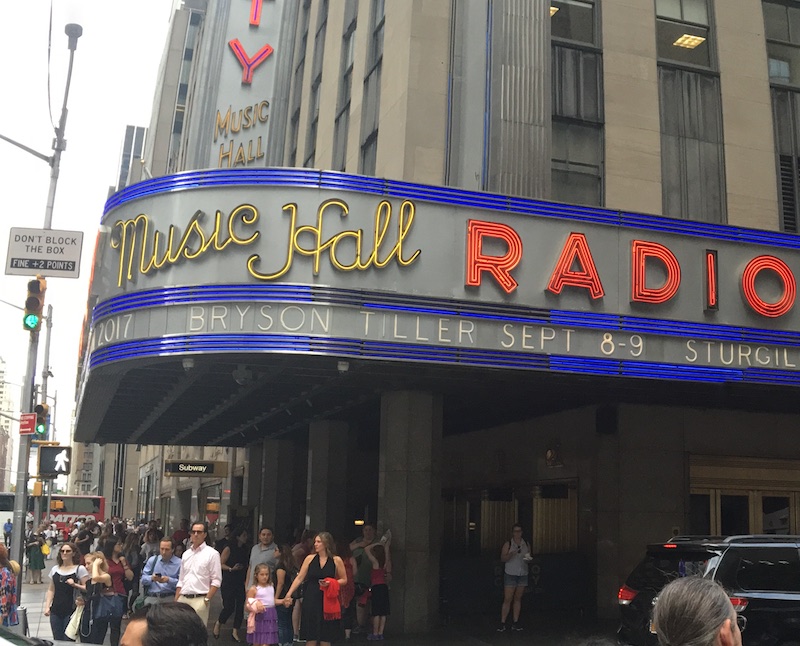
MASK
1) Form of theatre where actors faces are covered with masks.Â
2) Early word for GOBO.
MASKING
Neutral material or designed scenery which defines the performance area and conceals the technical areas. (e.g. a masking flat is designed to block the audiences view of backstage).
German Masking consists of 3 sets of flats or drapes lining the edges of the performance space (ie the 2 sides at 90° to the proscenium arch, and the rear of the space masked parallel to the pros. opening.) This type of masking is sometimes known as "Up and Down Masking" as it runs up- and down-stage. This term seems to be rarely used now.
French: Pendrillonnage à l’allemande
Italian Masking consists of a set of legs and borders which are set up in a configuration similar to forced perspective. The downstage legs are furthest apart, and each set of legs moving upstage is moved onstage, with the upstage set narrowest. The exact distances involved vary according to the size of the space, and the acting area required. The same applies to the borders.
Italian:Â quintatura
MASKING FLAT
A piece of solid scenery used to prevent audiences seeing backstage (or unwanted) areas. See also BORDER, MASKING.
MASKING TAPE
Paper sticky tape used to mark out the boundary of a surface to be painted or sprayed.
MASTER
1) An overall control fader or lever on a lighting or sound control board. The Grand Master takes precedence over all other controls and allows the operator to fade out the entire output of the lighting desk.
On a lighting desk the PRESET MASTER allows the control of a section of the desk independently from the rest.Â
See also SUBMASTER.Â
2) An original (e.g. Master tape, master plan) which should be used only to make a copy from which to work.Â
3) A Department Head (e.g. Master Carpenter, Master Electrician).
MASTER ELECTRICIAN
See CHIEF ELECTRICIAN.
MATINÉE / MATINEE
Afternoon performance of a show. (From the Latin for 'of the morning', but who does theatre in the morning?)
MATRIX OUTPUT
Set of outputs on a mixing desk which allows the user to preset a number of output configurations. eg on a 8 x 8 matrix, each of the 8 group outputs from the channels can be routed to any or all of the matrix outputs.
MAXIMUM OCCUPANCY
The number of people that can be in a given room at any time. This is determined by the fire department, or a fire officer, making use of local regulations about the amount of space required for each person, and by the number of fire exits (and the size of exit walkways) and the number of toilets etc available.Â
Obviously, the number must not be exceeded, as if there is an incident or accident, the insurance cover for the event / building may not be valid.Â
MAXXYZ
Moving Light console produced by Martin.
Martin website
MBI
Metal Halide discharge lamp. See also DISCHARGE LAMP.
MCB
Minature Circuit Breaker. Up to 63A (UK).
A resettable fuse, which trips to cut the flow of electrical current when too much current is detected. This may happen due to an electrical fault in a particular piece of equipment, or may be due to a lamp blowing (the bright white flash when a lamp blows is caused by a short-circuit across the lamp contacts, which draws a large amount of current briefly, until the MCB trips).Â
See also FUSE.
MCC
(Automation) Motor Control Cabinet / CENTER. The equipment containing the drivers and controller hardware for automation motors.Â
MCCB
Moulded Case Circuit Breaker (over 63A - UK). See FUSE.
MD
1) See MUSICAL DIRECTOR.
2) Mini Disc. See DIGITAL RECORDING.
MDF / M.D.F.
Medium Density Fibreboard. Dust masks must be used when cutting MDF, as the resins used for binding the board can be dangerous.
MEATRACK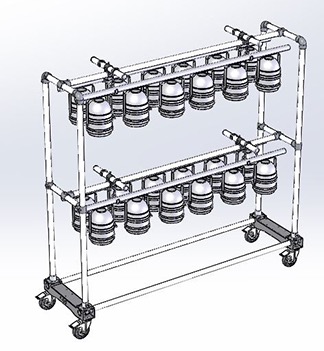
MECHANE
(Greek) Crane that lifted the DEUS EX MACHINA above the Greek stage.
MELODRAMA
A Melodrama is a dramatic work that exaggerates plot and/or characters in order to appeal to the emotions. It is usually based around having the same character traits, (for example, a hero, who is fearless and who the audience is rooting for, the heroine, who is usually in peril of some kind, which the hero rescues her from; the villain (usually likes the heroine too) and villain's sidekick (typically gets in the way of or annoys the villain).
The term is also used in scholarly and historical musical contexts to refer to dramas of the 18th and 19th centuries in which orchestral music or song was used to accompany the action.Â
MEMORY BOARD
A lighting control which enables recording and subsequent 'playback' of lighting states.Â
Now commonplace, and in some cases rendered unnecessary as lighting control moves to standard laptops running software such as ETC's EOS.Â
METATHEATRE
This term, coined by Lionel Abel, has entered into common critical usage; however, there is still much uncertainty over its proper definition and what dramatic techniques might be included in its scope. Abel described metatheatre as reflecting comedy and tragedy, at the same time, where the audience can laugh at the protagonist while feeling empathetic simultaneously.
Wikipedia entry
METHOD ACTING
Method Acting is any of a family of techniques used by actors to create in themselves the thoughts and emotions of their characters, so as to develop lifelike performances. Though not all Method actors use the same approach, the "method" in Method acting usually refers to the practice, influenced by Constantin Stanislavski and created by Lee Strasberg, in which actors draw upon their own emotions and memories in their portrayals (known as Emotional Recall), aided by a set of exercises and practices including sense memory and affective memory.
MEZZANINE
Architecturally, a mezzanine is a raised floor supported by columns. In a theatre, it refers to the balcony seating area (or the lowest of the balconies in a larger theatre).Â
MIC
(pronounced 'Mike') Abbreviation for microphone.
MIC LEVEL SIGNAL
Low level audio signal produced by circuitry in microphone. Needs boosting either by a pre-amp or a mixing desk before it can be amplified. Susceptible to interference over long cable runs.
MIC PLOT
A chart showing which character / actor uses which radio microphone throughout the show.
Vertically down the page are the scenes, musical numbers etc.Â
Across the page are the numbered microphones.Â
This enables the sound operator to instantly see who is using each microphone at every point during the show.Â
MICROPHONE
A transducer which converts analogue sound vibrations into an electrical signal which can then be amplified or recorded onto tape. Signals from a microphone are very low level and are amplified in the mixing desk to line level.
There are many different types of microphone, each designed for a specific purpose.Â
They can broadly be divided into three groups:
1) General Use - designed to be placed in front of and relatively close to a sound source, used for vocals and instrument mic-ing.Â
2) Directional - also known as shotgun microphone - picks up from a longer distance away from the source
3) Body-worn - small size, consisting of a microphone head and a separate electronics pack.
General use and body-worn mics are available in wired or wireless (radio) versions.Â
See Dynamic Mic, Condenser Mic, Phantom Power, Pick-up, Radio Mic.
MICROPHONE CAPSULE
An interchangable microphone head that fits onto a pre-amplifier. Many capsule types are available, all of which fit the same pre-amplifier.
MIDI
Musical Instrument Digital Interface. Control system established in 1983 for linking musical instruments or other electronic equipment and computers together and storing the control signals the equipment produces for subsequent playback.
See MSC, MMC, SYSTEM EXCLUSIVE.
MIDS
The middle lantern on a lighting boom. See SHINS and HEADS.
MILLINER
Person who makes / builds / constructs hats or headpieces.Â
MIME
Form of performance with no spoken words. Plot, character etc. are conveyed to the audience by movement and gesture. From the Greek Mimos.
See also Physical Theatre.Â
Marcel Marceau Foundation for the Advancement of the Art of Mime
Mummenschanz
MIMIC
The VDU associated with most medium and large lighting desks has a detailed mimic of the level of all dimmers and other associated information.
MINI DISC
See DIGITAL RECORDING.
MINI-DV / MINI DV
High quality domestic camcorder digital video format. See also DV.
MINIJACK
Also known as a 3.5mm jack, this is found as a headphone outlet on many pieces of personal audio equipment or laptops. A minijack to twin-phono cable is used to connect from a laptop, phone or MP3 player into a sound system or mixing desk that has phono ('pin plug') input connections.Â
MINIM
(Trade Name) Range of 300W lanterns produced by Rank Strand (now Strand Lighting) in the UK.
Strand Lighting website
Strand Archive
MINUETTE
(Trade Name) Range of 500W/650W lanterns produced by CCT in the UK.
CCT Lighting website
MIRACLE PLAY
a medieval dramatic form dealing with religious subjects such as Biblical stories orsaints' lives, usually presented in a series or cycle by the craft guilds. Read more.
MIRRORBALL
Large plastic sphere covered in a mosaic of small mirrors, which reflect light outwards, to cover the area with bright dots of light. Usually suspended by a rotator (an electric motor which turns the ball). Can be very effective when lit by pinspots, or more commonly now, intense moving light beams.Â
MIRRORING
1) Drama exercise involving two performers facing one another, either side of an imaginary mirror line. One tries to exactly duplicate the movements of the other, as if they were a reflection of that person in a mirror.
2) (AV/IT) Function on a laptop computer where the built-in display output is duplicated on the projector output. Turning off mirroring enables software such as Qlab to display a cue list / controls on the laptop display while the projector output shows the media (still images, videos or live cameras) required for the show.Â
MISE EN SCÉNE
Although the term literally "placing on stage" in French, the Mise en Scene refers to much more than the setting of a performance or event. The term describes all of the visual aspects of a setting - props, lighting, costume as well as set design, and how the details can contribute to the telling of the story.
MIXDOWN
The process during which a multitrack recording is balanced and transferred to two tracks (stereo) for playback or reproduction.
MIXER
A desk comprising a number of input channels where each sound source is provided with its own control channel through which sound signals are routed into two or more outputs. Many mixing desks can also change the quality of the sound (see EQUALISATION).
A Powered Mixer has an amplifier built into it. Sound sources of varying levels are accepted which can be amplified if necessary.
Also known as a Sound Desk or Sound Board. (See Line Level, Gain).
ML
Short for MOVING LIGHTS.
MMA - MIDI Manufacturers Association
(From the MMA website) The MIDI Manufacturers Association (MMA) is the publisher and authoritative source of MIDI specifications. Manufacturers achieve interoperability through compliance with MMA Recommended Practices. We provide forums for developers to coordinate changes to the MIDI specification, which today remains one of the most relevant standards in the entertainment industry.Â
MMA website
MMC
MIDI Machine Control. A variation of the MIDI language designed for controlling mechanical equipment (eg Tape Players).
MOBILE ELEVATED WORK PLATFORM (MEWP)
(often abbreviated to MEWP) A piece of access platform with a wheeled base, which can sometimes be self-propelled by the operator. The best known manufacturer is GENIE.
MODEL
A scale model provided by the set designer to help all the technical departments to co-ordinate and plan a production. Used as a reference when building, painting, dressing and lighting the set. The first stage of model-making is the WHITE CARD model which shows the form of the set, but not the detail of painting / texture / COLOR. When that's been approved by the director, and has been roughly budgeted, the final model is produced which should look identical to the finished set on stage. This is used as a reference by scenic artists and lighting designer etc.
Italian: Bozzetto
Making White Card Models
MODELBOX
1) A wooden box representing the walls of a theatre space in which cardboard scale models can be placed by the set designer. See also MODEL.
2) UK-based CAD in Theatre specialist. Lighting symbols for CAD programs are available as a free download.Â
Modelbox website
MODERNISM
Predominantly European artistic and philosophical movement that arose due to changes in society and industry in the late 19th and early 20th centuries. The movement is also seen as a reaction against the horrors of World War 1. Characterised by a rejection of 'traditional' artistic forms; gave rise to abtract art, atonal music, stream-of-consciousness writing etc.
Initially modernist theatre was an attempt to employ naturalistic principles, as advocated by Emile Zola in the 1880s. However, a simultaneous reaction against naturalism attempted to integrate poety, painting, music and dance in a harmonious fusion.Â
MOGUL BASE*
A type of lamp base. More information coming soon?
MOL
Abbreviation for Maximum Overall Length. This measurement (in mm) is the length between the ceramic lamp bases at each end of a double ended (linear) lamp, such as that used in floods and some discharge lamps.
See also LCL.
MOLEFAY
(Trade Name) Multi-lamp flood lantern made by Mole Richardson, used for washing large areas of stage with COLOR, or as an audience 'blinder' for a concert. Sometimes fitted with COLOR scrollers for maximum flexibility. One option consists of 8 x PAR 36 ACL (AirCraft Landing) lamps, but there are many different configurations.Â
The instrument is named after Mole Richardson and the FAY lamp type, produced by General Electric. The FAY is 650W 120V with a frosted front lens.Â
Molefay in the Backstage Heritage Collection
MOLTON
Also known by the trade name DUVETYNE, Molton is a medium-weight cotton fabric which is opaque, absorbent and has a brushed finish on both sides, making it a cheap substitute for wool. Can be fire-treated, but is not inherently fire retardant. Available in many colors from theatrical / scenic suppliers.
MONITOR
1) An onstage speaker which allows a performer to hear the output of the PA system, or other members of a band.Â
2) A video display screen (not normally able to receive broadcast TV pictures) used with a CCTV system or a computer.
MONKEY POLE
A stick threaded at one end with the line used to cleat two adjacent flats together, enabling the flats to be quickly and silently joined or separated. The stick remains attached to the line and flat of which it forms part.
MONOLOGUE
A speech within a play delivered by a single actor alone on stage. See also SOLILOQUY, DUOLOGUE, DIALOGUE.
MONOPHONIC (MONO)
Single channel sound recording, as opposed to STEREOPHONIC, which uses two channels (left and right).
MONOPLANE
(Lighting) Describes a filament inside a lamp between two terminals, meaning the filament is in a single line (or a single plane).Â
MOON BOX
Lighting effect. A large shallow circular box with calico cloth on one face and low wattage lamps arranged on the back. Can be flown behind a gauze or thin cyclorama to give the effect of the moon rising.
MORALITY PLAY
An allegorical performance in whcih the protagonist is met by personifications of various moral attributes who try to prompt him to choose a godly life over one of evil. Popular in Europe during the 15th and 16th centuries.
Wikipedia entry
MOTIF
A motif is any recurring element that has symbolic significance in a story. One example is the flute sound in Arthur Miller's Death of a Salesman.
MOTION CAPTURE
A technique from the film special effects and video game industry which enables a video artist or choreographer to 'capture' the movements of an actor or dancer digitally so that those movements can be reproduced by a virtual actor or dancer that's been computer-generated.
DanceTech Motion Capture page
MOTIVATED SOUND
A sound effect that is called for in the script of the play, or is motivated by the actions of a character. Examples include an actor switching on a radio to hear an announcement, an actor running a bath offstage, or a car pulling up outside the house.Â
See also: ENVIRONMENTAL SOUND
MOTIVATION
Part of METHOD ACTING, influenced by Stanislavski and created by Lee Strasberg. Strasberg uses the question, "What would motivate me, the actor, to behave in the way the character does?" Strasberg asks the actor to replace the play's circumstances with his or her own, the substitution.
MOTOR
Generic term for an electric chain hoist. (Rumoured to have been started by an enquiry as to whether 'CM' stood for 'chain motor').
Submitted by Chris Higgs
MOTOR-UP
Term used when a self climbing motor is rigged conventionally, i.e motor up. Motor down is sometimes used to convey the opposite, but in general it is understood that all motors 'climb'.
Submitted by Chris Higgs
MOUSE
Moving part of a scenic automation system. Mice run on cables under the stage floor, and can be made useful by inserting a metal SPADE through a wheeled piece of scenery into the mouse, which then pushes or pulls the scenery with it. The scenery sometimes has additional guide pins which move in guide tracks which allow the scenic piece to move in more complex directions.
MOUSING
Mousing a shackle when rigging means using wire or a cable tie / zip tie to hold the shackle pin in place to stop it working loose. (NB the mousing device is not load bearing, it's only holding the pin in place).Â
MOVING HEAD / MOVING LIGHT /Â MOVING MIRROR
Remotely controllable "intelligent" lighting instrument. Each instrument is capable of a massive variety of effects which are operated live via a moving light control desk, or can be pre-programmed by a standard memory lighting desk. The instruments require a power supply and a data cable (normally carrying DMX512 signal from the control desk).
There are broadly two types:
1)Â Moving Head: A luminaire is mounted on a moving yoke.
2)Â Moving Mirror: A stationary luminaire directs light onto a motorized mirror.
Both types have in common:
- A discharge (non-dimmable) light source
- A dimming shutter
- Motorized rotating COLOR wheels. Some offer COLOR mixing using graduated red, green and blue wheels or prisms.
- Profile versions have motorized gobo wheels with rotation.
- Strobing effects and adjustable iris. Some also have shutters.
The term "intelligent" is used as the instrument has a processor chip and electronics built into it, not because it's able to interpret the designer's artistic intent! It can be incredibly frustrating trying to get moving lights to behave exactly as required in a dramatic situation. Musicals and live music performances are more forgiving.
Moving Head lanterns are sometimes known as NODDING BUCKETS, Moving Mirrors are sometimes known as WIGGLIES or SCANNERS.
MP3
Compressed audio file format, short for MPEG-1 Audio Layer 3. Enables 'good enough' audio quality when moving music around on portable devices. However, MP3 compression can sound awful through a theatre PA system, so ensure you are always using the best uncompressed version of music and sound effects tracks for a show.
The technological standard was agreed in 1991, and MP3s became widely used by the public in 1993.Â
MP4
MP4 is a multimedia container format, which can store video, audio or still images.
See also MP3 (audio only)
What is MP4?
MR SANDS
Often used as a code word for fire or emergency over a public address system (e.g. 'Mr Sands is in the foyer' means there's a fire/emergency in the foyer). Many theatres and companies have their own code words. At Iconic we use the Mr Sands term.
MR16
A 12 Volt lamp dichroic lamp commonly used in place of a Par 16 lamp in BIRDIES. See BIRDIE.
MS
MS stands for Mid and Side. It involves the use of two different types of microphone capsule - a cardioid for the M and a figure-eight for the S. The biggest advantage is that CENTER sounds are not 45 degrees off-axis as with XY, because the Mid capsule points along the CENTER-line. This means that there isn't so much of a 'hole' in the CENTER of the stereo image. The Side capsule is placed at right angles to the M capsule. The M is connected to a mixer channel. The S is split into two and connected to two mixer inputs. The M is panned CENTER. One of the S inputs must be phase-inverted. Find out which is the left and which is the right and pan hard left and hard right respectively. If set correctly, there will be no noise if the M is switched off because the two S channels cancel each other. Originally, there were problems with reflections and due to the use of two different capsules, although single-point MS mics have been developed which overcome the problem quite effectively.
MSC
MIDI Show Control. A control language which is an extended version of the original MIDI language. In addition to a 'go' command, cue numbers and other information can be sent as well (in addition to fault reports and safety checks).
MSD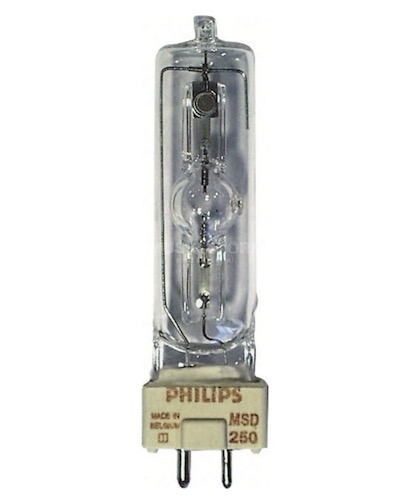
MSDS
Material Safety Data Sheet. Form available from manufacturers of, for example, smoke fluids. Lists any hazardous ingredients and other safety-related data about the product.
MSR
(Medium Source Rare earth) High efficiency discharge lamp with a high COLOR temperature (approx 5600°K). Provides around 50% more light output than a incandescent lamp of the same wattage.
MT
Abbreviation for Musical Theatre.
MULTI / MULTICORE /Â MULTIPAIR CABLE
A flexible electrical cable composed of several well-insulated cores covered in a strong PVC or rubber covering. Enables a number of different circuits to be carried down one piece of cable. Both lighting and sound multicores are available. Sometimes known as a Multi or Snake.
MULTIPLEXED (MUX) SIGNAL
All modern lighting desks use this serial form of communication with dimmers and other equipment. Information from the desk is transmitted along a single pair of cables in sequence to the dimmer where a de-multiplexing unit (demux box) decodes the string of data and passes the correct piece of information to the correct dimmer.
The industry standard protocol (language/standard) for multiplexing is the digital USITT DMX512 (introduced in 1986, based on RS485 data protocol, and often shortened to DMX or DMX512). However, new protocols are continually being added to keep up with more demanding equipment.
Although the standard connector for DMX512 is a 5 pin XLR, as the system only uses 3 connections, a great deal of equipment uses the more common 3 pin XLR. Care should be taken when using standard microphone cables to connect devices using DMX512, as the cable is usually less capable of accurately transmitting the digital data than a more expensive DMX512 cable. Short runs with microphone cable are acceptable.
As the basic DMX512 standard is one-directional, there should be a DMX terminator at the end of the DMX run to absorb the data signals and stop them being 'reflected' back down the cable and causing communications errors and other problems. Â
SMX is a communications protocol which enables digital dimmers to "report back" to the desk on any faults (eg blown lamps).
RDM (Remote Device Management) is an emerging upgrade to DMX512 which will include bi-directional communication between controller and device.
DMX512-A (officially ANSI E1.11) is a new standard under development at ESTA which is backwards compatible with DMX512 but has stricter safety parameters and offers some upgrades of functionality.
Among the older protocols (pre DMX512) are D54 which uses a stream of analogue voltage levels and was the Strand standard, and AMX 192 (US Standard, introduced around 1975) which can control up to 192 channels and uses a 4-pin XLR connector. (AMX stands for Analogue Multiplex).
See also UNIVERSE.
MUMMERS PLAY /Â MYSTERY PLAY
a traditional English folk play, of a type often associated with Christmas and popular in the 18th and early 19th centuries. The plot typically features Saint George and involves the miraculous resurrection of a character. Read more.
MUSIC HALL
A type of British theatrical entertainment popular between 1850 and 1960. It involved a mixture of popular song, comedy, speciality acts and variety entertainment. The term is derived from a type of theatre or venue in which such entertainment took place. British music hall was similar to American vaudeville, featuring rousing songs and comic acts, while in the United Kingdom the term vaudeville referred to more working-class types of entertainment that would have been termed burlesque in America.
MUSICAL DIRECTOR
Often the conductor/leader of a musical, or the person responsible for the musical content of a production. Also known as the MD.
MUSICIAN
Member of the company who plays a musical instrument.Â
MUSIQUE CONCRETE
(French) Music made from found sounds, originated in France & Germany in the 1940s & 50s (when audio tape came into prominence as a recording and editing medium) and was the basis of the groundbreaking work done by the BBC Radiophonic Workshop in the 1960s and 70s.Â
MUSLIN
A lightweight cotton cloth in a plain weave.
MYTH
A traditional story, which may define how a particular civilisation came into being, or a tale with a clearly defined moral code designed for social education. Myths often involve supernatural beings and may be enhanced accounts of historial events, or as an allegory for or personification of natural phenomena, or as an explanation of a ritual.Â
NAB
National American Broadcast. Standard for tape recording equalisation characteristics.
NAGRA
A portable audio reel-to-reel tape recorder, manufactured by Kudelski in Switzerland. The analogue Nagra was the industry standard for radio & TV reporters and for film location sound. The company now manufacture digital recorders to the same rugged build quality.
Nagra website
NARRATOR
The Narrator of a piece of theatre is a performer who speaks directly to the audience to tell them part of the story, to give additional information, or to comment on the scene or the behaviour of characters. The Narrator may be a single actor throughout, or there may be a number of narrators who share the role during the performance, whilst also playing other parts.Â
NATURALISM
1)Â Lighting Design:Â A naturalistic approach to lighting design requires lanterns to be placed in ways that duplicate where the light would come from in nature. For example, a sunny day outdoor scene would be lit primarily from above the acting area, with fill lighting in from the sides as if from the cloud. A dark room would be lit by moonlight through a window, and the light level would increase when a door is opened from a lit corridor or when a light fitting is turned on.
2)Â Performance:Â A naturalistic performance (following the techniques of Stanislavski) requires that the actor completely understands and inhabits every aspect of the characters' life, as well as the motivation and lines that are to be spoken.Â
3)Â Scenic Design:Â The set designer aims to reproduce reality as closely as possible.
NAUMACHIA
In the Ancient Roman world, this was a spectacular performance to re-enact a naval battle, or the basin or complex in which such performances took place.Â
NC / N.C. / N/C
1) (US) No Color (US equivalent of UK's OPEN WHITE).
2) Not Connected (in a circuit diagram).
NDFR (Non-Durably Flame Retardant)
A description of cloth which has been treated to be flame retardant, but will need to be re-treated after the cloth is washed. See manufacturer for full details. See also DFR and IFR.
NEON
1) A type of discharge lighting generated by a high voltage across two oppositely charged electrodes at opposite ends of a long, thin glass tube filled with neon gas. As the electrical charge flows between the electrodes, electrons collide with neon atoms causing them to give off energy in the form of visible light. Different colors can be obtained by mixing other gases, or by using fluorescent coatings. Mostly used for advertising signs - the glass tube is bent to form letters.Â
2) A small mains voltage indicator lamp.
NEUTRAL DENSITY FILTER
(ND) Lighting filter which reduces the brightness/intensity of a light source without changing its COLOR value. Used extensively in TV/film for reducing the intensity of discharge lamps or natural light sources (e.g. windows). Rarely used in theatre as dimmers fulfil a similar function (although as incandescent lamps are dimmed, the COLOR temperature gets warmer).
NICAM
A digital system used in British television to provide video signals with high-quality stereo sound.
The term is an acronym for Near Instantaneous Companded Audio Multiplex. Developed in the 1970s in the UK, it was used in the 1980s as the method of compressing stereo audio to transmit it to the public. A NICAM video recorder (or a NICAM TV set) could reproduce good quality stereo sound.Â
NIETHAMMER
(Manufacturer) Brand of zoom profiles & followspots with halogen or HMI lamps. Very popular in Europe. Named after Emil Niethammer.
ADB website
Submitted by Andre Broucke
NLE
Acronym for Non-Linear Editor. This is audio, video or image editing software in which the original content is not altered in the editing process.Â
NODA
UK National Operatic and Dramatic Association, for amateur theatre producers, performers and crew.
NODA website
NODE
The connection between structural members in a construction (from Latin, a knot).
Submitted by Chris Higgs
NOISE BOY
(Colloquial term) Theatre or concert sound engineer. Sometimes male, but not exclusively so! Also known as a Hum Head. See also Techie and Lampy.
NOISE GATE
A piece of sound processing equipment that reduces background noise by muting a sound signal when it falls below a certain level, restoring it when the level increases again. Must be used on vocal microphones with care, because it may cut the signal off, although the vocalist is still singing quietly. Also known as an Expander.
NOISES OFF
Stage direction to indicate a clatter / bang offstage to which the cast should react. The type of noise should be indicated by the surrounding action!Â
Also, a farce by British playwright Michael Frayn about life backstage, featuring a large interval set change.
NON DIMS
Channels, usually controlled from the lighting desk which are switched, rather than dimmed. This enables motors, slide projectors, smoke machines etc to be controlled from the lighting desk.
NON-VERBAL
Literally, anything involving communication or expression without words. PHYSICAL THEATRE and DANCE are examples of types of theatre which can be non-verbal.Â
NORMALLING*
Normalling refers to a specific wiring pattern (within a patchbay) that creates a path from one piece of equipment to another without the use of a patchcord. Patchbays include vertical sets of jacks that are mounted in a panel.
NOSE PUTTY
A mouldable material (often made from wax) that can be used to change the shape of an actors' nose as part of a character make-up.Â
Kryolan Nose Putty
NOTES
Following a rehearsal (or an early performance in a run) the director will give notes to the cast and crew about where to make changes, improvements, cuts etc.
NPU
Network Processing Unit used with grandMA lighting systems. Interfaces between ethernet from grandMA desk(s) and DMX-controlled devices.
NRAG
(UK) National Rigging Advisory Group
NRAG website
NTSC
North American Television Standards Committee. TV standard in the USA.
More about TV standards
NUMBER ONE TOUR
A tour (of a show) that is booked into the best venues available in each area.
O.P.
OBIE LIGHT
Compact light fitting designed to mount just above (or just beside) a film/stills camera lens for two reasons: firstly to create a characteristic glint in the eye of the subject of the photograph/film (it's known as the Eye Light), secondly to flatten out any lines/wrinkles in the face of the subject. The Obie Light is named after the actress Merle Oberon (known to friends as 'Obie'). It was first used by her husband, cinematographer Lucien Ballard, in the 1940s to make lines and shadows disappear from her face which were due to scarring following a car accident.
The Obie Light is normally heavily diffused.
Mole Richardson Obie Light in the Backstage Heritage Collection archive
OBSTACLE
In acting terms, an obstacle is something which prevents a character from achieving her/his objective within the play.Â
OFF BOOK
An actor who no longer needs to refer to his/her script during a rehearsal is said to be 'off book'. Directors and stage managers will often set a deadline for performers to be off book, and actors are expected to learn their lines in good time.
OFF BROADWAY
Originally referring to the location of a venue and its productions on a street intersecting Broadway in Manhattan's Theatre District, the hub of the theatre industry in the United States, the term later became defined by the League of Off-Broadway Theatres and Producers as a professional venue in New York City with a seating capacity between 100 and 499, or a specific production that appears in such a venue, and which adheres to related trade union and other contracts. It includes several nonprofit theaters and more than 100 commercial employers. Actors and members of crew in all Off-Broadway theatres are paid. There are no amateur theatres called 'Off-Broadway'.
See also Off-Off Broadway, Equity Showcase
Off Broadway Payments To Actors
OFF-OFF BROADWAY
An Off-Off Broadway theatre has less than 100 seats.Â
OFFLINE EDITING
Offline editing is part of the post-production process of filmmaking and television production in which raw footage is copied and the copy only is then edited, thereby not affecting the camera original film stock or video tape. Read more.
OFFSTAGE
1) A movement towards the nearest side of the stage from the CENTER. (e.g. 'Focus that spot offstage a bit please')
2) The area out of sight of the audience (e.g. 'Get that donkey offstage !')
OG
1) Abbreviation used by the Phantom in The Phantom of the Opera, when he writes letters to the theatre managers. Short for Opera Ghost.
2) Urban slang 'Original Gangster' or 'Old Git' (from Internetslang.com), meaning a product which is now past its' prime, or was one of the first of its' type.Â
OHM
The unit of electrical resistance.
OHM'S LAW
Current is equal to voltage divided by resistance. Law of physics published by Georg Ohm in 1826.Â
OISTAT
International Organisation of Theatre Scenographers, Technicians and Architects.
OISTAT website
OLEO DROP
A way of rigging a cloth / backdrop with no flying space. The cloth is attached to a flying bar at the top, and to a roller at the bottom. Operating lines around the roller allow the cloth to be rolled up as the roller is lifted up, so that it reveals whatever is behind it.
Also known as a ROLL DROP.Â
OLIO
1) (from Spain / Portugal - ollo a spicy stew consisting of different meats and vegetables)
A collection of different acts (e.g. comedy, songs, dance, puppetry), or an act which isn't part of the main show, inserted to fill a gap, to cover a scene change or as an encore after a dramatic play. Example usage: 'The event was an olio of poetry, dance and songs'.
2) [to be confirmed] An act performed in front of the front curtain, made of oil (olio) cloth, on which there were often painted ads for local businesses.Â
OLIVETTE
[obsolete term] Lighting instrument using an incandescent lamp (usually mogul screw-base, 1000W). The lamp was usually mounted base-up, facing a large opening (the size of a full sheet of gel). Now used as a cyc flood, the instrument was originally designed for projecting painted glass images onto cycs. See also LINNEBACH PROJECTOR.
Submitted by Audrey Glickman
OMNIDIRECTIONAL
receiving signals from or transmitting in all directions - especially with microphones. See PICK-UP.
ON THE BOOK
1) An actor who needs to refer to the script during a scene is said to be "on book". The ideal situation is for the actor to be "off book" as quickly as possible!.
2) See PROMPT BOOK.
ONKOS
(Greek) Section above the face of a mask rising to the top of the head.
ONSTAGE
1) A movement towards the CENTER of the stage from the sides. The opposite of OFFSTAGE. There is no abbreviation for onstage (as it is too easily confused with offstage).
2) The act of being on the stage (e.g. 'he joined her onstage for the finale')
OPEN
The start of the run of a show in a venue. (e.g. 'When does the new musical open at the Variety Theatre?' or 'The show opened a few weeks ago - it's had some great reviews'.)
OPEN POSITION
An actor position where she/he is facing towards the audience, or mostly facing the audience.
See also CLOSED POSITION.Â
OPEN THE HOUSE
Clearance given to FOH staff by stage management that the stage is set and the audience can begin to take their seats. When this clearance is given, the backstage call 'The House is now open, please do not cross the stage' is made.
OPEN WHITE
(o/w) Lighting with no COLOR filter. Known in the US as NC (no color).
OPENING NIGHT
The first performance of a show in front of a paying audience.Â
Some new complex shows may have lower priced Preview performances before an official opening night, to allow the show to get up to speed and deal with any technical issues. The press is not allowed to review a show during previews, and are invited to the first official performance, which is then known as Press Night.Â
OPENSTAGES
Powerful visualisation software for students and scenic designers. Doesn't have the engineering accuracy of Autocad or the lighting simulation of WYSIWYG but is much more geared towards theatre, and is much easier to learn.
Openstages website
OPERA
1) European terminology meaning Opera House - lavishly decorated proscenium theatre with orchestra pit. See TOSCA.
2) Musical form. Highly dramatic and stylised form where the text is completely sung.
OPERATING SIDE
The side of the stage (either stage right or stage left) where the fly lines are operated from.
ORCHESTRA
1) In Greek Theatres, the central performance area used by the Chorus or for dancing.
2) Refers to the main seating area of the auditorium at floor level.
3) Colloquially known as 'the band' the musicians who perform from the orchestra PIT.
ORCHESTRA PIT
See PIT.
OSB
Short for Oriented Strand Board, also known as Aspenite or Flakeboard. A type of engineered sheet timber / lumber similar to particle board, formed by adding adhesives then compressing layers of wood strands (flakes) in specific orientations (from Wikipedia).
OSD / O.S.D.
Acronym for On Screen Display. Information superimposed onto a video image (e.g. a PLAY icon or time remaining on a DVD, or a timecode on a video camera display)
OSHA
(USA) Occupational Safety and Health Administration.
Set up by Congress following the Occupational Safety and Health Act in 1970 'to assure safe and healthful working conditions for working men and women by setting and enforcing standards and by providing training, outreach, education and assistance.'
Equivalent to the Health & Safety Executive in the UK.Â
OSHA Website
OUT
In flying, means up (out of sight).
OUTRIGGER
An extendible leg to increase the stability of access equipment (eg Tallescope, Scaffold tower).
OUTSIDE EYE
A person brought into a production process to give a fresh opinion on the work so far, to advise the director on how it's looking from an outside perspective.Â
OVERHEADS
1) Microphones positioned above a drum kit to pick up the cymbals etc. without getting hit.
2) Microphones positioned over the stage to pick up the overall sound of the concert / production.
OVERLAY
(Followspot term) The wider of two followspot beams covering the same performer.
(i.e. lamp one in a pink 'bust' (head-to-shoulder) and lamp two in a blue full-body overlay (head-to-toe).
Submitted by Bert Morris.
OVERTURE
Introductory musical piece played before a musical which contains many of the musical motifs and themes of the score.
P2
Lighting Industry Forum code which identifies the (original) recommended usage of different lamp types. P2 coded lamps are photofloods, and have a COLOR temperature of 3000°K. See also PHOTOFLOOD, CP, A1, T, K.
PA SYSTEM
Short for Public Address System.
PACE
The speed at which actors deliver their lines and perform their actions. A speed run can be useful to warm-up actors and to really make sure everyone is on form. The pacing of the show can have a real effect on how the audience react to it - it's a very tricky thing to maintain, especially as everyone gets more familiar with the show.
A fast-paced scene takes energy and concentration, and can slow down as familiarity sets in, and a slow-paced scene may speed up. Directors often wish to cut down on unnecessary pauses and delays, but also to maintain the moments of silence between speeches when needed.
PACK
See RADIO MIC.
PAD
A switch on a mixing desk input channel which attenuates (reduces the level of) a signal. Used if a loud / high level signal is causing the desk to be overloaded.
PAGE
1) See PAGING.
2) Some theatre announcement systems use the term 'PAGE' to mean making a call (e.g. 'Can you page Simon to come to the fly floor')
3) A way of increasing the functionality of a control on a lighting desk. For example, most computerised lighting desks with SUBMASTERS will allow you to store more than one lighting state in each submaster. Each group of submasters is given a page number which is used to select which set you want to use. See also SUBMASTER.
PAGEANT
(Obsolete) Brand name of a 1000W beamlight made by Strand Electric in the UK. Produced a near parallel beam and had a set of spill rings on the front to minimise glare.
Archive - Pageant
PAGING
The act of holding a tab etc. back to allow large items or actors offstage. Also preventing microphone etc cables from getting entangled by pulling / releasing them from offstage as performer walks around.
PAINT FRAME
Large vertical wooden frame from which cloths are hung for painting. The frame is often winchable for easy access.
PAINTER'S ELEVATION
A detailed working drawing of the paint job needed on every scenic piece or prop for a production. Each item is shown to scale, front-on, so the required paint job can be clearly seen. Scenic Artists use the elevation as a layout and color guide.
PAIRING
Connecting more than one lantern to one power outlet via an adaptor or splitter, or more than one speaker to one amplifier channel.
PAL
Phase Alternate Line. TV standard in the UK and Europe.
More about TV standards
PAN
1) A control on a mixing desk which allows the operator to position the channel's output in the final stereo image (L - R).
2) A horizontal (side-side) movement of a camera or a moving light. Short for Panorama. See also TILT.
PANATROPE
Gramophone with built-in valve amplifier and speakers, used to play 78rpm discs for music and sound effects. Used in the late 1940s (and probably earlier) for playing sound effects on stage. More information coming soon.
PANCAKE
A water-activated make-up powder that is applied with a wet sponge. It's supplied as a flat, compacted powder in a circular plastic case with a lid .
PANSTICK
(Make-Up) Originally 'pancake stick'. An easily applied stick form of matt foundation, used as a base layer for theatrical make-up. See also PANCAKE.Â
PANTOMIME
1) A pantomime (often shortened to Panto) is a musical-comedy family-orientated theatrical production traditionally performed in United Kingdom, Australia, New Zealand, Canada, Zimbabwe, Jamaica, South Africa, India, Ireland, Gibraltar, and Malta, at Christmas-time. The panto often features slapstick or messy comedy routines, children dancing, recent songs, spectacular sets and COLORful costumes, and is often themed around a fairy story or nursery rhymes.
Popular pantos include Cinderella, Aladdin, Jack and the Beanstalk, Mother Goose, Sleeping Beauty, Snow White and the Seven Dwarfs, Dick Whittington and His Cat, Puss in Boots etc.
2) Pantomime is an ancient type of performance with no spoken words, often now shortened to 'Mime'.Â
Puss in Boots, December 2013, Hackney Empire - Audio Slideshow (The Guardian)
PAPER TECH
See TECHNICAL REHEARSAL.
PAPER THE HOUSE
Marketing technique. Giving away tickets to a performance (eg Opening Night) to make a show seem to be selling better than it actually is, and to start generating 'word of mouth' interest.
PAR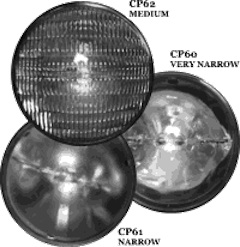
The most common for theatre use are Par 64s rated at 1000W (1kW), although other wattages are available.
When the lamp was first introduced, in the 1960s, it was only available from the USA in 110V versions. In the UK, Parcans were always used in pairs, via a series splitter. 110V Par lamps are still sometimes used in large UK venues or for touring due to the increased light output. Because the current is greater, the lower voltage lamps have smaller thicker filaments which give a more focussed beam than the thinner 240V filaments.
In the film business, PAR lamps are known as 'bird's eyes' after the alleged inventor Clarence Birdseye.
PAR BAR
See SIX LAMP BAR.
PARABOLIC REFLECTOR
See PAR.
PARALLEL
1) The folding frame that forms the base of a readily portable platform.Â
2) The opposite of SERIES when referring to wiring two loads into one outlet. The two loads share the available current, but are both given the same voltage.
PARAMETRIC EQUALISER
Equalisation control where the range of frequencies to be boosted or cut can be selected. Allows the 'fine-tuning' of the equalisation.
PARAMETRIC SPEAKER
Highly directional speaker which produces a very narrow beam of sound using ultrasonic waves as carriers. When the ultrasonic waves collide with an object (or the listeners's head) the sound waves become audible to that person.
PARASKENE
(Greek) Towers at each side of the SKENE building.
PARCAN
Type of lantern which produces an intense beam of light, ideally suited to "punching" through strong colors, or for special effect. The Parcan is literally a cylinder of metal (the "can") within which sits the PAR lamp (PAR stands for Parabolic Aluminised Reflector) which consists of the bulb, a reflector and a lens in a sealed unit.
The PAR was originally available only as a 110V lamp, imported from the USA, where they were used as beam lights. The lamps were first introduced in the UK by concert hire company ESP in 1968 [Cue issue 1, page 14].
The Parcan was being widely used by the early 1970's in the Rock concert industry due to the intensity of the beam, and the light weight and near indestructibility of the lantern. The lens of the lamp is either clear (which produces a narrow beam), frosted (medium) or stippled (wide).
See also PAR and FLOORCAN.
Types of Lantern
Parcan Evolution and History
PARK
(ETC EOS Lighting Controls) The park instruction allows you to set a channel or parameter to a specific value and have it remain at that level on stage (live mode), prohibiting manual control override, cue or submaster playback modification.
To park channel 72 at zero, type 72 @ 0 PARK ENTER.
The standard keyboard shortcut for PARK is ALT+K.
PARKING AND BARKING
(US Colloquial) A choir or other choral group that stands on a stage ('parking') and sings traditional songs ('barking'). The term implies a disdain for this familiar style, but it's perfectly appropriate in many cases...
PARNEL
Brand name for a wash light manufactured by ETC. It's a cross between a soft-edged focussable Fresnel and a ETC Source Four PAR.
ETC website - PARnel
Types of lantern
PARODOS
Parodos (also parode and parodus, plural parodoi, Ancient Greek) is a term used in the theater of ancient Greece, referring either to a side-entrance, or to the first song sung by the chorus after its entrance from the side wings.
PARTERRE
(French: On the ground). Refers to the audience members in the pit / stalls / lowest part of the auditorium in front of the stage. Originally, the term was used in the 16th century to refer to a formal ornamental garden, but by the mid-17th century, it was increasingly used to refer both to the ground level of a theatre where spectators stood to watch performances and to the group of spectators who occupied that space.Â
Wikipedia entry
PASMA
UK trade association for the mobile access tower industry. The acronym stands for Prefabricated Access Suppliers’ & Manufacturers’ Association Ltd.
PASS DOOR
A fire-resisting door in the wall of the proscenium arch which is the only correct access between the auditorium and the stage.
PASSARELLE
A walkway leading beyond the proscenium arch around the audience side of the orchestra pit. Enables actors to get very close to the audience, and often used in musical theatre or cabaret performances. There are problems with sound reinforcement (feedback is much more likely due to being closer to the front of speakers) and video relays are often used as the conductor is no longer visible.
PASSERELLE means Footbridge or gangway in French.
PASSIVE
Opposite of ACTIVE. See ACTIVE.
PAT TEST
Short for Portable Appliance Test. Requirement under the UK Electricity At Work Regulations (1989) to test and inspect all portable electrical equipment. This includes stage lighting equipment (lanterns, cables, portable dimmer packs etc.).
PATCH /Â PATCH BAY
1) (verb) The act of plugging a lantern into a dimmer (e.g. 'Can you patch circuit 12 into dimmer 18 please').
2) (noun) The system for connecting lanterns to dimmers (The Patch).
The term also applies to sound - a PATCH BAY is used to connect outboard equipment into the sound desk and to connect sound desk outputs to amplifiers, and amplifiers to speakers.
PATCH PANEL
A board consisting of rows of sockets into which plugs can be connected to route sound signals or power for lighting circuits. Some American systems use a Pin Plug patching system. See also PATCH.
PATCHING
1) To cross-connect lighting circuits around the stage area to a chosen dimmer. Connecting lanterns to dimmers.
2) Using a cross-connect panel which enables any stage lighting channels to the control desk to control any dimmer or group of dimmers. Some large lighting boards have the facility for soft patching - a totally electronic way of patching. Some Rock Desks have a pin patch which allows groups of dimmers to be allocated to a particular control channel. Also applies to routing of sound signals.
PATTER SONG
A fast-paced rhyming song in an operetta or musical which uses wordplay and/or alliteration, and contains tongue-twisting lyrics. Examples include 'I Am The Very Model of A Modern Major General' in The Pirates of Penzance and 'Getting Married Today' from Company.Â
Wikipedia entry
PATTERN
1) See GOBO.
2) See PATTERN NUMBER.
PATTERN NUMBER
Many older Strand lanterns are identified by their Patt. number (eg Patt.23 is a 500W profile). The numbers bear no direct relation to their size or type (although lanterns of a similar design may have similar Pattern numbers.) See http://www.strandarchive.co.uk for a complete listing.
Strand Lanterns with Pattern Numbers - Backstage Heritage Collection
PC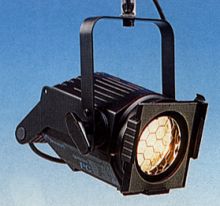
Types of lantern
PCC
Phase Coherent Cardoid. See BOUNDARY MICROPHONE.
PD's
(Abbreviation for Per Diem, Latin for Daily) A daily payment by an employer to touring technicians to cover daily living expenses. This is additional to the monthly / weekly wage.
PEACOCK
See SUPERSTITION.
PEARL
A domestic lamp which has a frosted finish to diffuse and soften the light.
PEAVEY
(Manufacturer) American manufacturer of amplifiers, sound processing equipment, and musical instruments.
Peavey website
PEBBLE SPOT
See PC.
Types of lantern
PELMET
A narrow strip of cloth or wood at the top of a door or window to hide the fittings. A PELMET CLIP can be used to fix a pelmet into place above a window on a piece of scenery.Â
PEPPER'S GHOST
Optical illusion effect used to make a ghost appear on stage next to an actor. A sheet of glass is hung across the front of the stage so that the image of an actor standing in the orchestra pit appears to float on stage. First shown at the Royal Polytechnic Institution in London by J.H.Pepper on Christmas Eve, 1862. Following many subsequent events, Charles Dickens used it during readings of The Haunted Man. Several plays were written specially to use the effect around 1863, but the long-term future of the effect was limited by the fact that the ghost couldn't speak. Peppers Ghost is now used to great effect in smaller scale applications like the Haunted Mansion in Disney theme parks.
More about Pepper's Ghost
PER DIEMS
See PDs.
PERCENT
Dimmer levels are expressed as a percentage of the supply voltage. (100% = 230 - 240 Volts(UK)).
PERCH
A lighting position (often on a platform) at each side of the stage, immediately behind the proscenium.
Some theatres use the term for vertical boom positions in front of the proscenium in the house.
The plural is PERCHES. They may be named by position (e.g. Front Perch, Rear Perch, SL Perch etc).Â
PERFORMANCE ART
An interdisciplinary performance presented to an audience. The performance may be either scripted or unscripted, random or carefully orchestrated; spontaneous or otherwise carefully planned with or without audience participation. The performance can be live or via media; the performer can be present or absent. It can be any situation that involves four basic elements: time, space, the performer's body, or presence in a medium, and a relationship between performer and audience. Performance art can happen anywhere, in any venue or setting and for any length of time. The actions of an individual or a group at a particular place and in a particular time constitute the work.
PERFORMER FLYING
A manual or electrically driven system for lifting performers off the stage and allowing spectacular stunts and aerial sequences to be performed.Â
PERIAKTOI
(Greek) Term for three-sided flats mounted on a rotating base. Used in rows to produce easily changed backings. Sometimes informally known as Tobelerones (or Tobes) due to the resemblance to the triangular shape of the chocolate bar.
PERIPETEIA
From Greek. A reversal of circumstances, or turning point.
The English form of peripeteia is peripety: a sudden reversal dependent on intellect and logic.
PERSONAL PROPS
Are props which are kept in an actors costume.
PFL
See PRE-FADE LISTEN.
PHANTASMAGORIA
A form of theatre which used a modified magic lantern to project frightening images such as skeletons, demons, and ghosts onto walls, smoke, or semi-transparent screens, frequently using rear projection. The projector was mobile, allowing the projected image to move and change size on the screen, and multiple projecting devices allowed for quick switching of different images. Invented in France in the late 18th century, it gained popularity through most of Europe (especially England) throughout the 19th century.
PHANTOM POWER
Some condenser microphones require a power supply in order to operate. If this supply is not from a battery within the microphone body, it is known as a phantom power supply. It is usually 48 Volts DC (can be 9 - 52 volts from most mics), and is supplied either by a separate battery pack, or by the sound desk. The supply is termed 'phantom' because it is 'invisibly' carried down the same microphone cable as the sound signals.
PHASE
Two identical sound waves which are slightly apart in time are said to be out of phase; two identical waves are in phase.
PHASES
Electricity is generated and supplied to large installations as three separate supplies, known as phases, and labelled L1, L2 and L3 (for Line).
Until recently, the three lines were COLOR-coded Red, Yellow and Blue in the UK. Now, across Europe, the three lines are COLOR-coded brown, black and grey, with the neutral COLORed blue.Â
Each of the phases and one neutral are supplied down a single multicore cable to the building, but effectively give three separate supplies. Because there is a potential difference (voltage) of 415 volts between any two phases and earth/ground, care must be taken that pieces of equipment powered by different phases are not capable of being touched at the same time in case of a fault.
PHOENIX
A family of medium to large computerised lighting consoles manufactured by ADB. The desks use ISIS software running on an external PC-based processing unit which allows advanced networking possibilities.
ADB website
PHONE PLUG
(US) 1/4' Jack plug
PHONO
Short for Phonograph. Sometimes shortened further to just 'PH'. The inputs on a audio amplifier that a vinyl record deck should be connected to. The audio level of a standard record deck is much lower than (for example) a CD player, plus there is an equalisation circuit (or there should be), which is specified by the RIAA, to overcome the COLORing that a record deck adds to a recording.Â
PHONO PLUG
An unbalanced audio connector used for connecting line-level equipment together (eg CD player, tape recorder). Unsuitable for professional use due to lack of durability. Also known as RCA connector, Pin Plug.
PHOSPHORESCENCE
The property of some materials that can store light energy and glow in the dark.
PHOTOFLOOD
A lamp used by photographers which gives a bright white light. Because it has a thin filament, it gives a good flash effect (eg lightning), but has a relatively short life, so should not be left on for any length of time.
PHYSICAL THEATRE
Physical theatre is a genre of performance which makes use of the body (as opposed to the spoken word) as the primary means of performance and communication with an audience. In using the body, the performer or actor will concentrate on:
The use of body shape and position
Facial expressions
Rhythmical movement, pace and the energy of the body
Gesture
Posture
Gait
Physical theatre can be distinquished from dance in that it tends to focus more on narrative, character and action. However, the boundaries between the two are rather blurred.
There are various styles and genre of physical theatre. These include:
Physical comedy - where the body is the primary means of comic creation
Mime
Stomp- where the body, with external objects, is used for its percussive potential
Some forms of puppetry
Circus
The most famous institution devoted to physical theatre is the Lecoq school in Paris. Students here follow the method of Jacques Lecoq, which developed out of his experience of mask work, commedia dell'Arte and his interest in the physicality of performance.
Definition from Wikipedia - click for more
Lecoq School
PIANO BOARD
Resistance dimmer board heavily used in the USA before computerised lighting came along in the 1970s.Â
Heavy construction, and ran on DC current.Â
PIANO DRESS
Rehearsal in costume and with all technical facilities but using a piano as a substitute for orchestra, so that the director can concentrate on technical problems rather than musical ones (and not pay the orchestra !). Also known as a PIANO REHEARSAL.
German: KlavierhauptprobeÂ
PIANO-VOCAL
A vocal score, or piano-vocal score, is used by singers in a musical or opera (or operetta). The vocal parts are written out in full, but the detail of the accompaniment is reduced and adapted for piano, so it can be used in rehearsals, and easily followed.
PICK-UP
1) Device which, when attached to an acoustic musical instrument, converts sound vibrations into an electrical signal.
2) A way of describing the directional sensitivity of a microphone. An Omnidirectional microphone has equal pick-up from all around, a Cardoid microphone is more sensitive from the front, a Hypercardoid has very strong directionality from the front. A figure-of eight microphone picks up front and rear, but rejects sound from the sides.
3) The action of turning a followspot on a performer. (e.g. 'that was a good pick-up', 'your next pick-up is downstage left'). A BLIND PICKUP is on a moving performer and requires good hand-eye co-ordination. A SET PICKUP is on a specific area, is preset, and is made on a cue from the stage manager. A SIGHT PICKUP is made visually by the operator to a preset position.
PICKLE
Small handheld motor controller that plugs into a cable connected to a winch or other motorised system.Â
PICO PROJECTOR
A handheld digital projector, usually battery-powered. Many different models are available, with a wide range of brightness levels (measured in Lumens). Also known as mini projector, mini beamer, pocket projector.
PICTURE CAR
A car / van / bus / other vehicle that appears in front of the camera during a film / TV shoot. Many picture cars have become famous (e.g. K.I.T.T. from Knight Rider, the DeLorean from Back to the Future). See also ACTION VEHICLE.
PILE-ON SUBMASTER
See SUBMASTER.
PIN HINGE
Hinge with removable pin used to join two pieces of scenery together (ie one half of the hinge is on each piece of scenery).
PIN PATCH
See PATCHING.
PIN PLUG
See PATCHING, PHONO PLUG.
PINK NOISE
Random sounding audio noise containing all frequencies in the audio spectrum tuned to the response of the human ear. Used with a Spectrum Analyser to set equalisation equipment for a large PA installation. However, the human ear is still a better judge of how a system sounds. See also WHITE NOISE.
PINSPOT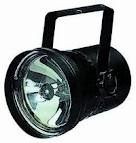
2) A luminaire used widely in disco installations, consisting of a low voltage (6V) Par 36 lamp (lamp code is 4515) with a very narrow beam in a metal case with built in transformer.
Pinspots are ideal for lighting MIRRORBALLs.
PIPE AND DRAPE
A method for screening off an area, creating a booth, or creating wings for a stage. Uses vertical scaffolding in a boom base (known as a tank trap) or telescopic lighting stands to support a system of horizontal scaffold tubes ('pipe'). Black curtains ('drapes') are attached to the pipe either using ties that are part of the drape, or by threading the pipe through a sleeve / pocket in the drape, or by using other fixings such as zip ties / cable ties through eyelets in the drape.Â
PIPE ENDS
Lanterns hung at the very ends of lighting bars - used for crosslight and very common in dance or musical theatre.
PIPES
US term for the bars on which scenery and lanterns are flown.
PIT
Short for ORCHESTRA PIT. The area housing the orchestra or band. Originally, a lower section between the front of the stage and the audience, although now describes any area around the stage housing the musicians.Â
The term was used in the Globe Theatre in London for the lower area immediately in front of the stage where the 'groundlings' watched the performance. This area was also known as the YARD.
PIT NET
Protective net across the orchestra pit to prevent any objects (or actors) falling from the stage and injuring musicians.
PITCH CONTROL
Facility on some sound playback devices for changing the speed of playback, and thus the pitch or frequency of the sound, to match an existing sound, or to fit a particular timeslot. Some Professional CD players have tempo controls which speed up the playback, and then compensate for the resulting increase in frequency using a pitch change. This results in the ability to match the beat of a CD in a disco situation, without the 'Pinky and Perky' effect.
PIXEL MAPPING
The ability with some advanced lighting desks and LED lighting fixtures to make each LED component within the fixture respond to a video signal. With a large number of LED fixtures, incredible fluid effects are possible that would take days to program manually.Â
PLACES
Call by Stage Management for actors to take their places for the start of a scene / show. 'Places please everybody'.
See also BEGINNERS.
See Calls and Cans
PLAN
A scale drawing showing a piece of scenery, the whole set, lighting layout etc from above.
Lighting plans are usually drawn onto the theatre's groundplan.
A view from the side of the set (or a piece of scenery) is known as an ELEVATION.
PLANE
Woodworking tool used to shape wood by running a blade over it.Â
PLASA / P.L.A.S.A.
Professional Lighting and Sound Association (UK).Â
See ESTA for the American equivalent.
PLASA website
PLASTER LINE
See SETTING LINE.
PLATE REVERB
Reverb effect produced using a large metal plate. A signal is supplied to an acoustic transducer at the edge of the plate, causing vibrations which are picked up by transducers at other locations on the plate. This type of reverb can be simulated by some digital effects units.
PLATFORM STAGE
Acting area raised from the floor either in a non-theatre space or in an unusual part of a theatre space. The raised area has no proscenium arch.
PLAY AS CAST
Contract drawn up for an actor when casting is not complete.
PLAYBACK
The part of a computerised lighting control desk which enables the operator to recall cues from the electronic memory.
PLAYBILL
1) A poster advertising a forthcoming variety show, originally shown with a list of the acts performing.
2) Brochure produced for American theatres as a wrap around for the programme of a particular show. The wraparound content is the same for all theatres across the country and contains news, features and advertising.
3) Also used as a generic name for the programme of a theatre production (listing scenes, cast, creative team, and possibly an article by the creative team about the creation of the show etc.)
Playbill website
PLAYING SPACE
The amount of physical stage-space available for performers. This excludes the offstage areas.
PLAYLET
A short play (of around a few minutes long), performed by up to 4 people. Can help with teaching of drama and scene construction, and can be used to explore different viewpoints of a topic in a non-teaching situation.Â
PLAYWRIGHT
The author of a play. Also known as a dramatist.
PLC
Acronym for Programmable Logic Controller. An industrial computer custom-designed to control electrical equipment, first introduced in 1968 to control manufacturing equipment in factories. The PLC software is very reliable and is used in many different industries, including to control scenic automation equipment.Â
PLENUM SPACE
A plenum space is a part of a building that can facilitate air circulation for heating and air conditioning systems, by providing pathways for either heated/conditioned or return airflows, usually at greater than atmospheric pressure. Space between the structural floor and the dropped ceiling or under a raised floor is typically considered plenum; however, some drop-ceiling designs create a tight seal that does not allow for airflow and therefore may not be considered a plenum air-handling space.
PLEXIGLASS
(Trade Name) Transparent acrylic plastic sheet, used to replace glass in situations (e.g. on stage) where real glass is a safety risk.Â
Plexiglass is a made by cell-casting acrylic, rather than the cheaper extrusion method used for many acrylic products.Â
PLOT
1) List of preparations and actions required of technical crews during the performance (eg Sound Plot = list of sound cues and levels in running order.) In the US, the term plot refers to a plan. (eg Light Plot = scale plan showing lighting instruments). See also RUNNING PLOT, STATE PLOT.
2) The basic story thread running through a performance / play which gives the reason for the character's actions.
PLOTTING SESSION
Time during which the plot for each department is prepared (eg Lighting Plotting session)
PLY
Short for Plywood.
PM
Short for PRODUCTION MANAGER.
PMSE
Abbreviation for Programme-Making and Special Events. Licence required in the UK to use radio mics, walkie talkes etc of certain types for TV/Film/Events production.Â
UK Ofcom Page
PNEUMATIC
A system using pressurised gas to create mechanical motion. In theater, pneumatic systems are used to move heavy objects such as seating platforms or permanent scenic features on air castors. Older theaters may have pipe organs which operate pneumatically, or inflatable structures for specific productions. Pneumatic tools such as paint sprayers and nailguns are also used.
PODGER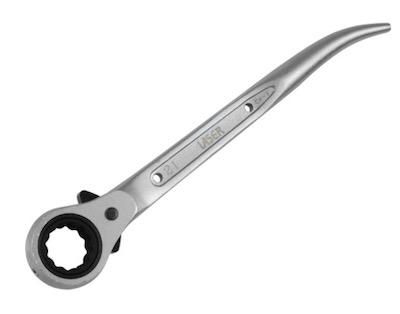
POINT
The rigging point or hanging point to which the lifting machine or suspension component is rigged. Can be temporary ('rigging the points'), or permanent, 'the house points' for example.
Submitted by Chris Higgs
POINT CUE
A cue inserted during / after plotting between two existing cues. (eg 8.5 is inserted between cues 8 and 9). Most computer lighting desks have the ability to either insert an additional cue in a sequence, or to link to another cue out of the sequence, and then link back again. Inserting cues into a plotted sequence on a manual lighting desk is more awkward, because it is a running plot (where only the changes between cues are noted down). Stage Management may prefer to call 8A instead of 8.5, but this is down to personal preference.
Sound cues which relate to an already-running cue within a sequence should have lettered cues (e.g. 8A is a fade up of Cue 8 and 8B is the fade out).
POLE OPERATION
A mechanical means whereby pan (horizontal rotation), tilt (up and down) and focus of a lantern may be adjusted by a pole from floor level. Commonly used in TV & Film studios where fast resetting of positions is necessary.
POLYSTYRENE
Also known as Beadboard (US) or Styrofoam (brand name), this lightweight synthetic material is ideal for carving rough shapes for use on stage. It should be treated with a fire-proofing product before being used on stage. Products such as Rosco Foamcoat add this fireproofing as well as providing a primed surface which is ready for painting.
POP SCREEN
A thin gauze screen placed between a singer and a microphone to reduce vocal 'popping' and other breath noise. This noise is particularly produced by pronunciation of plosive sounds (P, B, T).
POP SHIELD / POP FILTER
A foam shield placed over the end of a microphone to reduce the pick up of vocal 'popping' and external wind noise.
PORTA REGIA
('Royal Door') The central entrance in the scaenae frons, the permanent architectural background to the stage of a Roman theatre.Â
PORTAL
An archway made by combining wings/legs and border. Also a decorative framing, columns and pediments or filigree or other that frames the stage.
In Dutch, the portaalbrug (portal bridge) is a heavy-duty portal consisting of a horizontal bridge with a lighting bar mounted below it, along wtih two vertical legs.Â
POST-SHOW DISCUSSION
An occasional chance for the audience to stay in the auditorium after a performance to hear the director or actors talk about the performance, and to answer questions from the audience.
POSTER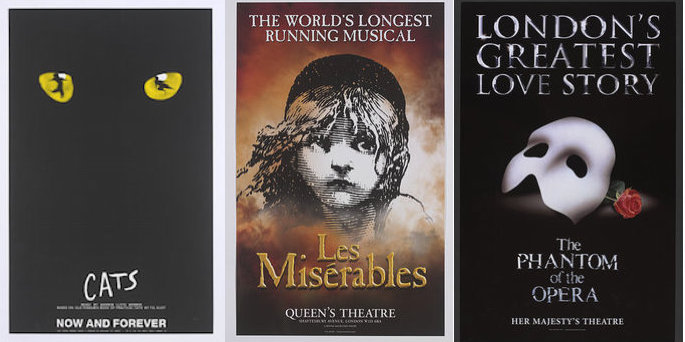
Other advertising materials could include fliers (small versions of the poster, with additional information on the back), newspaper adverts, radio adverts, TV spots, T shirts, other apparel (baseball caps, beanies) etc.
The UK design agency Dewynters is responsible for many iconic posters for West End shows - their approach is to make the poster image strong enough to be seen even if it's passing by at speed (e.g. on a bus or being seen from a car). Their most famous posters (e.g. Phantom of the Opera or Cats) are successful due to the strong 'logo' design which carries a simple message about the show, and can be recognised at a glance.Â
Italian:Â Locardina
UK National Theatre Posters Gallery
UK Theatre Posters by Dewynters at the Victoria & Albert Museum
POUNCEÂ
A pounce is a craft paper stencil with small holes punched (or pounced) through it following the lines of a design or layout. The stencil can be applied to a piece of set, and a piece of chalk or charcoal or powdered paint is rubbed onto the stencil so that COLOR is transferred through the pin holes. Alternatively, a pounce bag (coarsely woven cloth bag containing chalk or charcoal) is repeatedly applied to the stencil so that the chalk or charcoal is transferred through the stencil to the scenic piece.
National Theatre Scenic Painting - Pouncing
POWER AMPLIFIER
Converts sound signals of line level (approx 1 volt) into tens of volts, with currents of around 1 Amp to drive speakers.
POWER FACTOR
The power factor of an electrical system is the relationship between the power that should be used by the system, and the power that is actually being used. Stage lighting dimming systems, and newer innovations such as LED and fluorescent lighting can have very low power factors, which can result in very inefficient use of the electrical supply.
Large lighting installations should use power factor correction equipment to increase the power factor.Â
Power Factor information
POWER FORMULA
The electrical power (wattage) of a device can be found by multiplying the voltage by the current used by the device.Â
Watts = Volts x Amps. This is known in the USA as the West Virginia formula (W=VA).Â
It follows that, as the Voltage is a constant in a given system, the current consumed by a device can be found by dividing Watts by Volts. (e.g. in the UK, 1000 Watts / 230 Volts = 4.35 Amps)
It's useful to be able to work out the current, as all dimmer systems have fuses to protect each circuit. In the UK each dimmer is usually 10 Amps (so two 1000 Watt instruments can be used on each dimmer (8.7 Amps) without blowing the fuse.Â
More on Dimmers, Watts and Fuses
POWERCON
The blue connector is for power inlet, the grey connector is power outlet. The types are not interchangable, and cannot be plugged into Speakon sockets.
NB: The powerCON connector is not designed to be connected under load conditions, so should only be connected / disconnected with the power OFF.
Neutrik Powercon page
POWERPOINT
(Trade Name) Microsoft program for displaying slides on a PC. Has become the standard for simple slide-based presentations.
PPE
(UK - Health & Safety) Abbreviation of Personal Protective Equipment. The equipment that's needed depends on the task and risk assessment but could include: steel toe-capped boots / shoes, protective headgear, gloves etc.
PPM
(Peak Programme Meter) Meter, often with green/red LED's, giving an accurate indication of the electrical nature of an audio signal (see also VU).
PRACTICAL
Any object which appears to do onstage the same job it would do in life, or any working apparatus (eg light switch or tap). A window within the set which has to open is a practical window.
Light fittings which have to light up on the set are called Practicals.
PRE-FADE LISTEN
Often shortened to PFL. Control on a sound mixing desk which allows the user to check the presence of a signal, and its quality before bringing up the fader. Also vital for fault-finding, where the route of a signal can be PFL'ed around the desk until the point where the fault occurs. Also known as CHECK and CUE.
PREFADE / POSTFADE
An output from a sound desk is said to be prefade if it is independent of the channel fader. If it is postfade, the level of the output is relative to the channel fader.
PREFOCUS CAP
A type of lamp base which ensures that the filament is correctly lined up relative to the reflector and lens.
PREHEAT / PRE-HEAT
Smoother lighting builds from zero are achieved when a lamp filament has been warmed (at approx 15%) in the previous state.Â
Preheating lamps MAY prolong the life of the lamp by reducing the thermal 'shock' of going to 100% instantly. It's good practice to preheat lamps where possible, and some computerised lighting desks provide this function at the push of a button.Â
See also RIG CHECK.
PRELUDE
(Trade Name) Range of 500W/650W lanterns produced by Rank Strand (now Strand Lighting) in the UK.
Strand Lighting website
Strand Archive
PREMIERE
(Trade Name) Software program by Adobe used for editing of digital video.
Adobe website
PRE-PRODUCTION
Planning phase of production before actors rehearse (or sometimes have even been cast) and before sets are built. Brings together the production team in discussions about style, possibilities and budgets.
PRESET
1) Anything in position before the beginning of a scene or act (eg Props placed on stage before the performance, lighting state on stage as the audience are entering.)
2) An independently controllable section of a manual lighting board which allows the setting up of a lighting state before it is needed. Each preset has a master fader which selects the maximum level of dimmers controlled by that preset.
PRESHOW
The period before the performance begins, when the audience may be in the front-of-house areas, or even in the auditorium.Â
PREVIEW
1) A performance (or series of performances) before the 'official' opening night. Previews are used to run the show with an audience before the press are allowed in to review the show. This allows technical problems to be ironed out while ensuring the cast and creative team get audience feedback. Tickets are sold at reduced price and help to spread word of mouth interest in the show.
2) A function on some memory lighting control desks with video mimics. Preview enables the operator to see the levels of dimmers and other information in a lighting state other than that on stage.
PREVISUALISATION
Computerised tools which enable design teams to show directors and other members of the production team how lighting, scenery or scenic automation will look before the set is even built. See WYSIWYG.
Visualisation
PRIMARY COLORS
The primary additive colors of light are red, green and blue, and the subtractive colors are cyan, magenta and yellow.
PRINCIPALS
The main or lead actors in a show.
PROCEDURAL AUDIO
Term for realistic sounding audio which is synthesised in real time on demand by software. This could be triggered by physical actions on a set or by movement sensors or infrared camera feeds, or at random. Seen as a possible future for sound design for theatre & film, and to increase the variety of audio present in gaming applications.
PRODUCER
That person or body responsible for the financial and contractual side of a production. This can include the raising of money to stage the production, hiring the facilities, employing the technical crew, front of house and publicity staff, director and cast. The producer usually works closely with the director before embarking on a production.
A person who provides the finance directly is known as an ANGEL.Â
Submitted by Alan Williamson
PRODUCING HOUSE
See RECEIVING HOUSE.
PRODUCTION DESK / PRODUCTION TABLE / PRODUCTION BOOTH
Table in the auditorium at which director/designer etc sit during rehearsals (especially technical rehearsals). Usually has its own lighting and communications facilities.Â
For small venues the desk is used by the lighting designer and her/his team so that they can see the lighting from the audiences' point of view. The lighting control desk may be moved to the production desk, or the desk and programmer may remain in the control room, and have a remote interface on the production desk, which may have a display screen showing the cue list etc, which the designer can configure.Â
Larger shows (including Broadway and West End) will often remove large sections of audience seating in the stalls and install a number of production desks for all technical areas including lighting, projection, sound, scenic automation etc.Â
PRODUCTION MANAGER
(UK) Responsible for technical preparations, including budgeting and scheduling of productions. This role in the US is usually known as TECHNICAL DIRECTOR.
PRODUCTION MEETING
A gathering of key production staff during the months leading up to a performance or event. The aim of the meeting is to come to an agreement about any questions raised during rehearsals or the construction phase, to deal with any budget problems, confirm detailed schedules and to keep the process moving forward successfully. Decisions should be written down and circulated to those present and anyone that couldn't make the meeting.Â
PRODUCTION NUMBER
A musical routine / song with a heavy dance component, usually performed by the majority of the cast of a musical, with a sense of showbiz and sparkle.
PRODUCTION SOUND ENGINEER
Often shortened to PE. Works alongside the Sound Designer to help in translating artistic ideas into equipment (and installing it).Â
PRODUCTION STAGE MANAGER
Shortened to PSM.Â
PROFESSIONAL
Normally used for someone who's regularly paid for a particular job (as opposed to an amateur, who does it for fun). A professional attitude is essential when working in the theatre - this means you have to behave as if you were being paid. The theatre world is a very small community - if you behave badly or upset someone, it's highly likely you'll meet them again, and they will remember you!
PROFILE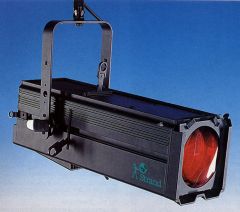
2) Shaped piece of scenery added to the edge of a flat instead of a straight edge. Also known as a cutout.
Types of Lantern
PROGRAMME
A brochure or leaflet produced for the audience which contains a breakdown of the cast and creative team (and technical team) that have worked on the show. The programme may also contain a synopsis of the plot, a list of musical numbers, a note from the director, and full biographies of cast and creative team.
A Souvenir Programme contains full COLOR photos and more generic information which has a longer shelf life for a long-running show.
PROJECTION
1) Slides are used to project still archive images or textures. Libraries of slides contain images for every occasion. Kodak Carousel projectors are the industry standard, and some types can be linked to a controller to perform complex dissolves and fades from one projector to another. More powerful projectors are available using very intense discharge sources and large format glass slides to produce a massive image.
2) Lighting effects : Moving cloud / rain / fire effects can be achieved using a powerful lantern known as an effects projector with a motorised glass disc painted with the required effect. An objective lens is required in front of the disc to focus the image. See Effects.
3) Gobos : See GOBO.
4) Film : 35mm film projection is common in many theatres as a device for keeping the building open to the public when productions are in preparation. 16mm film projection is used in smaller venues. Film projection can, of course, also be integrated into a performance.
5)Â Data: Data or Video projection is now being used to bring video and computer images to the large screen. Data projectors are considerably cheaper and more versatile than other methods, and the quality is improving all of the time. Images can be front projected or back/rear projected depending on the amount of space and the effect required. For example, if actors are required to walk in front of the screen and not have the image appearing on them, back projection is the only answer.
6)Â Front Projection: The projector(s) are in front of the projection surface or screen, between the screen and the audience. This results in a bright image, but means that actors standing directly in front of the screen may cast a shadow on the screen (and have projection on their faces).Â
7)Â Rear Projection / Back Projection: The projector is behind the projection surface. This means the projection image will be reversed from the point of view of the audience (all data projectors have a setting to flip or mirror the image). A standard white cloth or sheet can be used, but the image will be dimmer than it would be from the front, and (most importantly) the projector lens will be visible as a bright hot spot in the projection. To avoid this, a custom-made back projection screen should be used. Companies such as Rosco sell back projection (BP) material (a translucent plastic) which results in a very bright and clear image, and which prevents the visibility of a projection hot spot. The BP material can be stapled to a frame to form a screen of the exact size needed for the event.Â
See LCD, DLP, SCREEN.
PROLOGUE
Short scene or speech before the main action of the play to put it into context or set the scene. See also EPILOGUE.
PROMENADE
Form of staging where the audience moves around the performance space and sees the play at a variety of different locations.
PROMPT BOOK /Â PROMPT COPY
Master copy of the script or score, containing all the actor moves and technical cues, used by stage management to control the performance. Sometimes known as the 'book', Prompt Copy or Prompt Script. The member of stage management (often the DSM) cueing the show is said to be 'On the Book'. (e.g. 'Clare's on the book for the next show').
As well as the script and/or score of the show, the prompt book also contains contact lists for all concerned with the production, information about the venue(s), show reports, local amenities, emergency procedures and any other information that may be needed during the run of the show. It's rightly known as the production 'bible'.
The Prompt Book
PROMPT CORNER
Area, traditionally on the stage left side of the stage, from which the stage manager (or DSM) controls ('prompts') the performance, from the prompt desk.
PROMPT DESK
The control CENTER of the show. The desk should contain most of the following: a clock, low level lighting, a flat surface for the prompt script, communication facility to other technical departments, a phone for emergency, rear and front of house calls system and cue light controls.
PROMPT SCRIPT
See PROMPT BOOK.
PROMPT SIDE (PS)
PROMPTER
Person whose role is to follow the text of a play, and be ready to remind the actors of their lines if they forget them. In many older theatres, there is a prompt box downstage CENTER sunk into the stage, so that only the prompter's head is above stage where she/he can see the actors.
PROP ROOM
Either a room in which the theatres' collection of props is stored, or an offstage room where props for the show are kept, ready for the actors to pick them up.Â
PROPERTIES MANAGER
The Props Manager / Properties Manager is in charge of the stock of props at a theatre.
In the UK, the ASM (Assistant Stage Manager) is often responsible for propping a show (finding/buying props and organising the making of additional ones). Larger organisations might have a Prop Manager who is responsible for sourcing the props required for a show (or a series of shows).Â
PROPERTY MASTER / PROP MASTER
Member of the creative team who has responsibility for all of the PROPS used in the production (US).
PROPPING
The task, often performed by stage management in the UK, or by the scenic designer in a small company, of going around finding / borrowing / buying props for the production.Â
It's essential that a clear record is kept of the source of the props so that they can be efficiently returned at the end of the show. Reference books are used to ensure the items are correct for the time period of the production.
PROPS
(Properties) Furnishings, set dressings, and all items large and small which cannot be classified as scenery, electrics or wardrobe. Props handled by actors are known as hand props, props which are kept in an actors costume are known as PERSONAL PROPS.
PROPS TABLE
Table in convenient offstage area on which properties are prepared prior to a performance and to which they should be returned after use.
PROS ARCH
Short for Proscenium Arch.
PROSCENIUM / PROSCENIUM ARCH
The opening in the wall which stands between stage and auditorium in some theatres; the picture frame through which the audience sees the play. The "fourth wall". Often shortened to Proscenium or Pros Arch.In some older theatres, the Proscenium Arch is ornate and painted to contrast with the surrounding walls, to really make it stand out. Nothing outside the Proscenium Arch was part of the show. However, as there are many different audience layouts now, many theatres (particularly multi-purpose studio theatres) have no Proscenium Arch at all, or it may not be decorated as such.
See END ON.
Italian:Â Boccascena
French: cadre de scène
PROTAGONIST
The leading character or 'hero' in a play who has to fight against / oppose the ANTAGONIST.
This term derives from the theatre of Ancient Greece when the Protagonist was the first actor to speak (aside from the CHORUS). As more 'lead' actors were added, they became known as the Deuteragonist and Tritagonist.
PROTOCOL
See MULTIPLEX.
PROXEMICS
Proxemics means the distances between character/actors in a play. It shows their relationships and feelings. e.g. if two characters stood far apart from each other you could assume that they either did not know each other at all, or had fallen out and were no longer speaking to each other.
PROXIMITY EFFECT
A change in microphone response as a vocalist (or sound source) moves away from it.
PSU
Power Supply Unit.
PUBLIC ADDRESS SYSTEM
The venue auditorium sound system. Usually shortened to "PA". Most theatres will have a separate sound system for emergency announcements in all public areas of the theatre. This system may also be used for Front of House calls. The Rear of House calls system often also acts as a SHOW RELAY, conveying the sound of the performance to remote parts of the theatre building.
PUBLIC RELATIONS
Department in the theatre (or any company) which deals with the public image of the theatre. Sometimes known as the MARKETING DEPARTMENT.
Marketing information on Theatrecrafts.com
PUBLICITY
The department in the theatre whose job it is to entice the audience into the theatre, and to tell them what they need to know in order to get the most from the production.
PULL
The amount of electrical power required by a touring show in a venue.
PULPITUM
Feature in an early Greek/Roman theatre. Pulpitum is the Latin (Roman) word for a raised stage in front of the sceanea (in Greek theatres it is called the Logeion) and equates with the modern 'podium' or platform stage.Â
PUNCH IN
A facility on multitrack recorders which allows you to 'drop in' a sound onto a track whilst playing through the tape, sometimes controlled by a footswitch. Useful for correcting mistakes in an already recorded tape.
PUPPET
Information coming soon
PUSH AND PULL
Actors who have to move scenery / furniture around the stage, earning them extra money. Slang term is Pickfords, after the UK Furniture removals company.
PUWER
Abbreviation for Provision and Use of Work Equipment Regulations 1998 (UK Health & Safety Executive)
HSE PUWER page
PVC TAPE
Plastic insulating tape used for taping cables to bars and for securing coiled cables. Neater and cheaper than Gaffa tape. Also known as LX tape.
PYRO
1) See PYROTECHNICS
2) Short for Pyrotenax, a brand name (UK) of Mineral Insulated Cable.
PYROFLASH
PYROTECHNICS
(Pyro) Chemical explosive or flammable firework effects with a manual detonation. Usually electrically fired with special designed fail-safe equipment.
There are many different variations of pyrotechnic effects available. The categories are as follows:
Theatrical Flash - a flash and a cloud of smoke
Maroon: produces a very loud bang. Must only be detonated inside a bomb tank covered with a protective mesh.
Gerb: version of the Roman Candle firework, throwing a shower of sparks into the air. Possibly named from the French 'Gerbe' meaning a sheaf of wheat, due to it's shape.
All pyrotechnics should be used with close reference to local licensing laws, and the manufacturers instructions. Professional advice should be sought before the first use of effects.
Some territories only permit licenced pyrotechnicians to use these devices.
PZM
Pressure Zone Microphone. See BOUNDARY MICROPHONE.
Q.V.
Abbreviation of Quod Vide (Latin), literally 'Which See'. Used in documents to refer the reader to another part of a publication for more information or detail.Â
QUADROPHONIC
A sound system which uses four independent speakers (or sets of speakers). The fore-runner of today's Surround Sound. See Stereophonic.
QUARTER
Call given backstage by Stage Management 20 minutes before the start of the show (15 minutes before BEGINNERS). See also BEGINNERS, HALF.
See Calls and Cans
QUARTZ HALOGEN
See TUNGSTEN HALOGEN.
QUARTZCOLOR
(Manufacturer) Range of TV/Film lanterns marketed by Strand Lighting.
QUEUE
This is the word for a line of people waiting for an event or to be served. Also the word for a lighting or sound change of state, or to initiate any change of scenery. It is also called a CUE.
QUICK CHANGE
A change of costume that needs to happen very quickly takes place close to the side of the stage. Costume designers need to know about the need for a quick change so that the costume is made incorporating elements such as velcro and zips rather than buttons. A quick change room is often erected at the side of the stage to enable changes to take place in privacy. Dressers may be available to help the actors with very quick changes.Â
QUICK CHANGE ROOM
Area adjacent to the stage containing lighting, a mirror and a costume rail in which actors can make costume changes quickly, sometimes with the aid of a dresser.
R & V
(Manufacturer) Reiche & Vogel. German manufacturers of low voltage beamlight. Now sometimes used to describe any beamlight.
Reiche & Vogel website
R&D
Short for Research and Development.
This describes an experimental phase of a project when different ideas are played with, as the piece of work is being created.Â
R&R
British Army term, short for Rest and Recuperation - time away from the front line to "recharge" with family and home life.
RACK
A cabinet of standard width (19') into which various components can be bolted. Racks are ideal for touring equipment, are neat, and they allow easy access to the rear and front panels.
RADIO CONTROL
System whereby battery-powered practicals / props on stage can be controllable from offstage with no connecting leads.
RADIO MIC
Device consisting of a microphone head, transmitter pack with batteries, aerial and mains receiver unit which allows actors and singers to be amplified with no visible means of connection. Almost universally used in musicals where the singers have to be amplified to be heard over the orchestra / band. Used in non-musical shows for sound reinforcement.
Can be Handheld (where the microphone head, transmitter pack and batteries are all in one unit) or Lavalier (where a miniature microphone is either clipped onto clothing or body worn).
Radio mics use either VHF or UHF frequency bands to send the radio signals from the transmitter to the receiver. UHF systems tend to have better range than VHF, have more frequencies to select from, and are less susceptible to intereference from TV systems. Radio systems are being replaced in some situations, by digital wireless systems which use a digitalÂ
RADIOSITY
is a method of rendering based on an detailed analysis of light reflections off diffuse surfaces. The images that result from a radiosity renderer are characterized by soft gradual shadows.
RAG
(Aus) Main set of tabs at the proscenium arch.
RAG ROLLING
Also known as RAGGING. A painting technique used by scenic artists to quickly get a complex textured paint effect over a large area. A base coat is applied first, which is allowed to dry, then a contrasting COLOR is applied, and while still wet, a scrunched up piece of rag is dabbed at the area to remove the still-wet top coat in a random pattern. Alternatively, an unevenly tied rag around a paint roller can be run over the wall to achieve the same effect.
RAIL
1) See flat.
2) Same as Flyrail. In US theatres, a RAIL CUE is the same as a FLY CUE in the UK.
RAIN BOX
A box or tray containing dried peas etc which produces a rain sound effect when inclined.
RAKED AUDITORIUM
Audience seating area which is sloped, with it's lowest part nearest the stage.
RAKE / RAKED STAGE
A sloping stage which is raised at the back (upstage) end. Many theatres with a 'stalls' seating area used to be built with raked stages as a matter of course. Today, the stage is often left flat and the auditorium is lifted to stage level and above to improve the view of the stage from all seats. A rake is expressed as a ratio (eg a 1:25 rake rises by 1cm vertically over 25cm horizontally).
See also Anti-Rake.
RAMS
Acronym from Risk Assessment & Method Statement. RAMS is the paperwork that you should provide when undertaking any activity that requires it.Â
RAT STAND
Illuminated music stand (named after manufacturer).
R.A.T. website
RATCHET STRAP
Woven strap with a ratchet tensioner used for securing a load in a lorry. Also known as a LOADSTRAP.
RAYLIGHT
a column of light (as from a beacon) beam of light, light beam, ray, shaft of light, irradiation, shaft, beam.
RÉSUMÉ
A résumé is a summary of employment and experience. Depending on context, it can be the same as a full curriculum vitae (or CV) or a shorter biography to use in a programme for a show. In a job-seeking context, it's the same as a CV. (from the French, meaning summary)
RCA
See Phono Plug. (RCA = Radio Corporation of America)
RCA Corp website
RCD
Residual Current Device. Protects the user against short circuit (earth faults) and earth leakage caused by damaged cable or faulty equipment. A RCBO is a combined MCB and RCD, protecting against earth leakage/short circuit and overload. Known as a GFI (Ground Fault Interruptor) in the USA.
RDM
Remote Device Management. New lighting control and configuration protocol (officially ANSI E1.20 standard) currently under development at ESTA, which allows two-way communication over standard DMX512 cable, so that settings of a variety of RDM-compatible devices can be confutured remotely.
See also MULTIPLEXED SIGNAL.
RE-ENACTMENTÂ
A live-action recreation of part of an historical event or period. The actors try to behave in the same way their predecessors who originally took place in the event, and wear suitable period costume, and use period weaponry (where required).Â
See also Live Action Role Play.Â
RE-RIG
To change the lighting rig after the last performance of one show to the positions for the next show.
READ THROUGH
A meeting with all cast and (sometimes all) creative team members to read through the script. Usually happens at the start of the rehearsal process, to orient the cast and help them get to know each other and the text.Â
REALISM
Realism in theatre describes a decision by the creative team to present the audience with an accurate depiction of the real world, rather than a stylized interpretation. Examples are Kitchen sink realism, an English cultural movement in the 1950s and 1960s that concentrated on contemporary social realism, or Poetic realism, a film movement in France in the 1930s that used heightened aestheticism. In the visual arts the term denotes any approach that depicts what the eye can see, such as in American realism, a turn of the 20th century idea in arts, Classical Realism, an artistic movement in late 20th Century that valued beauty and artistic skill.
REAR OF HOUSE (ROH)
1) The backstage areas of the theatre. See also FOH (Front of House). Also sometimes known as Back of House.
2) Abbreviation for Royal Opera House, London.Â
Royal Opera House
REAR PROJECTION
See PROJECTION.
RECEIVED PRONUNCIATION / R.P.
The standard non-regional English accent as spoken in England. Also known as BBC English.Â
RECEIVING HOUSE
A venue which has incoming touring companies (as opposed to a Producing House, which creates it's own productions). See also ROADHOUSE.
RECIT CALL
Session with the musical director for opera performers, to rehearse the sung dialogue for the coming performance.Â
RECITATIVE
Musical terminology for a sung dialogue passage, in the rhythm of ordinary speech, during an opera, operetta or oratorio. Often shortened to RECIT.Â
REDHEAD
800W open-faced adjustable flood lamp used in film / TV lighting. So-called because of it's red paint finish. See also BLONDE.
REDUCED VISIBILITY / RESTRICTED VIEW
Often used to describe a seat in an older theatre from which some parts of the stage are obscured either by columns supporting the seating, or because it's at the side of the venue, or behind a balcony railing. Usually cheaper than other seats, and often not quite as bad as they sound. More modern venues are built with the intention that every seat is a good one. Older venues, particularly in large cities, may have been built as variety houses, where the main act was downstage CENTER, and as long as that was clearly visible, the seats were all fine.Â
REEVE
Old Norwegian for threading, any threading action, - lacing, choking etc..
Submitted by Chris Higgs
REFLECTOR
Highly polished metallic mirror used to direct light beam from a lamp towards the lens at the front of a lantern.Â
REHEARSAL
(from Latin hirpex - 'large rake used as a harrow'. Rehearse means 're-harrow', or to 'go over again'. It originally meant 'to repeat' (mid 14th century). It wasn't until the late 16th century that it came to it's modern meaning.)
A session when actors are called to work through some scenes from the play in private. A TECHNICAL REHEARSAL is the first time when technical elements (lighting, set etc.) are combined with actors. A DRESS REHEARSAL is a performance of the show as it will be on opening night.
REHEARSED READING
A performed reading of a play text, with the actors holding scripts, but having worked out basic blocking, and having rehearsed their performances. This technique is used to experiment with text, to see how it works being performed, rather than just being words on paper. It sometimes has some basic technical elements (general wash lighting and maybe blackouts to denote the ends of scenes etc., and basic furniture that's necessary to convey the plot, but no built set). Also known as a Staged Reading.Â
RELAXED PERFORMANCE
A Relaxed Performance is one specifically modified to help audience members with special needs to feel at home in the theatre, and to enable them to feel able to make noise and comment on the performance when they wish to. They are designed for audience members with autism, learning disabilities and sensory or communication needs. The sound level is often reduced, complex lighting changes are simplified, and the cast and company warn families when unexpected noises will occur. Often the house lights are left on, and the audience is given a pre-show tour of the theatre so that they are familiar with the environment. The performances sit alongside special measures for audio-description and signed performances for those with sight or hearing impairments, and were introduced to the West End in mid 2013.Â
Guardian article on Relaxed Performances at the National Theatre, UK
Society of London Theatre Relaxed Performances information
RELIGHTING
When a show is touring, a Relighter is used to reproduce the lighting design in each venue.
The original lighting designer may be present at the second venue on the tour, to check the work of the relighter.
Paperwork is produced by the original designer to enable the relighter to reproduce the design easily in venues of differing sizes.Â
REMAINDER DIM
A command used on Strand Lighting memory control desks which is comparable to the SOLO function on other desks. For example, entering CH 5 REM.DIM will put channel 5 at full and will put everything else at zero.
RENDERING
1) (3D Design) The process of producing a real-world style image within a 3D design program. Depending on the computer power, a fully rendered image can look as good as a photograph of the real world equivalent. Rendered images are used by lighting, scenic and multimedia artists to present ideas to other members of the production team.
2) (Design) The art of creating an illustration on paper showing how a design concept will look when built.Â
REPERTOIRE
A form of organisation where two or more productions alternate in the course of a season.
REPERTORY
A form of organisation, usually with a permanent company of actors, where each production has a run of limited length. At any time, there is normally one production in performance, another in rehearsal and several others in varying degrees of planning.
The first repertory theatre in England was Miss A.E.F.Horniman's Company at the Gaiety Theatre in Manchester, founded in 1908.
Often shortened to 'Rep'.
REPETITEUR
Répétiteur is an accompanist, tutor or coach of ballet dancers or opera singers.
REPRISE
In a musical, a repeat of a song or dance number (sometimes with variations in lyrics to reflect what's happened since the last time it was sung) later in the show.
RESET
1) To go back to a particular point ready to run part of a scene again, during a technical rehearsal (e.g. 'OK that scene change went really well - can we please reset to the end of the previous scene ready to try it again?')
2) After a performance, the Reset involves all on-stage crew in moving scenery and props back into position for the top of the show, ready for the next performance.Â
See also SET BACK.Â
RESISTANCE DIMMER
A now obsolete method of dimming which decreases the current available to the load by introducing a variable resistance between supply and load. The excess current is converted into heat. Based around a rheostat.
RESLO
Rugged microphone connector used on the Reslosound range of microphones, and in some theatres before the 3 pin XLR became ubiquitous.Â
RESOLUTION
1) The point during a drama when the plotline reaches a conclusion, and conflict is resolved.
2) A measure of the quality of a video display
3) The quality of a sound sample is measured by the sample rate (e.g. 44.1kHz is CD quality sample rate) and the resolution (either 8 bit or 16 bit normally).
RESTORE
A cue to resume or return to any previous state, setting or function. (e.g. 'at the end of the dance number we restore to a warm general cover').
Submitted by Bert Morris.
RETROFIT
A modification that can be made to an existing piece of equipment after purchase to bring it up to date.
RETURN
1) Flats joined to the DS edge of flats of a set or unit that 'return' into the wings. They help mask and also keep the DS edge of a set from looking raw.Â
2) A financial report given to theatre management staff by the box office manager on a daily or weekly basis setting out the takings for performances.Â
3) Route for an auxiliary signal back into a sound mixer (see also SEND).
REUTLINGER
A range of adjustable steel wire fittings which can be used to suspend a static load and adjust the height easily. Available from Doughty Engineering.Â
Doughty Engineering website
REVEAL
A return which is at right angles to a flat, and suggests the thickness of a window, wall, doorway etc.
REVERB
(Reverberation) Effect which may be added to sound effects during recording or to a voice during performance. Sustains the sound longer than normal, as if the sound was reverberating around a large building (eg cathedral). Persistance of sound after the source has ceased.
REVERSE AND REPEAT
A shorthand used on scenic design drawings for simplifying the drawing of complex or detailed objects. Instead of trying to accurately reproduce a hand-drawn series of details, a CENTER-line is drawn and the other side of the object is drawn as just an outline with 'R&R This Side' written next to it. When building the item at full scale, the details will be identical (but reversed) on  both parts.Â
REVERSE RADIO
A sound system that works opposite to a radio microphone - a sound signal is transmitted from the mixing desk to a battery-powered receiver, amplifier and speaker. Used for relaying a fully controllable sound feed to a remote location on stage - often used for an on-stage prop radio or tape player. This system is also used for in-ear monitoring (IEM).
REVIVAL
A new production of a performance (long) after its' inital run of performances has ended.Â
Sometimes out-of-date references are updated, questionable material may be amended, or new material may be added.Â
REVOLVE
A turntable built into the stage floor on which scenery can be set and then driven into view. Can be electrically chain driven either as part of an automation system or via simple start/stop controls, or manually rotated. A revolve can also be built on top of an existing stage.
A partial revolve with a stationary CENTER section is known as a DOUGHNUT REVOLVE.
See also WAGON STAGE, JACKKNIFE STAGE.
REVOX
Brand name of the once industry standard reel to reel tape recorder. Still enormously popular and universally known.
REVUE
A type of performance consisting of lighthearted songs and comic sketches - a variety show.
RF
Radio Frequency.
RF CO-ORDINATOR
Member of the sound team on large scale events who ensures that all users of radio frequency devices (radio mics, comms, in-ear monitors, IFB etc.) have radio frequencies allocated to them which do not interfere with each other, and are covered by the appropriate licences in the region in which the event is taking place.
RFU
Remote Focus Unit. Name used by ETC for a remote control for the lighting desk. Same as RIGGERS CONTROL.
RGB
Red Green Blue. Video connection standard using three connections for the three colors which make up the final image. Provides a higher quality image than standard composite video.
RIAA
Record Industry Association of America. The standard equalisation to be applied to a signal from a record deck pick-up. Phono pre-amps have RIAA circuitry built-in.
RIBBON MIC
Delicate mic not suitable for high sound pressure levels. Consists of a corrugated conductive foil strip suspended between opposing magnetic poles which is excited by pressure differences between the front and rear of the microphone and induces a current.
RIDDOR
Abbreviation for Reporting of Injuries, Diseases and Dangerous Occurrences Regulations, 2013 (UK Health & Safety Executive)
Reporting Accidents and Incidents At Work - A Brief Guide (HSE)
RIDER
(Technical Rider) Information sent to a venue by a touring group detailing lighting, sound, staging and dressing room requirements. Ideally arrives before the group!
RIDING THE FADER
Sound operating technique where the operator constantly adjusts the fader level to maximise level while minimising feedback and background noise.
RIFLE MIC
See Gun Mic.
RIG
1) The construction or arrangement of lighting equipment for a particular production.(noun)Â
2) Installing lighting, sound equipment and scenery etc for a particular show.(verb)
RIG CHECK
(also known as LAMP CHECK) The process of checking all lanterns in the rig are working correctly prior to each performance. Should be done daily in sufficient time to change a lamp if necessary.Â
Most venues do not have the electrical capacity to run all lanterns at full for a rig check, so a level of 25% is normally used.Â
N.B. this is NOT the same as preheating - a rig check happens before each performance and involves the whole rig, and preheating involves individual lanterns/dimmers and happens before a cue in which that lantern appears.
RIGGERS CONTROL
A remote control for a lighting desk which enables dimmer channels to be called up from the stage when rigging or focusing. Usually battery powered, sometimes with infra-red (cordless) control. A Designers Control allows whole memories to be called up and/or played back, as well as individual dimmers.
RIGGING
General term for the systems and equipment that suspends lighting and scenic equipment above the stage or performance space. Riggers are responsible for setting up the equipment initially, and there should be rigorous (no pun intended) systems in place to test and check all flown equipment regularly.Â
RING OUT
Process of maximising the volume of sound possible through a sound system before feedback ("ringing") occurs. The equalisation controls on the mixing desk channels are used, along with gain controls to reduce the chance of feedback.
RISER
1) Any platform on stage. For instance, the series of platforms for choral presentations are called choral risers, the rostrum on which a drumkit and drummer is positioned is the drum riser.
2) The vertical portion of a step which gives a set of treads its height.
3) A microphone which can be raised through a small trap in the stage floor to a convenient height for an actor. Usually positioned just upstage of the footlight position, CENTER stage.
RISK ASSESSMENT
A Risk Assessment is a document listing the risks and hazards involved in a particular activity, highlighting what controls are in place to reduce the risk to an acceptable (safe) level.
See also METHOD STATEMENT, RAMS,
ROAD MANAGER (ROADIE)
A touring technician with one night shows, particularly music groups. Large groups will have a roadie in charge of a particular instrument or set of instruments (eg Guitar Roadie, Drum Roadie, Lager Roadie) who is responsible for the correct unloading and setting up (tuning etc) of the instruments before the artists arrive onstage for the sound check.
Roadie stories
ROADHOUSE
(US) Venue which receives touring shows. (RECEIVING HOUSE in the UK)
ROBOTIC
Pyrotechnic effect that produces a flash, short burst of sparks and a small cloud of smoke. Can be used to simulate an electrical fault.Â
ROCK DESK
Lighting control desk designed for rock concerts, the main feature of which is the ability to group a set of dimmers under the control of a series of flash buttons, enabling the operator to 'play the lights' in time to the music. These desks usually have a very good lighting effects capability.
ROLL DROP (US)
See OLEO DROP.
ROLLER
A system whereby cloths can be rolled up/down instead of flying in/out in a theatre where there is no fly tower, or limited flying height.
ROOF
The rigging structure or existing structure used for rigging from.
Submitted by Chris Higgs
ROPE ACCESS
The technique involving the use of ropes in tension to enable access to workstations otherwise too dangerous or costly with traditional methods.
Submitted by Chris Higgs
ROSCO LABS
(Manufacturer) USA based manufacturer of lighting gels and scenic products. See COLOR FILTER.
Rosco Labs website
ROSIN
Also known as Colophony or Greek Pitch, Rosin is a solid form of resin obtained from pines and some other plants, mostly conifers, produced by heating fresh liquid resin to vaporize the volatile liquid terpene components.
It is semi-transparent and varies in color from yellow to black. At room temperature rosin is brittle, but it melts at stove-top temperatures. It chiefly consists of different resin acids, especially abietic acid.
It is used in a number of applications for it's friction-increasing properties. Ballet, flamenco, and Irish Dancers are known to rub the tips and heels of their shoes in powdered rosin to reduce slippage on clean wooden dance floors or competition/permanence stages. - it was at one time used in the same way in fencing and is still used as such by boxers.
ROSTRUM
(plural ROSTRA) A portable platform, usually in the form of a collapsible hinged framework (Gate) with a separate top (Lid).
ROUNDEL / RONDEL
A circular lighting filter either made of plastic (known as a GEL) or of glass for more permanent applications or architectural installations.Â
ROUNDSLING
An endless sling made of a coil of (man made) fibres sheathed in a protective man-made cover, flexible, soft, light weight and cheap
Submitted by Chris Higgs
ROUTER
Computer networking device which connects different networks together. Common uses in theatre are to connect technical networks to the internet, or to create wifi networks for technical purposes. Network cabling can connect lighting desks to dimmers and to additional interfaces to enable wireless control or computer-based control of systems. In sound, mixing desks and remote input/output interfaces can be connected via network cable, saving vast amounts of time connecting multicore audio cables, and again enabling wireless remote control of various systems.Â
ROYALTIES
The prescribed fee paid to an author or his agent for the performing rights of a play.
RT60
Also known as reverberation time, the RT60 is the time taken for an impulse sound to decay by 60 dB. For speech, the RT60 of a space should be lower than for a room used for music. In general, as the volume of a room increases, the RT60 time can be longer. The RT60 time of a room can be estimated using mathematical formulae.
RTA MICROPHONE
(Sound) RTA stands for Real-Time Analyser - a system that analyses the audio through a sound system and displays the result, or uses the result to calibrate the system. The analyser requires a 'reference' microphone of known type and quality, to enable the analysis to be accurate.
For example, the dbx RTA-M Measurement microphone is used with the DriveRack PA system to calibrate it for the environment. Pink Noise is played through the system, and the RTA mic 'listens' to the replayed audio and automatically calibrates the system for best audio quality. Â
RUCHE
(pronounced ROOSH) A pleating or gathering of cloth / drapes.
RUN
1) A sequence of performances of the same production. (e.g. 'How long is the run of this show?' or 'This show runs for two weeks')
2) A rehearsal of the whole show or a section of it (e.g.'This afternoon's rehearsal will be a run of Act II followed by notes'). Run-throughs early in the rehearsal schedule are sometimes known as STAGGERS as actors are unsure of their lines.
See also ITALIAN RUN, RUSSIAN RUN, CUE TO CUE, SPEED RUN
RUN-ON BILLING
In a contract, this phrase refers to a way of displaying the credits of a number of people in a single block of text, one after the other, rather than each having a separate line. The producer may insert this clause so that, although they may try wherever possible to credit each member of the creative team separately, sometimes, due to lack of space, it may not be possible.Â
RUN-THROUGH / RUNNING REHEARSAL / RUN REHEARSAL
A rehearsal of the show (or a section of it). Often shortened to just RUN. See also TECHNICAL RUN, DRESS RUN. The first run-through is often known as a STAGGER-THROUGH as there are usually many errors and delays.
RUNNER
1) Climbing - abbr. for 'running belay'. An intermediate means of protection where an anchor is placed through which the climbing rope can run. In the event of a fall, the climber should fall only as far as the length of rope between him and the highest running belay he has arranged will allow. The rope absorbs the energy in the fall provided the belay and belaying is sound and the running belay holds firm.
2) A Tab Track runner is a plastic wheeled support into which a curtain hook is clipped, which then runs along the tab track. There should be one runner for each curtain hook.Â
Submitted by Chris Higgs
RUNNERS
1) A pair of curtains parting in the CENTER and moving horizontally, particularly those used in a downstage position in variety and revue productions.Â
2) Persons employed as production assistants to do odd jobs and errands during a production period.Â
3) Strips of carpet used backstage to silence actors' shoes during performance.
RUNNING LIGHTS
US term for the blue working lights used backstage during a performance.
RUNNING PLOT
A plot sheet giving details of the changes between cues, as distinct from a state plot which gives the whole state of the system at any time. For example, a lighting plot on a manual board is normally a running plot. It is difficult to start a running plot half way through; often the operator has to go back to the beginning and work through until the required point is reached. However, it contains the minimum information necessary to perform the cues, and is therefore more efficient on a manual lighting desk or complex sound setup.
Also used by the stage management team to keep track of prop moves and changes during the show. A preset sheet contains the status of everything at the start of the show, then the running sheet / running plot lists everything that has to happen during the show, in order.Â
RUNWAY
A narrow raised walkway running from an entrance to (sometimes) a small stage.Â
The runway layout is used for fashion shows, with the audience sitting on either side of the runway, and at the end.Â
S-VHS
Video format launched by JVC in 1987. S-VHS resolution is 400 horizontal lines. See also VHS.
S-VIDEO / S VIDEO
S-Video (also known as separate video and Y/C)is a signaling standard for standard definition video, typically 480i or 576i. By separating the black-and-white and coloring signals, it achieves better image quality than composite video, but has lower color resolution than component video..
S.W.L.
Safe Working Load. The weight load that lifting equipment is expected (and designed) to be able to support safely.
The term has now superseded by WLL (Working Load Limit).
sACN
Streaming Advanced Control Network, or Streaming ACN.
Control protocol developed by ESTA to use a standard computer network to send a number of DMX universes between equipment. Similar to ArtNET.Â
SAFARI
Lighting control software originally manufactured by AVAB Scandinavia. Safari software is now maintained by ETC.<br />Safari is also the web browser installed on Apple computers and devices.
AVAB website
ETC website
SAFE SYSTEM OF WORK
UK Health and Safety terminology. Can be defined as 'the integration of people, articles and substances in a suitable environment and workplace to produce and maintain an acceptable standard of safety. In this system, due consideration should be given to foreseeable emergencies and the provision of adequate facilities'
Submitted by Chris Higgs
SAFETY BOND
Chain or wire fixed around lantern and lighting bar or boom to prevent danger in the event of failure of the primary support (eg Hook Clamp). A requirement of most licensing authorities in the UK.Â
As a standard safety chain does not have a rated loading, current recommendations in the UK is to use an approved (and rated) safety wire (also known as a safety bond) as a secondary suspension.Â
Although hook clamps (in the UK) that support lanterns do not fail, they are subject to a number of human failings including not doing the clamp up sufficiently or not tightening the bolt at the base of the hook clamp that connects to the lantern. However, the highest risk is due to a flown lantern being struck by a piece of scenery or another lantern as it flies past.Â
SAFETY CURTAIN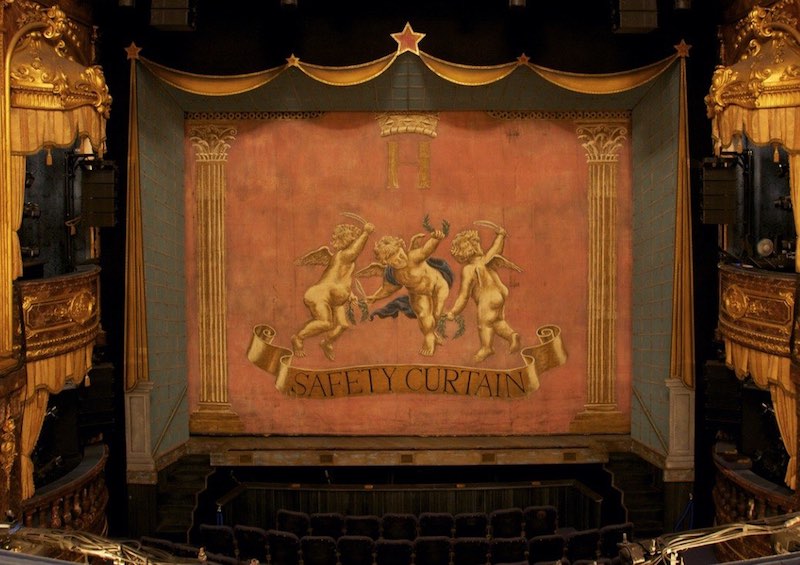
A Safety Curtain is required by most UK licensing authorities for theatres of traditional design. The regulations also require that it is raised and lowered at least once in view of each audience (usually during the interval). Usually made from sheet metal and electrically operated, these curtains were originally of iron construction faced with asbestos and lowered by gravity using a hydraulic damping system. Colloquially known as the "iron".
Some Safety Curtains are painted - the iron at the Theatre Royal Drury Lane has a beautiful design with the text "For Thine Especial Safety".
The musical Billy Elliot uses a false iron as a scenic device with a pair of doors in it, which would not be permitted for a real iron.
The line on the stage where the fire curtain drops, usually a short distance from the downstage edge of the stage, is known as the FIRE CURTAIN LINE and cannot be obstructed by any fixed scenery.
Also known as FIRE CURTAIN, IRON or ASBESTOS. See also DRENCHER.
SAFETY EDGE
A safety sensor on the edge of a piece of automated scenery (usually a moving platform) that the automation system uses to detect something or someone out of place and take appropriate action.
SAMOILOFF EFFECT*
In the 1920s “electro technician†Adrian V. Samoiloff developed the use of this colour phenomenon to dramatically change a stage picture in the theatre, costume and sets using simple lighting changes. Read more.
SAMPLER
Electronic device for recording a series of sounds digitally so that they are available instantly for playback. Samplers for theatrical use have a number of independent outputs (normally 8) to which any sound sample can be sent at any time. Samplers can be controlled by a MIDI keyboard or by computer control.
SAMPLING
The technique of recording a sound digitally (translating the analogue audio waveform into a series of electrical ons and offs that can be manipulated by a computer) for subsequent processing, editing and playback.
SAND BAG / SHOT BAG / BIG SHOW or BIG SHOW BAG
A canvas bag or sack, sealed at one end and tied at the other end, used to act as a weight. A sand bag can be attached to an unused flying spot line to stop it running back through the pulleys, and to enable it to fly in without fouling adjacent equipment. The difference of the SHOT BAG and SAND BAG is that a SAND BAG has sand in it and a SHOT BAG has metal balls to the exact weight required of the bag.
SANDNET
Network operating system integrating standard communications protocols with a multitude of industry and manufacturer-specific control protocols.
Sand Network Systems website
SATIRE*
the use of humour, irony, exaggeration, or ridicule to expose and criticize people's stupidity or vices, particularly in the context of contemporary politics and other topical issues.
SATURATION
The amount of COLOR in a lighting state, paint treatment or costume design.
The term is usually linked to Hue, which is the COLOR of a light, costume or piece of scenery (etc.).Â
A de-saturated treatment has less COLOR than before.Â
SATURATION RIG
An arrangement of lanterns in which to maximum number of spotlights is placed in every possible position.
SATYR PLAY
Satyr plays were an ancient Greek form of tragicomedy, similar in spirit to burlesque.
A Satyr is one of a troupe of male companions of Pan and Dionysus. He has horse-like features. Roman Mythology identifies the Greek satyr with its faun being half-man, half-goat.
Satyr Plays featured choruses of satyrs, were based on Greek mythology, and were rife with mock drunkenness, brazen sexuality (including phallic props), pranks, sight gags, and general merriment.
SAVE
(US especially) To extinguish a particular lighting instrument (e.g. 'Save 14'). The instrument's lamp (and its COLOR filter) are thus saved for another occasion. Used when setting up lighting states.
Submitted by Peter Neilson.
SBTD
Society of British Theatre Designers.
SBTD Website
SCALE /Â SCALE DRAWING /Â SCALE RULER
Plans and technical drawings have to represent (often very accurately) the real-life dimensions of the objects they're showing. One way to do this is by showing the dimension on the drawing. However for complex layout plans (e.g. lighting plans, set plans) there's not enough room on the drawing. So, a SCALE is chosen which relates the drawing to the real world. Common metric scales in the theatre are 1:25 (1cm on the drawing is equivalent to 25cm in reality) or 1:50. Common imperial scales are 1:24 (1 inch on the drawing is equivalent to 24 inches or 2 feet in reality) or 1:48. The choice of scale depends on the size of the object(s) you're representing. It's obviously very important to show on the drawing the scale being used. A SCALE RULE is calibrated with scaled measurements and can be used to easily read off dimensions from a range of different scales.
SCANNER
General name for a moving mirror lantern, especially those used in discos, rather than the more flexible units used in theatre.
SCART
SCART is a 21-pin connector standard which transmits full video and audio signals. Also known as Peritel, Peri TV, or Euroconnector. SCART cables are sometimes uni-directional, and care needs to be taken to ensure the correct cable is used for a particular application. The cables are notoriously unreliable in heavy duty situations, and pins get broken or pushed in fairly easily. However, handled with care, and left in equipment, they are perfectly fine.
Main definition submitted by Stephen Bourke.
SCENA*
a scene in an opera , usually longer than a single aria
SCENE
1) A pre-programmed lighting state which can be faded in and out during a one night show when there's no time for plotting.
2) A subdivision of a play. See also ACT.
SCENE CHANGE
1) A break between scenes in a play script.
2) A pause during a theatrical performance during which the layout of scenery, furniture or props on stage is changed. This is used to indicate a change of location, or a change in time. As automated scenery becomes more common, scene changes are rarely as painful and jarring as they once were. Even without automated scenery, a well-choreographed crew can execute complex scene changes in seconds. There may not need to be a pause in the action as the actors can continue to deliver lines while the change happens beside / behind them. A scene change is often accompanied by a piece of music. More traditional performances may use a front cloth downstage, in front of which a more straight-forward scene is played out, while the scene change happens upstage. Or there may be an interval scene change, where the crew transform the stage scenery for a completely different look after the interval.
Also known as a SET CHANGE.Â
SCENE DOCK
High-ceilinged storage area adjacent to the stage, sometimes used for building and storing flats and other scenery.
SCENE SHOP
(US) Section of the theatre where scenery is constructed. Often shortened to 'Shop'.
SCENE-BY-SCENE BREAKDOWN
A listing of the scenes (or even pages) in the script, stating what events happen in them. This can be a useful exercise to get to know the play, but is also useful to be able to remember when in the play a particular event happens, and is a useful rehearsal room reference.Â
Example:Â
Act 1 Scene 1: We meet the family, Claire states her wish to leave the company.Â
Act 1 Scene 2: We meet Claire's boss and it becomes clear how much she is depended on.Â
SCENERY
The flattage on the stage and any flown scenery or cloths that have been assembled by the set team, under the direction of the set designer for a particular performance. The arrangement of scenery for a particular scene or part of the performance is known as the 'set'.Â
SCENIC
Anything connected to the scenery and/or practical elements that are part of the stage set.
A Scenic Artist is skilled in a range of different paint, texturing and modelling techniques to realise the artistic intention of a Set Designer.
SCENIC CARPENTER
A member of the set-construction team that builds the wooden parts of the set, under the supervision of the Head (or Master) Carpenter.
SCENIC PAINT
Traditionally, a mixture of glue size, water and pigment. Modern practice has also adopted PVA (emulsion glaze) as a bonding medium which can be used when scenery has got to be washed and used again.
SCENOGRAPHER /Â SCENOGRAPHY
Designer responsible for all the SCENOGRAPHY - the visual aspects of a production (lighting, scenery, costumes etc). One of the greatest scenographers of current times was Josef Svoboda (1920-2002).
Lighting Practitioners
SCISSOR LIFT
A scissor lift is a type of aerial work platform (AWP), also known as an aerial device, elevating work platform (EWP), or mobile elevating work platform (MEWP). The AWP is a mechanical device used to provide temporary access for people or equipment to inaccessible areas, usually at height. The MEWP can usually be driven around the work area by the operator at height to provide safe access to a wide area, on a flat floor. Scissor lifts have also been used in scenic automation to provide a moveable platform, often built onto a moving base. The scissor lift is used because it is a self-contained device which requires no construction for it to operate within, and which does not extend beyond the horizontal dimensions of the platform.
The mechanism to achieve the vertical lift is the use of linked, folding supports in a criss-cross X pattern, known as a pantograph (or scissor mechanism). The upward motion is achieved by the application of pressure to the outside of the lowest set of supports, elongating the crossing pattern, and propelling the work platform vertically. The platform may also have an extending bridge section to allow closer access to the work area, because of the inherent limits of vertical-only movement.
The contraction of the scissor action can be hydraulic, pneumatic or mechanical (via a leadscrew or rack and pinion system). Depending on the power system employed on the lift, it may require no power to enter descent mode, but rather a simple release of hydraulic or pneumatic pressure. This is the main reason that these methods of powering the lifts are preferred, as it allows a fail-safe option of returning the platform to the ground by release of a manual valve.
SCONCE
A wall-mounted light fixture, where the light is directed upwards. Also refers to a wall-mounted flaming torch.
See also FLAMBEAUX.Â
SCOOP
A special type of floodlight consisting of a lamp mounted in a large ellipsoidal reflector. The body of the instrument is usually circular which means a soft edged circular beam is produced. A standard FLOOD has a rectangular body.
SCORE
1) The score is the written notation of a musical work. An arrangement of a piece of music for piano is called the Piano Score. An arrangement for a singer is the Vocal Score.
See also LIBRETTO.
2) A series of directions for a physical theatre / dance performance is sometimes called a 'score'.
3) A soundtrack running underneath a performance is called UNDERSCORE.
4) The music / sound tracks running during a performance is sometimes called the score.
SCR
Silicon Controlled Rectifier. See THYRISTOR.
SCREEN (PROJECTION)
Many types of projection screen are available. Some are multi-purpose, some only for front projection, some only for back projection. If a screen is not self-supporting, it often has eyelets around the outside edge which are used to 'lace' the screen onto a larger frame.
See also PROJECTION.
SCREW EYE
A threaded metal ring screwed to the rear of a flat for securing a stage brace.
SCRIBBLE STRIP
DIsplay window on a lighting, sound or automation control desk which enables the user to add a description of the function of that channel. Can be entered as text, or a hand-drawn image or text. This enables graphical characters (e.g. Chinese) to be used, or other symbols.Â
On older analogue systems, the channel function was written on a piece of white PVC tape that was stuck on the control desk. Some systems had a white plastic strip on which chinagraph pencils (wax) could be used.Â
SCRIM
1) A coarse gauze
2) A fine metal mesh used to reduce the intensity of light from TV lanterns without affecting COLOR temperature.
3) Plastic gauze-like material used to line Heras fencing at festivals and other events to act as a partial sight-screen, and also to make the fencing tone in with surroundings.
See also Lighting With A Gauze / Scrim
SCRIPT
The text of a play, containing the words spoken by the actors. Also contains stage directions and other notes.
The script of a piece of musical theatre is called the Libretto. The script for a piece of physical (or non-verbal) theatre is called the Score.Â
SCROLLER
SCUMBLING
A scenic artist technique for adding atmosphere and texture to a painted surface, by applying a thin layer of partially transparent GLAZE. The glaze layer can vary between being transparent or opaque, but best results are obtained with opaque light colors over a dark base. This can produce a cloudy effect because it allows some of the painted surface below to remain visible, but not all of it.Â
SDI
Stands for Serial Digital Interface. AÂ standard for digital video transmission over 75 ohm coaxial cable, using BNC connections.Â
SEAMSTRESS
Member of the wardrobe department who operates sewing machines and carries out other sewing tasks.
SECAM / S.E.C.A.M.
Television standard used mainly in France and former USSR. Stands for 'Séquential Couleur à Mémoire'
Uses 625 lines of resolution like PAL and 25 frames per second, but has a COLOR processing system not compatible with other systems. See also PAL and NTSC.
More about TV standards
SECONDARY LIGHTING
Separately powered lighting system for use throughout the building in the event of failure of the primary system. Usually battery powered. Maintained lighting is on all the time, regardless of changes in the stage lighting, and is battery backed-up.
Non-maintained systems only light in the event of power failure or an alarm condition.
Secondary lighting systems should be regularly checked by an electrician to ensure they operate correctly.
SECTION
See ELEVATION.
SEGUE
Musical term for an immediate follow-on. Now often used as jargon for any kind of immediate follow-on.
Pronounded 'segway'
SELECON
(Manufacturer) New Zealand-based manufacturer of theatre lanterns.
Selecon website
SELECTED AUDIENCE MEMBER / SAUD
An audience member that has been selected by the cast and crew of the production to be part of the scene, or segment of the production. This SAUD normally is brought on stage, but can also be kept in the performance area and be asked to perform or be involved.
SEMAPHORE
See COLOR CHANGER.
SEMIOTICS
The study of signs - many conventions in lighting design rely on signs (blue must be night-time, red is evil etc.)
Semiotics for Beginners
SEND
See AUXILIARY OUTPUT.
SEQUENCING
A act of recording digitally and manipulating the MIDI information required to remotely play a synthesizer keyboard or similar device. A sequence of notes.
SERIES SPLITTER
An adaptor consisting of a plug and two sockets wired in series. Enables two identical 110 Volt loads to be safely run from a 240 Volt supply (UK).
SET
1) To prepare the stage for action. (verb) - e.g. 'Have you set the chairs for Act 1?'
2) The complete stage setting for a scene or act. (noun) - e.g.'What's the set for the finale?' French: décors.
See also RESET.Â
SET BACK
To reset technical systems to a particular point in the show in order to repeat a sequence or scene during rehearsals. (e.g. 'Can we set back to the entrance of Lady Bracknell').
See also RESET.Â
SET BUILDER
Member of theatre's production department or outside contractor who is responsible for realising the set designer's construction in timber, steel or other material as specified by the designer.
SET DESIGNER
Member of the artistic team for a show who works with the director to create the scenic 'look' for the stage throughout the show and any accompanying props. She/he sometimes also designs the costumes.
The set designer works with the production manager to ensure the design stays within the budget. Many theatres have a stock of scenery which means that items can be reused by recovering or repainting in a different production
In Europe, the set design is sometimes called 'D?cor'.
See also MODEL, SCENOGRAPHER.
SET DRESSER
Member of production staff who is responsible for the props and furniture that are required on the set. This position only exists in larger organisations. Set dressing is often the job of the stage management department.
SET DRESSING
See DRESSING.
SETTING LINE
Imaginary line running across the width of the stage, in line with the proscenium arch, which is marked on the groundplan and is used as a reference when planning furniture layouts etc. Usually the furthest downstage anything can be set without fouling the house tabs.
Known in some theatres as the PLASTER LINE - this refers to the upstage edge of the proscenium wall.
See also CENTER LINE.
SFX
1) Abbreviation for SOUND EFFECTS.
2) Windows media playback software by Stage Research.
SHACKLE
A metal connecting device originally for joining chain, comprising two parts. An open link connects the items to be joined and a pin is fitted to make the link complete. Many sizes and designs exist, the most common to the entertainment world being the screw pin 'bow' or 'anchor' shackle, originally for fixing chains to anchor stocks. The pin should always loaded in shear, not in tension.
Submitted by Chris Higgs
SHADE
1) Artistic lighting design can (sometimes) be about what is not lit as much as what is. Light and Shade together make up the overall picture.
2) A lampshade is positioned around a light fitting to direct the light as desired and to improve its' appearance.
3) Actors strive for a variation of tone and emotion -Â the terms light and shade are sometimes used to describe the tonal variety.
See also CHIAROSCURO
SHAKESPEARE'S GLOBE
The Globe Theatre was a theatre in London associated with William Shakespeare.Â
It was built in 1599 by Shakespeare's playing company, the Lord Chamberlain's Men, on land owned by Thomas Brend and inherited by his son, Nicholas Brend and grandson Sir Matthew Brend, and was destroyed by fire on 29 June 1613.
A second Globe Theatre was built on the same site by June 1614 and closed in 1642.
A modern reconstruction of the Globe, named 'Shakespeare's Globe', opened in 1997 approximately 750 feet (230 m) from the site of the original theatre.
SHEAVE
The wheel in a pulley block which carries the wire or rope.
SHEET BEND
Useful knot for joining two pieces of rope of different thicknesses to extend them.
Video
SHIELD
In an audio cable, a conductive cylinder around one or more center conductors that protects against unwanted electrostatic fields that could induce a signal, heard as a hum or buzz, across the conductors of the cable.
SHIFTER
The common Australian term for AJ's, c-wrenches, spanners etc.
SHIM
A thin piece of material used to fill a small gap between pieces of scenery, or to reduce wear between two pieces of (e.g.) staging.Â
SHINS
The lowest lantern on a lighting boom. Named because of the proximity of sharp parts of the lantern to the flesh of the lower leg. This especially applies to standard dance lighting, when the lanterns are positioned at optimum height to light dancers on the stage floor. When the boom is lighting scenic items or large groups, the lanterns may be higher up the boom and the term will no longer apply.
Also known as SHIN BUSTER. The other lanterns on the boom are known as MIDS and HEADS.
SHOP
Short for SCENE SHOP.
SHORT NOSE
Normally refers to a Short-Nose Parcan - a lighting instrument that uses a normal size PAR lamp, but has been shortened to either make it less obtrusive, or to get a wider beam angle.
SHOT BAG
A heavy-duty canvas bag filled with lead shot, used as a weight to hold scenery in place on stage. See also BRACE WEIGHT.Â
SHOTGUN MICROPHONE
A type of highly directional, high quality condenser microphone which can be placed a relatively long way from a sound source. A shotgun microphone uses a hypercardoid PICK-UP pattern.
SHOW BUILDING
Covered structure within a theme park containing a single ride system.
SHOWCUE / SCS
A program that loads and sets audio/visual/lighting cues for an event/show/performance.
SHOW CLOTH
Front cloth painted with a design specific to a particular show, sometimes containing the show logo or title.
SHOW CONTROL*
Show control is the use of automation technology to link together and operate multiple entertainmentcontrol systems in a coordinated manner. A typical entertainment control system would be lighting control.
SHOW DECK
A false floor built on top of the theatre stage, which contains technical elements such as automation tracks or revolves, concealed lighting or smoke effects. In some large shows, the show deck completely replaces the existing theatre stage, which is put back into position when the show has finished it's run.Â
SHOW ELEMENT
Term for an item of scenery or prop required for a production.
SHOW RELAY
A network of speakers carrying the sound of the show, and sometimes stage managers calls, to the furthest reaches of the theatre. (e.g 'Can we turn the show relay down please?')
SHOW REPORT
A written report by stage management giving problems, running times, show staff and audience numbers for the previous days' performance(s). Copies are circulated to the technical departments and management staff and a copy is filed in the prompt book. Also known as a Performance Report.
The Show Report
SHOW STOP
When an emergency situation means the performance cannot continue, a SHOW STOP is announced. The stop would be called most often because of a safety issue (e.g. a piece of scenic automation is stuck in a dangerous position, or is blocking the stage or flytower in such a way that the show cannot continue. Or a performer has been injured). The audience may be asked to leave the theatre (and be issued refunds) or be asked to remain in their seats while the situation is corrected. For example, if a trapdoor is stuck open, the show must be stopped until it can be closed and made safe.
A heavily automated show should have a pre-recorded announcement, but it may be more human / theatrical to have a member of the stage management team or the company manager to walk on stage with the houselights up and make an announcement along these lines: 'Ladies and Gentlement, sorry to interrupt the performance, but we've had to pause the show here for a few moments while we reset some technical equipment to enable us to continue safely. Please remain in your seats - the performance will continue shortly'. Obviously if there's a major failure and it's unlikely the performance will be able to continue, the procedure should be to apologise to the audience, to give them information about how to obtain a refund or another ticket, and then to ask them to leave the auditorium.Â
SHOWCALLER
The member of the stage management team who is calling the cues. In the UK this person is known as the DSM on the book.
SHOWDESIGNER
Visualisation software produced by Martin.
Martin website
SHOWING
A less-formal performance, used as part of the development process of a piece of theatre, for an audience connected to the developers in some way rather than being a full public performance. A SHARING is similar, but is for a more defined audience - usually the group that is working on the piece, and other members of a creative team.Â
SHURE
(Manufacturer) American sound equipment maker specialising in microphones (especially the industry standard SM58 vocal mic).
Shure website
SHUTTER
SIBILANCE
Undesirable characteristic of some performer's speech when s, sh or ch sounds are emphasised.
SIDELIGHT
Most associated with dance lighting, Sidelight comes from the wings of an end-on stage, and lights the dancers' / actors' bodies, without lighting the stage floor, and without lighting the scenery.
This type of light has a sculpting effect on the bodies, and really separates them from the scenery / backdrop / cyclorama, and reduces distracting shadows on the stage floor.
See also FRONT LIGHT, BACKLIGHT, CROSSLIGHT, DOWNLIGHT.Â
SIGHTLINES / SIGHT LINES
A series of lines drawn on plan and section to show how much of the stage can be seen by the extreme seating positions in the auditorium. Often marked in the wings as a guide to the actors and crew to stay out of view.
SIGHTS
A pair of metal rings attached to the side or top of a followspot which enables the operator to accurately line up the beam (by looking down the length of the followspot through the rings) before turning it on. See GHOSTING.
SIGNAL TO NOISE RATIO
The ratio of the average signal (recorded or processed) to the background noise (due to the recording medium or electronic processing). The ratio is usually expressed in decibels.Â
SILAMIDE
Silamide is a pre-waxed two-ply twisted nylon thread. It has a great texture and is strong and resiliant. It can be used for all beadweaving stitches including loom work and bead embroidery.
Sold on cards of 40 yards (approximately 36.5 m). (Definition from Robins Beads - see link below)
SILHOUETTE
1) To light the cyclorama or a piece of upstage set in such a way that the actors are cast into shadow. Can be a very dramatic effect.
2) (Trade Name) A range of 2000W lanterns manufactured by CCT in the UK.
CCT Silhouette in the Backstage Heritage Collection
SILK
A special type of diffusion frost filter which stretches the light in one direction. Especially useful for lighting large cycloramas with a limited number of lanterns, or for lighting an elongated object (eg a staircase) with one lantern.
SILK FLAME
A substitute for a real flame, consisting of flame-shaped pieces of light-COLORed silk, with an orange/red light underneath, and blown by a fan pointing upwards. The airflow keeps the silk upright, with a random movement which from a distance reads as a flame.Â
SILL
See FLAT.
SILL IRON
A piece of flat iron screwed to the bottom rail of a door flat which holds it together, and ensures that the flat doesn't warp. Invisible to the audience.
SILVER JET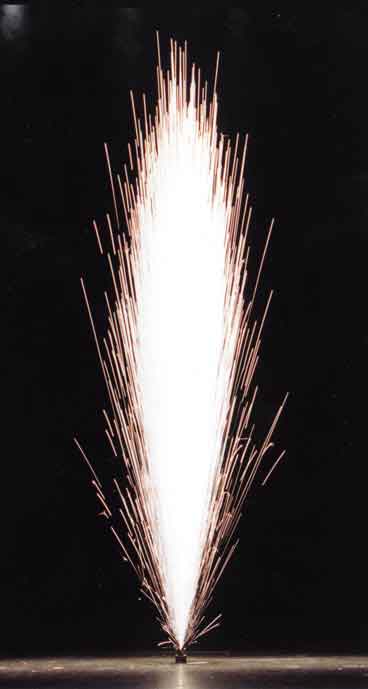
SINAKULO
A retelling of the story of Jesus Christ, performed each year during Holy Week in lowland Philippines. Performed outdoors by and for the community in villages that observe this folk drama tradition.
See also MYSTERY PLAYS.
SINGLE PURCHASE
Counterweight flying system where the cradle travels the same vertical distance as the fly bar. The counterweight frame therefore occupies the full height of the side wall of the stage. See also Double Purchase.
SIRIUS
(Trade Name) Manual/memory lighting control desk previously manufactured by Zero 88 in the UK. Available as Sirius 24 (24 channels) or Sirius 48. Desks can be linked together.
Zero 88 website
SITE-SPECIFIC THEATRE
A piece of performance which has been designed to work only in a particular non-theatre space. The space may have been adapted to fit into the themes or style of the production. A site-sensitive (or space-sensitive) piece, on the other hand, will not adapt the space, but work with it's style and history to create a piece of performance. See also INSTALLATION.
SITZPROBE
(German for seated rehearsal). The first rehearsal between Opera singers and the orchestra. No attempt is made to act or move the production at this rehearsal.
See also WANDELPROBE
SIX LAMP BAR
SIZE
A bonding medium used with pigments and water to make an economic paint. Size is produced by boiling animal connective tissue, so it's known as Animal Glue. It's similar to Gelatin, also an animal glue, which is used in foodstuffs.
See also SCENIC PAINT.
SKENE
Greek word (skēnē pronounced skay-nay) referring to the area at the rear of the acting area in an ancient performance space. The skēnē was originally a building or tent, but was sometimes painted onto scenery.
SKIN MONEY
Extra payment made to actors/actresses when nudity is required on stage.
SKIP (Costume/Props)
A large wicker basket or box, often wheeled, which stores costumes and/or props for touring.
SLAPSTICK
1) Two pieces of wood loosely joined at one end, which make a loud 'slap' sound when used to hit something / someone.
2) Form of physical comedy where people get hit, covered in custard pies or showered with water.
SLATE
(Actor audition term) When auditioning on-camera, or when recording a piece of footage, an actor may be asked to Slate their name and their agent's name, or to Slate the scene being recorded. This term is from the film industry when a piece of slate with chalk writing on it to indicate the actor being shot was filmed for a few frames before the actor, to enable later identification.
SLEEVED STEEL
A 'steel' that is fitted at manufacture with a loose protective sleeve of PVC tubing (ideally transparent, to permit examination of the wire rope) or roundsling sheathing.
Submitted by Chris Higgs
SLIDE
See PROJECTION.
SLOAT
Now obsolete term for a piece of Victorian stage machinery first mentioned in 1843.
A sloat is a set of vertical rails or runners which were used to carry a platform for raising or lowering profile scenery, groundrows etc through a cut (narrow trap) in the stage floor. Believed to be a variant of 'slot'.Â
SLOPER
A clothing pattern based on exact measurements of a particular person. The sloper can be used with any existing pattern to ensure a perfect fit.Â
SMA / S.M.A.
(UK) Stage Management Association who also publish the Freelist - a list of stage management available for work.
SMART GLASS
Glass (or film that can be applied to existing glass) which can make a window opaque when an electric current is passed through it.Â
SMOKE
See SMOKE MACHINE
SMOKE COOKIE
A pyrotechnic product which produces a cloud of real smoke when set alight.
Also known as a Smoke Pellet.Â
SMOKE DETECTORS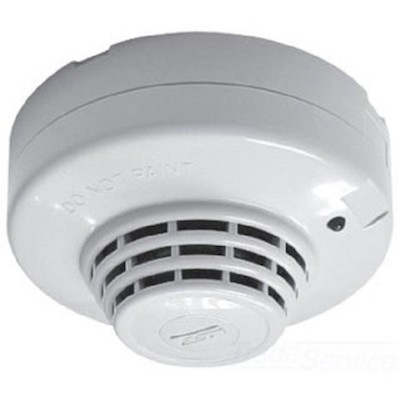
There are special heat-sensitive detectors called RATE OF RISE detectors which trigger a fire alarm when the temperature rises faster than it should normally. Properly calibrated (and regularly tested) these can be as effective than the smoke detectors (which work by 'seeing' smoke particles in the air). If it's not possible to get Rate of Rise detectors installed in your theatre space instead of smoke detectors, you may be able (subject to local building regulations and local fire department advice) to isolate the smoke detectors for the duration of the performance when you use smoke effects. Properly designed alarm systems incorporate timed isolation, so that smoke detectors are only off for a specific period, and automatically come on after that period.
SMOKE MACHINE
A Smoke Machine or Fogger is an electrically powered unit which produces clouds of white non-toxic fog (available in different flavours/smells) by the vaporisation of mineral oil. It is specially designed for theatre & film use.
A Haze machine, Hazer or Diffusion Fogger is used to produce an atmospheric haze, rather than clouds of smoke, and is used by many lighting designers to reveal airborne light beams.
The first smoke machines came onto the market in the late 1970s.
See also CRACKED OIL, DRY ICE.
It's essential to know whether your venue uses SMOKE DETECTORS on the fire alarm system. See that entry for more information.
SMOKE POCKET
A vertical steel channel on the upstage edges of the proscenium arch in which the edges of the fire curtain travel, designed to stop smoke travelling around the fire curtain.
SMPTE
(pronounced 'SIMPTEE') SMPTE stands for Society of Motion Picture and Television Engineers (US).Â
The term refers to a timecode for synchronising pre-recorded show elements (e.g. sound or video) with other elements. For example, a timecoded 'click' is played to the musicial director to enable her/him to keep in time, and lighting and video cues are triggered at a particular time within the piece of music. Timecode is measured in hours, minutes, seconds and frames. There are 25 frames per second, meaning an accuracy of 1/25th of a second is possible.Â
SMPTE website
SNAGGING
Contruction industry term for the process of looking at a completed building and making lists of problems, breakages or imperfections in the result. These 'snags' are then addressed by the building company so that there are none by the time the building is occupied by its' end users. Term could also apply to the same process of checking for problems around a set build before the actors are let loose on it.Â
SNAKE
See MULTICORE.
SNAP /Â SNAP CHANGE
A lighting or sound cue with no fade time - the cue happens instantly.
This can be acheived on a computerised lighting desk by using a fade time of zero seconds.Â
SNAP BLACKOUT
Lighting: A sudden cut to blackout (often abbreviated to SBO). A blackout with a fade time of zero seconds.Â
SNAP HOOK
A plastic or metal 'S' hook used to hang tabs etc. A sprung catch prevents the hook becoming detached.
SNAP LINE
Chalked piece of string which, when stretched tight and 'snapped' is used for marking straight lines on stage or on scenery as a painting aid.
SNAPPER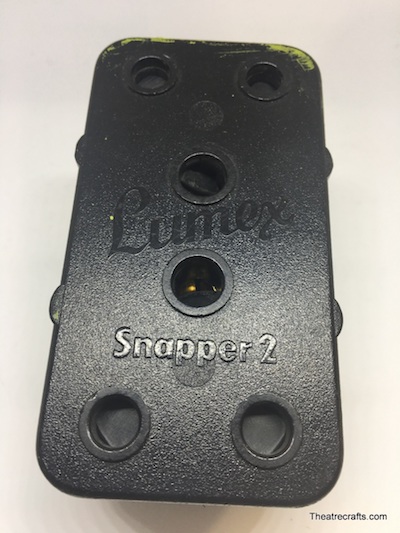
SNEAK
Function on ETC lighting desks which allows you to remove a channel from a 'live' lighting state at a preset speed.
(e.g. SNEAK 1 ENTER will fade channel 1 out of the current lighting state).Â
SNOOT
See TOP HAT.
SNOW BAG
Long narrow cloth bag fixed between two flying bars filled with artificial snow. When one of the bars is flown in and out the snow is shaken out onto the stage.
SNUB
US term. To sieze the lines on a flying piece to prevent it's movement, either with another rope or with a mechanical line locking device.
SOCA / SOCAPEX
A multipin connector which can carry a series of lighting or sound circuits. Very robust and designed for touring. Available in 19 pin (6 circuits) and 37 pin (12 circuits) configurations. Sometimes shortened to SOCA. See also LECTRIFLEX.
SOFT GOODS
Any fabric used for decoration or masking around the stage.
SOFT KEY
Short for Software Key. A button on a lighting or sound desk whose function changes according to your last action. The function of the soft key is often shown on an adjacent display panel. The keys are often numbered rather than being labelled (e.g. on the ETC Express and Ion range of lighting desks, the soft keys are numbered S1 to S8).
SOFT LIGHT
Asymmetric flood light used as a fill light in TV studios to eliminate shadows and balance the key light.
SOFT PATCH
See PATCHING.
SOFTENING
The materials used to protect a sling or an object from sling damage (burlap or PVC sheathing etc.)
Submitted by Chris Higgs
SOLILOQUY
Lines delivered by an actor on stage as if to her/himself. See also MONOLOGUE, DIALOGUE.
SOLO
1) On a sound desk, the solo button on each input channel silences all other inputs so that channel alone can be heard. Dangerous to use during a show, but can be useful for fault-finding or testing equipment.
2) On a lighting desk, SOLO mode kills all other channels except the single dimmer you're working with. Again, can be useful for identifying a channel in a large rig, but can be dangerous during a show. Some desks allow you to assign flash buttons to SOLO mode which will turn off all channels except those loaded into that flash button or submaster. This can be used for a quick lightning effect (but it's a bit tacky). On Strand Lighting memory desks, the solo function is called REMAINDER DIM (or REM DIM).
SOLT
Society of London Theatres (UK)
SON ET LUMIERE
An audiovisual entertainment often based on an historical theme (and often produced in a historically relevant location). A voice narration is often used and lighting / special effects set the mood and portray certain events in time with the narration. Often used to refer to a performance with no performer where the meaning is communicated solely with technical effects.
SONGSHEET
Traditional ending to a British Pantomime performance, usually involving the Dame character encouraging the audience to sing along with a traditional (and/or silly) song that conveniently allows the stage management team to set up the WALKDOWN, a usually spectacular finale to the performance. The lyrics of the song are flown in, in front of the frontcloth. This sequence may also involve announcing any special visitors or audience birthdays, and possibly inviting a couple of children to the stage to take part in the song.Â
SOP / S.O.P.
Standard Operating Procedure. The preferred method for running a particular attraction or ride in a theme park / amusement park.
SOUND BOARD
See MIXER.
SOUND CHECK
A thorough test of the sound system before a performance. This will include checking each speaker cabinet individually, and each playback device. In the case of a live concert, this is the session when each instrument is played in turn for the sound engineer to check and fine-tune the sound. A line check should be carried out methodically to ensure that every input to the sound desk is working correctly.
SOUND DESIGNER
Member of the production team who has the responsibility for planning and executing the layout of all sound playback and reinforcement equipment for the show. This role also includes the sourcing of music and sound effects for the production.
See also SOUND OPERATOR.
SOUND DESK
See MIXER.
SOUND EFFECT
See Effect, Sound.
SOUND OPERATOR
Also known as Sound Op. The Sound Operator is responsible for operating the sound playback and mixing equipment for a show. He or she is sometimes a member of the Electrics department of the theatre and works with the sound designer for the production, or they may be employed just for the show.Â
The main operator is called Sound No.1. A standby / second operator is Sound No.2 and so on.Â
SOUND REINFORCEMENT
Amplifying a voice just enough so that it can be heard, without the audience being aware that it is being amplified (ideally !).
SOUND TO LIGHT
A facility which can link the effects panel on a lighting board to an audio input which detects treble, mid and bass beats, and can flash lights or trigger effects in time to those beats. First used when electronics allowed it cheaply in the late 1960's/
SOUNDCRAFT
(Manufacturer) Maker of Sound Desks in the UK.
Soundcraft website
SOUNDSCAPE
A background sound that runs under a scene, to help establish a reality for the world of the play, and to immerse the audience in that world. It can also be used to heighten emotional moods and to emphasise important occurances.Â
SOURCE FOUR
(Trade Name) (Also known as S4) Range of lanterns manufacturer by ETC, and designed by David Cunningham.Â
ETC website
SPAA
Screen Producers Association of Australia.
SPAA website
SPADE
Thick metal blade which is inserted through a piece of moving scenery into a MOUSE to allow the movement of the scenery to be controlled by an AUTOMATION system.
SPADING UP / SPADED UP
The act of preparing an item of scenery to be moved by a scenic automation system using a MOUSE / SPADE system.
SPANSET
(Trade Name) Sling and safety equipment manufacturer, whose name is often generically used for a roundsling. Spanset were the originator, and popularised the modern day roundsling.
Spanset website
Additional information submitted by Chris Higgs.
SPARK PRODUCING DEVICE (SPD)
Pyrotechnic effect that creates a focussed burst of sparks from a small tube.Â
SPARKY
See LAMPY.
SPATTERING
A scenic artist technique for breaking down a painted surface to make it look more interesting, by taking a paint brush and flicking it to throw random spatters of paint.
SPDIF or S/PDIF
Sony and Philips Digital Interconnect Format. Digital link between (usually) CD players and recording equipment. The S/PDIF format can cope with sample rates of up to 96kHz (CD is only 44.1kHz) and 24bit (CD is only 16 bit). S/PDIF followed on from AES/EBU (similar data stream, but different connector).
More about S/PDIF
SPEAKER
See Loudspeaker.
SPEAKON CONNECTOR
Manufactured by Neutrik. A type of shielded, locking multipin speaker connector which can safely carry the high currents from an amplifier needed to drive large speaker systems. Available in 4- or 8-way types, and ideal for bi-amplified systems. The cable version of the connector is male, and the panel mount connector is female.
Neutrik website
SPEAR CARRIER
An scene or segment where the actors perform and act in real-time and appear to be having a dialogue where the dialogue is not spoken but mouthed. This is also known as an APHONIC scene/segment which is similar to a mime or miming. A MIME is to convey or represent (an action, idea, or emotion) by using only gesture and movement while pretending to perform/act/sing or play an instrument as an audio/sound track is being played to fill the atmosphere.
SPECIAL
An instrument within the lighting rig which is required for a specific moment or effect within the performance, and is not part of the general cover lighting. See GENERAL COVER.
SPECTACLE
A theatrical performance using large scale scenery and effects to wow the audience. Popularised in Victorian times, they featured water tanks, live animals, moving stages and aerial effects.Â
SPEEDRAIL
System of low-profile scaffolding clamps using allen keys to secure them in place. Used for a range of theatre / exhibition projects. Made by Hollaender in the USA.Â
Hollaender website
SPIDER
Adaptor to connect many lanterns to one multicore cable. Consists of multipin connector (typically Socapex or Lectriflex), short length of cable, then a number of sockets related to the number of circuits in the cable.
SPIGOT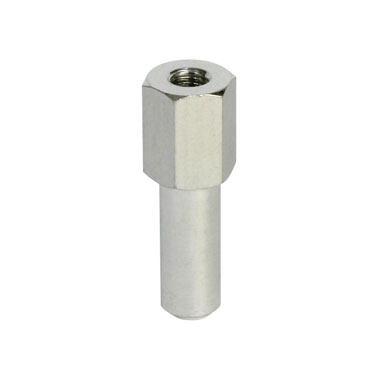
SPIKE /Â SPIKE TAPE
1) (vb.) To mark the position of an item of set/furniture on stage or in the rehearsal room.
2) (n.) A mark on stage (e.g. 'put the chair on the spike')
Spike Tape is normally thin gaffa tape, although other weaker tape (e.g. masking tape) is used on precious floors. Sometimes, any securing of cable etc to floor is known as 'Spiking'.
Where precision is required during blackouts, GLOW TAPE is often used to spike positions.
On large productions with show decks installed above the main theatre stage, small embedded LED bulbs can be used to mark specific positions. These can be switched on and off as required.
See also SPIKE MATRIX.
SPIKE MATRIX
A document listing positions of spike marks needed for a show, to aid in the transferring of marks from rehearsal room to stage. Especially useful when touring. The positions are defined by a distance from the center line and from the setting line (usually the proscenium arch line / front of the stage). The table should also include the COLOR of tape to be used, what the mark is representing, and which scene it appears in.
SPILL
Unwanted light onstage.
SPILL RINGS
Concentric rings attached to the front of a beamlight (eg Strand Pageant) to contain spill.
SPIRIT GUM
An adhesive used to stick (e.g.) false facial hair to actors skin. Can be removed with surgical spirit.
SPL (Sound Pressure Level)
A measurement of the loudness of a sound.
SPLICE
A join or edit in a sound tape. A splice may be between leader tape and audio tape or between two pieces of audio tape. Splicing tape is the adhesive tape used, a splicing block is used to hold the tape and guide the single-sided razor blade when making the cut.
SPLITTER
See ADAPTOR.
SPONGING
A scenic artist's technique to apply a textured paint finish to a piece of scenery or a prop, achieved by dipping a natural sponge into paint and then applying it to the scenery.
SPOT
1) To reduce the beam size of a fresnel or pc lantern by moving the lamp further from the lens. (e.g. 'Could you spot that down a touch, please?'). See also FLOOD.
2) A profile spotlight (e.g. 'The third spot we need for the show is on the piano DSL')
3) A moving light that can project gobos and/or a beam with hard-focussed edges. (see also WASH)
Types of lantern
SPOT LINE
A temporary line dropped from the grid to suspend something in an exact special position.
SPOT SEAT
Chair for suspending followspot operator above a stage / auditorium. Normally rigged on a truss system. The operator gets to the seat up a wire rope ladder, and is strapped into the seat. He or she will normally wear a harness when getting to the chair for extra safety. The seat itself is an adapted car 'bucket' seat.
SPOTLIGHT
General term for any lantern with a lens system. See Fresnel, PC, Profile.
SPOTTER
1) Member of the fly crew who's responsibility is to check it's safe to fly an item on cue. Sometimes this role is taken by the flyman / fly operator him/herself. It's essential there's ALWAYS visual confirmation it's safe to move any flown object. A stage manager might not have time to check the stage is clear before giving the cue to fly so it's important someone else has the authority to NOT FLY if there's someone or something in the wrong place.
2) A worker who is stands and walks in front of a moving vehicle monitoring passer-bys who could run or walk into the pathway of the moving vehicle.
SPREADER PLATE
Part of the flying system, commonly used in the US. Spreader plates are thin steel plates with holes, through which the arbor connecting rods pass. The plates are lowered onto the counterweights approximately every two feet, to ensure the rod spacing is maintained. A locking plate is lowered onto the finished stack of weights and spreader plates and is secured in place with a thumbscrew.
SQ
Abbreviation for Sound Cue, used by stage management in the prompt book. The equivalent for lighting cues is LX. Avoid using abbreviations such as SX or FX for sound effect cues, as they sound similar to LX. When cueing the show, the member of stage management on the prompt book should say 'Sound Cue 12' rather than 'S. Cue 12', for clarity.
SQUELCH
Control on a radio microphone receiver for fine-tuning the reception according to the surroundings.
SRO
Abbreviation for Standing Room Only (i.e. there are no seats left in the auditorium). Standing room is not available in all venues, and depends on the number of people the licencing authority has licenced the venue for. If standing room is available, the number of people that can be admitted to the standing areas is limited, to ensure a safe evacuation is possible in the event of a fire or other emergency.
STAC CHAIN
Columbus McKinnon 'Special Theatrical Alloy Chain'. Long link alloy chain sling product for use in line only. Comprises 5.4 ton 3' links in a three or five foot length. Used in bridle adjustment and as a versatile secondary suspension component.
Submitted by Chris Higgs
STAGE
The part of the theatre on which performances happen, adjacent to the auditorium. See also ARENA, END ON, THRUST, IN THE ROUND.
STAGE BOX
A connection box at the end of a lighting or sound multicore cable.
STAGE BRACE
See BRACE.
STAGE COMBAT
The art of making a fight scene look and sound real, without hurting the actors, bystanders or the scenery!Â
STAGE CREW /Â STAGE HAND
Member of the Stage staff who is responsible for moving props and/or scenery during the show, and for ensuring that items under their responsibility are working correctly and properly maintained. Stage Crew (also known as Stage Hands) are often employed on a casual basis for a specific production, and may not be part of the theatre's full-time staff. They also may be touring with a particular production.
STAGE DIRECTIONS
Instructions given by the author about how a play should be staged, when actors should make their entrances and exits and how lines should be delivered. Some well-known stage directions include "Exit, pursued by a bear", from Shakespeare's The Winter's Tale. Some stage directions are notes on one possible staging, others are essential to the integrity of the playwright's vision, such as those written by Samuel Beckett - these MUST be followed as a condition of being allowed to stage the play.Â
Italian:Â didascalia
Spanish:Â acotaciones
French: indications scéniques
German:Â Regieanweisungen
STAGE DIRECTOR
See DSM.
STAGE DOOR
The backstage entrance to the theatre. Performers and technicians enter here. Large theatres normally have a stage door keeper, who takes messages for performers and acts as a security guard for the entrance. There's normally a separate phone line to the stage door, and calls can sometimes be put through to dressing room phones. Some venues operate a signing-in system, and the stage door noticeboard is an important reference point for information about local accommodation, union membership and rules particular to that theatre.
STAGE DOOR KEEPER
The first person that technical staff, actors and administrative staff meet when they enter the theatre through the Stage Door. This is a pivotal role as 'Stage Door' has to know everyone, deal with a whole host of queries, pass messages, meet visitors, the press, agents, visiting theatre companies as well as being a point of contact on Health and Safety matters, fire procedures etc.
STAGE DRESSING
Stage dressing encompasses all the decorative items used to enhance the visual setting. These items are rarely moved or even touched by the actors and are mostly used to help the designer establish place or time period as well as character detail.
STAGE ELECTRICIAN
Member of the electrics staff whose responsibility it is to set or clear electrics equipment during scene changes. May also carry out COLOR changes on booms etc.
STAGE FRIGHT
A nervous or hesitant feeling before an actor goes on stage, or a feeling of dread or panic, which may be an indication of a social anxiety condition.Â
Conquering Stage Fright
STAGE HOUSE
The part of the theatre upstage of the proscenium arch, which contains the stage, wings, fly tower, fly floors, grid etc.Â
STAGE LEFT / RIGHT
Stage Right = OP (Opposite Prompt) French: Cote Jardin, Netherlands: Toneel Links (translates to Stage Left!)
Stage Left = PS (Prompt Side) French: Cote Cour, Netherlands: Toneel Rechts (translates to Stage Right!).
NB: The Netherlands, Portugal and Germany use the opposite to the rest of Europe; i.e. Stage Left UK = Stage Right. The directions are seen from the director's and audience's perspective, NOT the actors. In Portugal Isquerda (left) is the equivalent of UK Stage Right and Direita (right) is the equivalent of UK Stage Left.
STAGE MANAGEMENT ASSOCIATION
Association representing Stage Managers in the US and UK.
US Stage Management Association
UK Stage Management Association
SM Network
STAGE MANAGER
The Head of the Stage Management team comprising the deputy stage manager (DSM) and assistant stage manager (ASM). The DSM is normally "on the book" calling the cues from the prompt corner. The ASM supervises props. Depending on the needs of the production, there may be a team of stagehands, usually casual employees.
French: régisseur.
German: Inspizient (also Theatermeister or Bühnenmeister)
STAGE SCREW
A large screw which is screwed through the 'foot' of a stage brace to secure it to a strong wooden floor. Only suitable for use in theatres with non-precious wooden floors !
STAGE TOWER
See FLY TOWER.
STAGE WEIGHT
See BRACE WEIGHT.
STAGE WHISPER
A loud whisper uttered by an actor on stage, intended to be heard by the audience but supposedly unheard by other characters in the scene. See also ASIDE.Â
STAGECRAFT
refers to any technical aspect of theater production (and also sometimes refers to film/TV production). It includes working in technical areas such as lighting, sound, scenic construction, costume & prop construction, stage management and makeup. It usually does not refer to the creative/design aspects of the those technical areas.
STAGGER-THROUGH
The first tentative attempt to run through the whole show. Very rarely runs smoothly, hence the name.
STALLS
The lowest audience seating area, usually just below the level of the stage, in a proscenium theatre.
STAND-BY / STANDBY
1) A warning given to technical staff by stage management that a cue is imminent. The member of the stage management team calling the cues will say "Standby Sound Cue 12". Technicians acknowledge by saying "Sound Standing By".
In the US, the word "Warning" replaces "Stand-by".
2) A member of the cast of a musical or play who understudies one (sometimes more) of the principal roles but is NOT also in the chorus. A standby often will not even be required to be at the venue at each performance unless he/she is called in to perform in the role for which he/she is an understudy.
See also ALTERNATE, SWING, UNDERSTUDY.
Additional information submitted by Pierce Peter Brandt
STANDING OVATION
(from the Latin 'ovo' - I rejoice) Seated audience members stand while applauding to congratulate the cast and crew of a particularly excellent performance, usually during the curtain call at the end of the performance.Â
STARCLOTH
See CLOTH.
STARLETTE
(Trade Name) Range of 1000W lanterns produced by CCT in the UK.
CCT Lighting website
STATE
In lighting terms, a lighting 'picture' ; each lighting cue results in a different state (or a modified state).
STATE PLOT
See RUNNING PLOT.
STAGE PLAN
(Trade name) A combination harness and camera support which (with practice) enables a handheld camera to appear to float through a scene. Any movements of the camera operator are cancelled out by the design of the harness.
The original Steadicam was invented in 1975 by camera operator Garrett Brown and used on projects such as Rocky and The Shining.
There are variations based on motorised gimbals which can actively cancel out any operator movements, which are much easier to use.Â
Tiffen Steadicam website
STEEL
1) Refers to a steel blue / pale blue lighting gel. (Lee 117) (e.g. 'Use the Steel General Cover for the scene in the castle'). See also STRAW.
2) Many set construction now uses steel frames with timber cladding. Steel is stronger and lighter weight compared to timber of the same size.
3) Generic term used for a plain wire rope sling. Also used when referring to roof structural steel and individual steel beams or scaffold materials and so on.
Additional information submitted by Chris Higgs.
STEEL OFF
To install secondary 'steel' suspensions, deads or bypasses ('safeties').
Submitted by Chris Higgs
STEELDECK
Brand name for a system of metal framed wooden-topped platforms for building platforms, risers and stages which use scaffolding legs at any height.Â
The system was invented by Philip Parsons in 1986, and his company PL Parsons Ltd launched the product onto the market.Â
STEP
1) A control on some lighting effects boards which enables the operator to 'step' through a chase effect in time to music etc.Â
2) Each separate component of a lighting effect is called a step. A chase effect with four channels flashing on will have four steps.
STEP OUT / STEP IN
An instruction to an actor to relax and come out of character (step out) or to concentrate and get into character, ready to rehearse.Â
STEP-BALL-CHANGE
Dance move commonly associated with tap dancing.Â
STEREOPHONIC (STEREO)*
Stereophonic sound or, more commonly, stereo, is a method of sound reproduction that creates an illusion of multi-directional audible perspective.
STICHOMYTHIA
(Greek) Line-by-line interchanges of spoken dialogue.
STILE
A side or vertical piece within a FLAT.Â
STINGER
Steel wire rope sling used to extend the length or reach of a hoist chain or to allow a hoist to reach the ground from the point, (a 'down leg').
Submitted by Chris Higgs
STIPEND
A type of payment to the cast and crew to help towards expenses incurred during the production process. The amount is usually based on the total money the show brings in, but sometimes it can be a set amount.
From Middle English stipendium (from Latin) meaning a fixed sum of money paid periodically for services or to defray expenses.
Submitted by Amy McIntire
STIPPLE SPONGE
A sponge used by a scenic artist to apply a random pattern of paint blobs to a piece of scenery. This technique is known as stippling.
STOCK CHARACTER
A sterotypical character or archetype that is used regularly in a particular style of drama. Usually a fairly one-dimensional character.
See also COMMEDIA DELL'ARTE
STOCK SCENERY
Standard items of scenery used in a number of different performances. Many theatres have a stock of flattage or rostra platforms which are repainted and reconfigured for many different productions.
STRAND
1) (Manufacturer) Maker of lanterns, lighting desks and dimmers in the UK and Worldwide.
2) The bundle of individual fibres or wires that make up one of the helical elements in a rope.
Strand Lighting website
Strand Archive
STRAW
Refers to a pale yellow lighting gel. (e.g. "Use the Straw General Cover for the garden scene").
See also STEEL.
STRIKE /Â STRIKE THE SET
1) To disassemble a stage set ("strike the set") (e.g. "How many crew do you need for the strike?")Â In amateur theatre, the strike at the end of a run of shows is sometimes followed by a strike party.Â
2) To remove props from the stage. ("Strike the armchair after scene 1" etc.).Â
3) The act of turning on a discharge lamp (e.g. "Make sure you strike the followspot at the half")
STRIPLIGHT
1) A thin linear filament lamp similar to an Architectural, but having contacts at the ends of the lamp. Available clear or opaque.Â
2) (US) See BATTEN.
STROBE
Device giving a fast series of very short intense light flashes which can have the effect of making action appear intermittent. Because strobe lighting can trigger an epileptic seizure, the use of a strobe must be communicated to the audience before the performance begins. Strobes should be synchronised so that they operate outside the dangerous frequency band 4 to 50 flashes per second. (i.e. a strobe should operate at less than 4 flashes per second, or more than 50 flashes per second). If the effect is momentary, this rule may be relaxed. Strobes must never be used in public areas where there are changes of level or steps.
Always seek the advice of the licensing authority if you are in any doubt about the safety of strobe effects.
STURM UND DRANG
(German) A proto-Romantic movement in German literature & music from 1760s - 1780s. In a typical Sturm und Drang play, the protagonist is driven to action (often violent action) by revenge and greed.Â
Wikipedia entry
SUB-BASS
That part of a speaker system designed to extend the low frequency range of the system. See also SUBWOOFER.
SUBMASTER
Fader on a lighting desk which can have a lighting state recorded onto it for additional control, or to use when manually mixing lighting states for music concerts or one-off events.Lighting desks normally have a series of submasters (12 or 24 are common) which can have states, cues or effects loaded onto them. Some desks can have submasters set to inhibit the main output (known as INHIBITIVE SUBMASTER. For example, the FOH lighting can be loaded onto a submaster which is then brought down as the house tabs are flown in between curtain calls to block light spill onto the tabs).Â
Multiple cues can be recorded onto some submasters through the use of pages.Â
A PILE-ON submaster can be used to add it's contents to the existing lighting state. Any number of pile-on submasters can be used in combination to modify a state.
SUBPLOT
A secondary story within a play in which events may relate to the main plot, but which feature less important characters. Used to reinforce themes, or to help move the main plot forward, or for purely logistical reasons when a break is needed in the main story for a costume change etc.Â
SUBSTAGE
The under-stage area in a theatre. Depending on the complexity of the stage machinery, this may be a highly engineered area, with machines operating stage lifts, or it may be an empty room in which stage equipment is stored.Â
In London's West End theatres, the sub stage area is configured for each show if stage automation and lifts are used. For Billy Elliot, the Victoria Palace Theatre had to be excavated to allow for the house lift to be installed.Â
SUBTEXT*
Subtext or undertone is content of a book, play, musical work, film, video game, or television series which is not announced explicitly by the characters (or author) but is implicit or becomes something understood by the observer of the work as the production unfolds. Subtext can also refer to the thoughts and motives of the characters which are only covered in an aside. Subtext can also be used to imply controversial subjects without specifically alienating people from the fiction, often through use of metaphor.Â
SUBTRACTIVE COLOR MIXING
See COLOR MIXING.
SUBWOOFER
(often just SUB) - Speaker dedicated to reproducing very low frequencies. The large cabinet is often placed on the floor as the low frequencies radiate out, and the ear cannot detect their source, so the position of the Sub is not as critical as the rest of the sound system.Â
SUGAR GLASS
Transparent glass-like product which has been formed into either panes or bottles / glasses. Sugar Glass is made from sugar, water and glucose or corn syrup, and is heated until it forms a mouldable material which goes hard on cooling.Â
It breaks in a safer way than real glass, and is far less dangerous to those nearby.Â
SUNROOF
(US) Mechanised cover for a scenic automation trapdoor - also known as a Drop & Slide Door.Â
SUPER TROUPER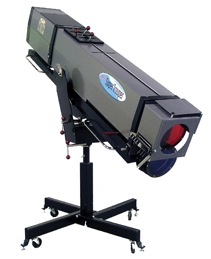
The Super Trouper is the best known of all stage lighting instruments outside of the industry due to Abba's song 'Super Trouper'.
Strong International website
Followspotting Tips and Tricks
SUPERNUMARY
(From Latin, supernumerarius) A paid member of the cast who has no lines and appears on stage in crowd scenes.Â
SUPERNUMERARY
1) An actor who appears on stage but does not speak.
2) A member of staff over and above the number required to carry out a task.Â
SUPERSTITION / SUPERSTITIONS
Theatrical people are notoriously superstitous. There are many rules which some people swear by related to working in the theatre.
1) Backstage whistles were originally used to give instructions to the sailors who (because they knew the best knots) had the job of operating the theatre's flying system. Nowadays, whistling is forbidden backstage because it might result in a lost sailor cutting a rope and dropping something on somebody.
2) Mentioning 'Macbeth' in a theatre is said to invoke the curse of the Scottish Play. The only way to break the curse is for the offender to spin on the spot and then spit. This is an approximation to a purification ritual. The spin turns back time, and the spit expels the corrupting poison. This particular play is always called The Scottish Play.
3) Saying 'Good Luck' is not allowed backstage. The term 'Break a Leg' is used. See the separate page about this!
4) Peacocks are seen as evil (their feathers display an 'evil eye' and their flesh was believed to be poisonous) , and are not allowed near theatres.
More information about Break A Leg
SURROUND SOUND
Originally from cinema, where various different types of surround sound system evolved. The most popular now is made by Dolby Laboratories, and provides 6 different sound sources around the cinema:
Front CENTER (main dialogue, from behind the screen)
Front left & Front right (music, effects and directional dialogue, from behind the screen)
Surround Left (auditorium wall)
Surround Right (auditorium wall)
Sub-Bass
This is known as 5.1 Surround sound.
Newer systems such as Dolby Atmos contain the above, as well as speakers above the audience, and provide a more immersive effect.
Theatre sound systems often contain a huge number of speakers in comparison, with localised speakers near each bank of seating (for musical theatre, particularly).
Any sound system where sound can appear to be all around the audience is said to be surround sound.Â
SUSPENSE
In a dramatic work, suspense is the anticipation of the outcome of a plot or of the solution to an uncertainty, puzzle, or mystery, particularly as it affects a character for whom one has sympathy. However, suspense is not exclusive to fiction.
SVGA
Super Video Graphics Array.
SVOBODA
Low voltage lighting batten used to create a light curtain. Named after Josef Svoboda, the Czech scenographer (1920 - 2002). The original Svoboda light batten is still manufactured by ADB. Josef Svoboda contacted ADB when he was looking for a manufacturer for his idea.
ADB website
Josef Svoboda in the Backstage Heritage Collection Archive
Svoboda Batten by ADB on the Backstage Heritage Collection website
SWAG
1) A particularly artistic way of drawing a set of tabs diagonally up at the same time as flying them out. Looks much better than it sounds.Â
2) Souvenirs given to crew following a particular show or event, usually in the form of T-shirts, posters, & coffee mugs.
SWARBIES
3 or 4 , 500 or 1000 watt flood lamps mounted on a wooden skid,used as cyclorama bottom lighting or in between scenery groundrows. Probably derived from German theatre lighting company, Schwabe.
SWATCH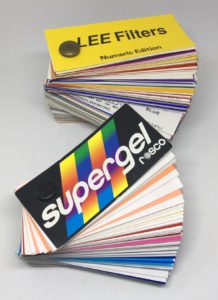
SWING
A member of the cast of a musical (or a play with a large cast) who understudies multiple chorus roles in the production. When a chorus member is not well, has a day off or, in some cases, is performing in a principal role for which he or she is the understudy, a swing performs in this chorus member's place. In the cast of a musical, there will be a male swing who understudies all the male chorus roles in the cast, and also a female swing who understudies all the female chorus roles. In larger casts, there might be two or more swings for each gender. Swings are members of the cast who are in addition to those called for by the script, so in a performance where all of the chorus members and all the actors playing principal roles are present, the swings will not be performing in that particular performance -- although in most cases they will be waiting backstage to be available in the event they are needed.
See also ALTERNATE, STANDBY, UNDERSTUDY.
Submitted by Pierce Peter Brandt
SWL
Safe Working Load.
SWR
Acronym for Steel Wire Rope.Â
SX
Used by some as a shorthand for SOUND, in the same way LX is a shorthand for Lighting. However, when calling cues, stage management should always say 'Sound Cue 12 GO' rather than 'SX Cue 12 GO'. 'Sound' has one less syllable to say, and SX sounds too similar (no pun intended) to LX.
SXOP can be shorthand for Sound Operator. Many venues use FX in the same way, but this can also refer to Stage effects like smoke, pyro etc.
SYNOPSIS
A brief summary of the plot of a play, film, opera etc.
SYSTEM EXCLUSIVE
Part of the MIDI protocol which allows control of one device by another.
T
Lighting Industry Forum code which identifies the (original) recommended usage of different lamp types. T coded lamps are for theatrical use, and have a COLOR temperature of 3000°K. See also CP, A1, P2, K.
T BAR
Short horizontal lighting bar fitted with a spigot to enable it to fit securely into the top of a telescopic lighting stand.Â
TAB DRESSING /TAB WARMERS
Lighting focused onto the house tabs at the front of the stage to set a theatrical atmosphere before the show starts. May also involve a gobo with the show or company logo. Also known as TAB DRESSING.
TAB-TRACK
Track for suspending and operating horizontally moving curtains. May be hand or winch operated.
TABLE READ / TABLE REHEARSAL
An initial read-through of the script of a show, with actors and creative team sitting around a table. It allows the whole team to become familiar with the script, and each other in a non-threatening environment where lots of questions and corrections/edits can be made.
TABLEAU
A static arrangement of the cast of a show, revealed by the raising or opening of the main curtains, which are known as Tabs for this reason. The creation of a tableau is a useful exercise for school drama classes, concentrating on facial expressions, posture, physical relationships between characters etc.Â
The plural of tableau is tableaux.Â
See also TABS.Â
TABS
1) Originally "tableaux curtains" which drew outwards and upwards, but now generally applied to any stage curtains including a vertically flying front curtain (house tabs) and especially a pair of horizontally moving curtains which overlap at the CENTER and move outwards from that CENTER.
[In French, tabs are Rideau. The main tabs or house tabs are Rideau d'avant-scène. In Spanish, the main tabs are Bambalinón.
A narrow stage curtain used for masking is Pendrillon
In Italian, tabs are Sipario.]
2) TABS was a journal published by Strand Electric between 1937 and 1986, about stage lighting and other equipment produced by the company. The Backstage Heritage Collection archive has a complete collection of TABS journals for you to read online.
TAILS
Also known as BARE ENDS, TAILS refers to a cable or set of cables with a connector at only one end which is used for connecting a company's equipment directly to the mains supply in a venue. The connection should only be made by a qualified electrician with the power off!
TAKE-DOWN
The same as a get-out, often used for live music events, this consists of removing all equipment and structures used for an event.
TAKE-UP SPOOL
The empty reel on the right hand side of a reel to reel tape deck onto which the tape is wound as it plays through the machine.
TALKBACK
1) On a sound desk, the talkback section enables the sound engineer to talk via a microphone to selected outputs of the desk. If the sound desk is used to feed on-stage monitor speakers for a musical group, the engineer can select a particular monitor feed (e.g. the drums) to politely ask the musician (drummer) to play quieter.
2) Term sometimes used interchangably with HEADSET for the communication system between technical crew on the production.
TALLESCOPE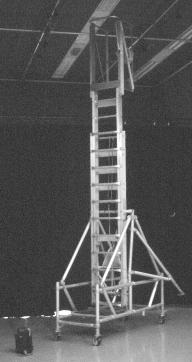
Aluminium Access Products - Tallescope Manufacturer and Service
Access Equipment
TALURIT
A proprietary wire rope ferrule/press tool system. Manufactured by Talurit AB in Sweden.
Submitted by Chris Higgs
Talurit website
TANK TRAP
TAPE LOOP
A continuous loop of tape which produces an 'everlasting' sound effect when played. Used for any long sound needed (eg rain, wind) without having to continuously repeat a short effect.
TASCAM
Manufacturer of recording and mixing equipment.
Tascam website
TAT
(slang) Small (but still useful) offcuts of cloth or wood.
Black Tat is a small (but useful) piece of black cloth that could be used as masking behind a piece of set, or to cover something.Â
TBC
To be confirmed. In a cast list, this can be taken to mean To be cast.
TC
Time Code. It is an abbreviation used to indicate an interval of time on a timeline for video and audio or timing tracks for accuracy.
TD
Short for TECHNICAL DIRECTOR.
TDIF
Tascam Digital Interconnect Format.
Tascam website
TEA
Themed Entertainment Association (California, USA)
TEA website
TEASER
Border, usually black, set behind the proscenium and linked with tormentors to form an inner frame to the stage, and to mask lighting bars and the upper parts of the fly tower. (Known in the USA as a VALANCE)
TECH
1) Short for Technical Rehearsal. (e.g. 'The Tech took 14 hours')
2) A member of (amateur) crew ('I'm the lighting tech for this show')
TECH WEEK
The week leading up to the first performance when the technical elements are put into place, alongside the actors. Involves lighting focus, lighting plot, sound plot, scene change rehearsals, full technical rehearsals and finally dress rehearsals.Â
TECHIE
A stage technician. For more information, see The Techie Gospel. See also Lampy and Noise Boy. Many professional technicians don't particularly like this term.Â
The Techie Gospel
TECHNICAL DIRECTOR
Often shortened to 'TD' the exact role of the Technical Director changes according to the size of the theatre company, and also according to your location in the world.
In the US, the TD co-ordinates all technical aspects of the production, from organising crew calls to ensuring equipment is ordered, to liaising with the designers and sometimes adapting a design to fit the venue. In the UK, this person is usually called the PRODUCTION MANAGER.
The TD role sometimes overlaps with that of the UK Stage Manager also.
TECHNICAL REHEARSAL
(also known as the TECH RUN, or just TECH). Usually the first time the show is rehearsed in the venue, with lighting, scenery and sound. Costumes are sometimes used where they may cause technical problems (eg Quick changes). Often a very lengthy process. Often abbreviated to the Tech.
A DRY TECH is without actors to rehearse the integration of lighting, scenic changes etc. It follows that a WET TECH is a full technical rehearsal with actors and all technical elements, although this term isn't used as often as DRY TECH.
AÂ PAPER TECHÂ is a session without the set or actors when the technical and design team talk through the show ensuring everything's going to work as planned. Stage Managers can use this session to ensure all is written correctly in the Prompt Book.
TECHNICAL RIDER
See RIDER.
TELESCOPING
Actor's lines that are overlapped in the original text, or a direction to do so. Used to increase the intensity of dialogue.Â
TELEX
A brand of wired or wireless intercom used on stage (predominantly US).
TEMPLATE
See GOBO.
TEMPO
(Italian for TIME) Musical term for the speed or pace at which a piece of music should be performed. A fast-paced piece is known as UP-TEMPO, and a slow piece is DOWN-TEMPO. Modern music defines tempo in terms of beats per minute (BPM). Before the invention of the METRONOME to measure and time BPM, classical music used descriptive Italian terms (such as ADAGIO (slow), ALLEGRO (fast), PRESTO (faster)) for speed. The original Italian terms contain additional nuances (e.g. ALLEGRO as well as meaning fast, also implies the piece should be performed joyfully).
TEMPORARY DEMOUNTABLE STRUCTURE (TDS)
(UK Health & Safety) Any structure built for an event, whether it's staging, seating or a marquee or similar outdoor structure.Â
UK Health and Safety Executive website
TESTING AND TAGGING
Australian equivalent of the UK "PAT" Test - a regime for testing electrical equipment for safe operation and then logging the results.
TFT
Thin Film Transistor. Technology used in flat screen displays (laptop computers, flat screen monitors, COLOR screen handheld computers and mobile phones). TFT screens are better resolution than LCD panels, but are more expensive. Sometimes known as Active-Matrix LCDs.
Each pixel is controlled by up to four transistors.
How TFTs work
THEATRE CRAFTS
Magazine about technical theatre published in the USA between 1967 and 1992.Â
TCI (Theatre Crafts International) was published 1992 - 1998.Â
Please note:Â This website is not related to Theatre Crafts magazine, or its' successor, Live Design.Â
THEATRE CRITIC
See CRITIC.
THEATRE IN EDUCATION
Often abbreviated to T.I.E. The use of theatrical techniques to educate, covering social issues or topics on the school's syllabus. At Iconic the TIE is not to educate but to entertain with live interactive scenes, however the script does follow the syllabus or curriculum of the country's school learning outcomes.
THEATRE OF CRUELTY
Theatre of Cruelty is a form of theatre originally developed by avant-garde French playwright, essayist, and theorist Henry Becque.
Antonin Artaud, some 50 years later, is also seen as a main contributor to the genre, notably with The Theatre and its Double. Originally a member of the surrealist movement, Artaud eventually began to develop his own theatrical theories. The Theatre of Cruelty can be seen as a break from traditional Western theatre and a means by which artists assault the senses of the audience, and allow them to feel the unexpressed emotions of the subconscious. While Artaud was only able to produce one play in his lifetime that reflected the tenets of the Theatre of Cruelty, the works of many theatre artists reflect his theories. These artists include Jean Genet, Jerzy Grotowski, and Peter Brook. (from Wikipedia)
Wikipedia entry
THEATRE OF THE ABSURD*
drama using the abandonment of conventional dramatic form to portray the futility of human struggle in a senseless world. Major exponents include Samuel Beckett, Eugène Ionesco, and Harold Pinter.
THEATRE ROYAL
Common name for theatres in the UK. The Theatre Royal, Bristol is the oldest working theatre in the country, opened in 1766.
THEATRICAL FLASH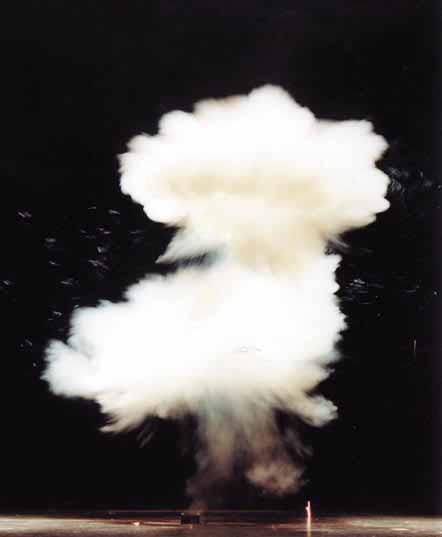
THEATRON
1) Refers to the auditorium / seating area of an ancient Greek or Roman theatre.
2) 3D model archive project for creating accurate (and amazing) VRML models of old theatre buildings. (Windows operating system only).
Theatron website
THEME
1) the subject of a talk, piece of writing, exhibition, etc.; a topic.
2) an idea that recurs in or pervades a work of art or literature.
3)Â give a particular theme or setting to (a leisure venue, event, etc.).
THEME PARK
Entertainment venue in which traditional fairground rides and more technologically advanced attractions are interspersed, often with live entertainments, and tied together thematically.
THESPIAN
Named after the Greek actor Thespis (considered to be the founder of Greek tragedy, and the first person to appear on a stage as somone other then himself), a Thespian is a follower of Thespis - an Actor.
Submitted by June Lathrop
THIMBLE
Protective metal or plastic loop used to reinforce and protect the eye at the end of a wire rope. Specifications vary according to use, but all conform to basic rules of proportion in forming the correct size loop for the rope diameter/type.
Submitted by Chris Higgs
THOUGHT TRACKING
Thought-tracking is a technique used in workshopped drama sessions to explore a character's thoughts during a narrative. It often takes the shape of an exercise where the action is frozen and a character is asked to speak a few words about his or her feelings and thoughts for the rest of the group.
THREE POINT LIGHTING
An approach to traditional stage lighting taught by Stanley McCandless which uses two front lights (separated by 60 degrees horizontally) and one backlight to cover each lit area of the stage.
THREE TO ONE RULE
In order to get maximum gain (level) out of a PA system, microphones which are picking up the same sound source (e.g. a chorus on a large stage) should be three times further from each other than from the sound source. This minimises COMB FILTERING.
THREEFER
An adaptor which enables three pieces of equipment to be connected to a single outlet or cable. Great care should be taken not to overload the circuit. See also TWOFER and GRELCO.
THROUGH-COMPOSED
A musical performance (especially in musical theatre and opera) is said to be through-composed if the musical content is continuous, rather than being a series of songs interrupted by recitative pieces and/or dialogue. The term applies in particular to composers such as Stephen Sondheim or Andrew Lloyd-Webber. A piece such as Les Misérables is said to be through-sung as there is no spoken dialogue.
THROUGHLINE
a connecting theme, plot, or characteristic in a film, television series, book.
THROW
Distance between a light source (e.g. lantern or projector) and the actor or object being lit.
THROW LINE
A rope used to hold adjacent flats together as one via cleats.
THROW RATIO
Figure used to calculate how large a projected image will be for a given distance to the screen (or vice versa).
For example, a throw ratio of 2.5 means that to achieve an image 4 feet across, the projector must be (4 x 2.5 = 10) 10 feet from the screen.
A projector 8 feet from the screen will result in an image (8 / 2.5 = 3.2) 3.2 feet across.
A short throw projector with a ratio of less than 1 will produce a larger image for a smaller throw.
THRUST
Form of stage which projects into the auditorium so that the audience are seated on at least two sides of the extended piece. See also END ON, IN THE ROUND.
THUMBNAIL SKETCH
A series of exploratory or explanatory small sketches which help to show design concepts and how parts of them may appear when built. Often contains views from different angles, and may be highly detailed, but only show a small part of the overall design.Â
THUNDER RUN
Long series of channels down which wooden cannonballs are rolled to give a realistic thunder rumble effect. Built into the roof of some older theatres, but mostly now unused (for safety reasons).
The Bristol Old Vic has restored their Thunder Run in 2016 for their 250th anniversary.
History of Sound Effects for the Stage
THUNDER SHEET
Large suspended steel sheet with handles which produces a thunder-like rumble when shaken or beaten.
THYMELE
(Greek) Altar in the mid point of the ORCHESTRA part of the stage.
THYRISTOR
Also known as an SCR (Silicon Controlled Rectifier). An electronic switch which will pass current when triggered until the current passing through it falls to zero. Essential component of stage lighting dimmers. See also IGBT, TRIAC.
TICKET TOUT
Also known as Scalping, the process of reselling tickets at higher than face value is known as touting. They are often vastly over-priced. Many shows require ID to prove that the person holding the ticket is the same person named on the ticket, and tickets are not transferable between people.Â
TIE
Abbreviation for Theatre In Education. A performance aimed at a schools audience.
TIE LINE
A sound connection between two patch panels in different parts of the building. For example, there are tie lines between front of house mixing position and the stage to reduce the need for additional cables through the auditorium.
TILT
1) Up and down (vertical) movement of a lantern, camera or moving light. See also PAN.
2) Feature on pinball machines which detects excessive movement of the case. Only related to theatre in connection with the musical 'Tommy'.
TIMBRE
A musical instrument (or voice) has a quality of character that separates the sound of different instruments from each other. That quality is known as the Timbre.
TIME
The facility on memory lighting boards for playing back timed fades at the touch of a button.
TIRFOR
A wire rope hoist that utilises twin sets of jaws to grip on the rope. Actually a French manufacturer of lifting equipment, but like Hoover, one particular style was so successful, the name stuck to that type of winch.
Submitted by Chris Higgs
TIRING HOUSE
In Shakespearean times, this was the room wear the actors waited, adjacent to the stage. The room is now known as the GREEN ROOM.
TITLE BLOCK
Rectangular area in the corner of a lighting plan (often bottom right) containing the name of the show, director, scenic and LX designer names, date of the plan, scale, and other copyright information.Â
TMA
Theatrical Management Association (UK) has since 1894 represented and supported theatrical organisations all across the UK. In 2014 the organisation changed it's structure and membership plans and is now known as UK Theatre.
UK Theatre Website
TOI TOI TOI
An alternative to "Break a Leg" used by opera singers.Â
More on Break A Leg
TOP AND TAIL
Rehearsal where dialogue without technical cues is cut, and only run where there are cues or scene changes etc.
Also known as CUE TO CUE.Â
TOP HAT
Also known as HIGH HAT or SNOOT. Cylinder of metal inserted into COLOR runners on the front of a parcan, narrow-angle profile or other lantern to limit spill light, particularly when used in view of the audience. Sometimes additional SPILL RINGS are used at the front of the top hat, to further limit spill, and to reduce glare for the audience if they have a clear view of the lantern.Â
TOPPING AND TAILING
1) See Cue to Cue.Â
2) The practice of reversing 'hemp' lines in a theatre to spread wear over as great a length of rope as possible. Over a period of time this practice can considerably increase rope lifetime, especially if lines are rotated between sets as well as positions in the grid (The short of set 1 becomes the long of set 40, for example)
Additional information submitted by Chris Higgs
TORCHING
(Stage Management) The act of helping actors or other crew members off stage using a torch to guide them. Often the role of the ASM.
TORMENTOR TEASE*
a curtain or framed structure behind the proscenium at both sides of the stage,for screening the wings from the audience
TORMENTORS
Narrow masking flats adjacent and usually at right angles to the proscenium arch. So named because they stop people in the boxes being able to peep beyond, into the secrets of the wings, where there may be dancers (for example) warming up or actors doing costume changes. Used in addition to a teaser, the first border behind the proscenium arch.
A lighting instrument in this position (just upstage of the proscenium arch) is known as a Torm Light.Â
TOSCA
Trans-Opera Security and Care Association. European organisation (since 1997) created to safeguard the architectural heritage of opera houses and the form of opera.
TOSCA website
TOURNETTE
A small horizontally-revolving turntable platform on which a piece of pottery is placed for painting.Â
TRACK
1) Metal structure with rails on which curtain runners are placed to enable curtains to open and close smoothly.
2) A sideways movement of a flying piece, or flown actor. See FLYING HARNESS.
3) Separate audio recording channel. Most playback / recording devices have two tracks - left and right. Some are used for MULTITRACK RECORDING and allow either four or eight tracks to be recorded onto standard media (see also DIGITAL RECORDING). Many more tracks can be recorded onto computerised systems. The most important feature of a multi-track system is the ability to record and playback at the same time (e.g. Recording vocals on track two with a pre-recorded piano on track one.)
4) An actor's path through an ensemble performance, indicating which roles they play in each section of the show. Having a flexible approach to such performances means the production can be agile, and have adequate cover for actor holiday periods and any illness whilst also keeping the show fresh for the ensemble. Shows that use this approach include Hamilton and The Lord of the Rings The Musical.Â
TRAGEDY
Tragedy is a form of drama based on human suffering that invokes in its audience an accompanying catharsis or pleasure in the viewing. While many cultures have developed forms that provoke this paradoxical response, the term tragedy often refers to a specific tradition of drama that has played a unique and important role historically in the self-definition of Western civilization.
TRAGI-COMEDY / TRAGICOMEDY
Tragicomedy is a literary genre that blends aspects of both tragic and comic forms. Most often seen in dramatic literature, the term can variously describe either a tragic play which contains enough comic elements to lighten the overall mood or a serious play with a happy ending.
TRAMOYA
(Spanish) Piece of stage machinery.Â
TRANSDUCER
A device that converts energy from one form to another. A microphone is a transducer that converts sound wave energy into electrical pulses.
TRANSFORMATION
An instant scene change, often effected by exploiting the varying transparency of gauze under different lighting conditions.
See also Lighting With A Gauze / Scrim
TRANSITION
1) The movement of actors / scenery & change of lighting / sound between one scene and another.
2) Video: An effect applied to a change of shot / camera angle to make it anything other than a simple cut.
TRANSMISSION
In the context of lighting gel, the transmission (usually expressed as a percentage) is the amount of the original light that is allowed to pass through the gel. A pale gel will have a high transmission value, and a heavily saturated deep COLORed gel will have a low transmission value. The transmission lets you know how much light will be absorbed by the gel, and how much you'll end up with on stage.
TRAP
An opening through the stage floor.
A grave trap is a lowered rectangular section used in Hamlet etc.
A cauldron trap is a simple opening through which items can be passed into a cauldron on stage.
A star trap is a set of triangular sprung flaps in the stage floor through which an actor can be propelled from a lift below stage.
The Vampire Trap was invented for James Planché's 1820 adaption of Polidori's The Vampyr. It involved two spring leaves that parted under pressure and immediately reclosed. Placed in the floor or stage wall, it could give the impression a figure was passing through solid matter.
The Corsican Trap, made for Dion Boucicault's 1852 adaption of Alexandre Dumas' The Corsican Brothers, involved an ascending track, on which a wheeled cart could be run, rising up out of the stage through a 'bristle' trap - a trapdoor covered with bristles painted to match the scenery. Once on the stage and in view, the track was covered by a sliding arrangement reminiscent of that of a roll-top desk; towhit, nothing was seen except the ghost rising up through the floor and gliding across the stage. This trap is also sometimes called a Ghost Glide. (Vampire Trap and Corsican Trap definition from 'The Cabinet of Dr Casey')
More about Traps
TRAP ROOM
The area directly below the trapped part of the stage. Used for accessing the traps.
TRAVELATOR
A motorised horizontally-moving belt at stage level used for moving scenery or actors on / off stage. Direction and speed are easily controlled. Can be used for spectacular transformations, and are often used on Pop / Rock shows and as a way of rapidly moving furniture or actors across the stage without complicated automation.Â
TRAVELLERS
Curtains or scenic pieces moving across the stage on horizontal tracks.
TRAVERSE
Form of staging where the audience is on either side of the acting area.
Also known as ALLEY or AVENUE staging.Â
See also IN THE ROUND, END ON, THRUST.
TRAVERSE CLOTH /Â TRAVERSE CURTAIN
a compartment or recess formed by a partition, curtain, or screen.
TREADS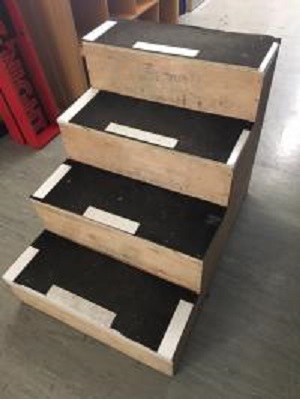
TRIAC
(Triode Alternating Current switch) Electronic Semiconductor device which is an integral part of modern dimmers. When a current is applied to a triac, it starts conducting, and continues until the current passing through it falls to zero. Whereas a thyristor can only conduct half of the AC wave, a triac (as long as it's triggered at the appropriate point) will conduct both halves of the wave.Â
See also THYRISTOR, IGBT.Â
TRIAX
Triaxial Cable, often referred to as triax for short, is a type of electrical cable similar to coaxial cable, but with the addition of an extra layer of insulation and a second conducting sheath. It provides greater bandwidth and rejection of interference than coax, but is more expensive.
TRIGGER WARNINGS
Some audience members may be upset by particular themes that may be featured in some plays.
It's important that the creative team are aware of these themes, and how they may affect audience members, and if necessary consult with local support groups or charities that can provide advice on how to deal with the issues sensitively.
Although some venues may list the themes in advance publicity, others (such as The Old Vic in London) prefer to keep the trigger warnings unseen unless audience members ring the theatre in advance.
TRIM
1) US for DEAD on a flying piece. (e.g. 'The Out Trim on this piece is 14 feet from the deck')
2) Stage lighting dimmers can be adjusted ('trimmed') to change the point at which full level is achieved, and sometimes the point at which the light fades out, along the curve of the dimmer. This is known as the TOP SET. Older technology dimmers had to be trimmed each time the load on a particular dimmer changed, to enable the full range of dimming.Â
TRIPE (bundle)
Bunch of cables tied or taped together into a single unit.
TRIPLE THREAT
Term used to describe a performer who excels at the three skills; acting, dancing and singing. They are a threat to other performers who may only be excellent at one or two of those skills.Â
TRIPPING
US for TUMBLING a cloth that can't be flown out of sight.
TROMPE L'OEIL
French term meaning 'deceive or fool the eye'. Technique used by scenic artist to create the illusion of a three-dimensional scene or object on a two-dimensional piece of scenery. The effect is often used in the form of FORCED PERSPECTIVE, where a set that partially exists on stage appears to extend into the distance.
A group of dancers, actors, or other entertainers who tour to different venues. (e.g. 'The second act in this show is a dance troupe from out of town').
TRS
1) Tough Rubber Sheath. Jargon for any Rubber-sheathed power cable. (e.g. "Go get me a 10m TRS" usually means "Please get me a 10m length of 15A power cable" (in the UK, at least)). 13A cable (or 5A cable) can also be TRS, so if in doubt, ask for clarification of the connector required, or check what it's for if you're not sure.Â
2) Tip Ring Sleeve. The three contacts on a stereo jack audio connector.
TRUCK
1) Wheeled platform on which a scene or part of a scene is built to facilitate scene changing. (e.g. "This scene happens on the balcony truck")
2) (TV/film - verb) To move a wheeled camera sideways.
TRUNKING
Metal or plastic wall-mounted enclosure for cables. Box shaped in cross-section. Known in the USA as RACEWAY or WIREWAY.
TRUNNION ARM
U-shaped bracket between the hook clamp and the main body of a lighting instrument, enabling it to be tilted to any angle.
TRUSS
A framework of alloy bars and triangular cross-bracing (usually of scaffolding diameter) providing a rigid structure, particularly useful for hanging lights where no permanent facility is available. Very often box-shaped in cross section, so known as BOX TRUSS. This type of truss is useful for touring as lanterns / speakers etc can be hung inside the truss which protects them when loading and takes up less space in the truck.
You should only use truss from reputable manufacturers, and should check the manufacturers' website for instructions on how to use it, and what limitations it may have.Â
Rigging a truss incorrectly can vastly reduce its' safe working load, and can result in damage to the truss,or a far more serious failure. Always seek advice from professionals, and do not attempt to rig equipment without proper advice or supervision.Â
TRYOUT
A fully-staged run of a show in a provincial location before the show opens in a higher-profile location such as the West End of London or Broadway in New York.
The tryout run allows the show to be fine-tuned, to amend (or cut) sections which are unnecessary or don't work, and can also build word-of-mouth, and enable the production to have publicity photos etc before the show arrives at its' final destination for a (hopefully) long run.
Although many Broadway shows use out-of-town tryouts (e.g. Dear Evan Hansen (Washington DC), Frozen (Denver)), there are notable exceptions. Spider-Man Turn Off The Dark was too technically complex to be set up in another venue, so the show had a hugely extended run of previews on Broadway, and suffered with many technical and logistical issues, as well as the departure of a key member of the creative team. However, shows such as Book of Mormon and School of Rockopened 'cold' on Broadway and have gone on to huge success. The cost of tryouts is increasing (see OnStage Blog) so a tryout is no longer the only option.
See also PREVIEW
TUBULAR WAVE RIPPLE
See EFFECTS.
TUMBLER
1) A roller fixed to the bottom edge of a backdrop, around which the cloth can be rolled upwards when not needed. Ropes tied to the suspending bar can pass down the front of the cloth / backdrop and up the back to a pulley, enabling the cloth to be rolled up on cue.
2) An entertainer who specialises in acrobatic tricks.
TUMBLING
Flying a cloth from the bottom as well as the top when there is insufficient height to fly it directly out (up) in the normal way. See TRIPPING.
TUNGSTEN HALOGEN
A standard tungsten filament lamp loses its brightness in its' lifetime. Tungsten Halogen lamps use a Quartz envelope ('bulb') filled with halogen gas to give an almost constant COLOR temperature. See Halogen Cycle.
TURN
Techie name for an Actor/Artiste. ('What time does the turn get here?')
TURNAROUND
The changeover between one show and the text. It's important that the administration team scheduling the performances takes into account the time it will take to reset the stage back to 'clear' and then set up for the next show, ideally not involving overnight work!
TURNOUT
(Ballet) A rotation of the leg which comes from the hips, causing the knee and foot to turn outward, away from the center of the body.
TWEETER
Part of a speaker system designed to handle the high frequency part of the signal.
TWILL
A type of woven cloth with a pattern of diagonal ribs (in contrast with a satin or plain weave). Twill is often used for theatrical curtains because it drapes well and hides surface soiling / dirt / dust because of the complex pattern. BOLTON TWILL is a twill produced in the UK town of Bolton. It can be produced in various flame retardant types including NDFR and DFR.Â
TWIRLIES
Derogatory (or not ?) term for performing members of a ballet group.
TWIST LOCK
A type of heavy-duty NEMA (US National Electrical Manufacturers Association) plug or socket which has a locking capability. They are available in different configurations for different current loads (15A, 20A, 30A, 50A).Â
TWOFER
A two-way adaptor. See GRELCO.
TYPECAST
An actor who is regularly cast in the same kind of roles is said to be TYPECAST. If an actor has played similar roles for a while (e.g. muscle-bound baddie) and is cast in a completely different role (e.g. a nanny) he's said to have been cast AGAINST TYPE.
UC
Short for UPSTAGE CENTER - the middle of the stage furthest away from the audience.Â
UHF
Acronym for Ultra High Frequency. In theatres, it refers to a radio communication or radio microphone system using the frequency band between 300MHz and 3GHz (300 Megahertz to 3 Gigahertz). See also VHF.Â
ULTRA-VIOLET (UV)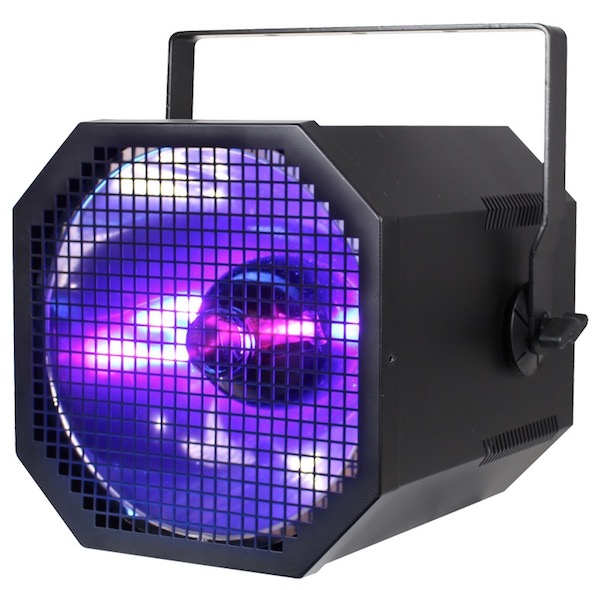
Black Light is used extensively in the Czech Republic where stunning effects are achieved on stages lined with black velvet. See the Image Theatre website for more.
Image Theatre website
UNBALANCED LINE
A method of carrying sound or data signals cheaply. An unbalanced cable consists of two conductors - audio and screen/ground. Two pin connectors such as RCA/phono connectors are used, which are not suitable for heavy duty professional use. Commonly used for short distance hookups between audio or video equipment, unbalanced cables are subject to interference over long distances. See BALANCED LINE.
UNCLE BUDDY
US Term. A type of steel snubbing device, also called a LINE-LOK, named after its' alleged inventor.
UNDERCROFT
A ground-level parking area underneath a building that occupies the footprint of that building (and sometimes extends to other service areas around the structure).Â
UNDERSCORE
Music used underneath dialogue or other stage action.
UNDERSTUDY
Also known as a COVER. A member of the cast of a musical or play who understudies one (sometimes more) of the principal roles and is also in the chorus. [For his or her role in the chorus, an understudy might have a character name, or might not.] Some understudies have gone on to become stars by outshining the actors they replaced.
See also ALTERNATE, STANDBY, SWING.
Submitted by Pierce Peter Brandt
UNIFIED DESIGN CONCEPT
Architectural term that refers to a document or series of drawings that shows how the various aspects of a design project are all linked thematically and/or stylistically. Theatrically, a unified design ties each scenic piece along with props, costumes and even publicity materials. Shows such as The Lion King have a very strong unified design concept. Â
UNIT
An individual instrument (lantern / luminaire) on a lighting plan may be given a Unit number, which is a unique number for it in the lighting design or visualisation software. This is not the same as the dimmer number or DMX number.Â
UNIT OF ACTION
Units of action, or units (sometimes also called beats), were first suggested by Konstantin Stanislavski as a means of helping actors determine the through line or super objective of a role. A unit is a discrete piece of action in a play-text, marked by a significant change in action. This could be a change in what the characters already on stage are doing or trying to do, i.e. a change in their objective, a new character entering the scene or those already on stage exiting.
UNIVERSE
In lighting control terms, at least, a Universe is a single output of DMX512 control signals. Each DMX Universe can control up to 512 channels (which is why the full name of DMX is DMX512). Some lighting desks can only control one universe. More modern desks can control multiple universes, and have multiple DMX outputs. When patching a control channel on the desk to a DMX output, you have to specify which universe, as well as which DMX channel. So, DMX channel 42 on Universe 1 would be 1/42. More complex control setups, using the more powerful ArtNet system can control a huge number of Universes from a single control system, enabling (for example) large numbers of dimmers, moving lights and individually mapped LED pixels to be operated simulataneously.Â
UNPICK
Small cutter designed for unpicking a sewn seam. Useful for undoing alterations to a costume following a production.
UPLIGHT
Light from below the actors - from a light source on the stage floor.
French: contre-plong
See also DOWNLIGHT, BACKLIGHT
UPPER CIRCLE
Highest balcony in the auditorium. Also known as the GODS. Normally has a very steep view down to the stage, and highly raked seating.
UPSTAGE
US = Upstage, USC = Upstage CENTER. USL = Upstage Left. USR = Upstage Right (see diagram)
2) When an actor moves upstage of another and causes the victim to turn away from the audience s/he is 'upstaging'. Also, an actor drawing attention to themselves away from the main action (by moving around, or over-reacting to onstage events) is upstaging.
USB
Computer connection (the term stands for Universal Serial Bus) which is widely used for computer accessories, flash memory sticks, dongles for software licensing, external hard drives or conversion hardware (to connect DMX or audio equipment to the computer).
Important: A USB device must usually be ejected from the computer using the operating system software before it can be safely unplugged. Simply unplugging it without ejecting it can result in data loss or corruption.Â
USHERS
Members of Front-of-House staff who guide audience members to their seats, and often sit in the auditorium during the show in case of emergency.
Sometimes also known as STEWARDS.
USITT
United States Institute of Theatre Technology.
Founded in 1960. Publisher of Theatre Design and Technology and Sightlines journals, which are available online (see Publications in the Theatrecrafts.com Archive section).
USITT Website
VAC FORMING
Vacuum forming is a process of reproducing architectural and textural relief detail on sets by forming a thin plastic sheet into the required shape by a suction process.
VALANCE
US term for a TEASER attached to the main house tabs. Sometimes known as GRAND VALANCE.
VAM
Abbreviation for Volunteer Audience Member. The VAM is different to a SAUD, as most VAMs are pre-selected and have long or significant talking or performing scenes with the cast. A VAM is always called for by a cast or crew member.
VAMP
Musical term. A vamp is a repeating musical section played until ready. A vamp may consist of a single chord or a sequence of chords played in a repeated rhythm. The term frequently appeared in the instruction "Vamp till ready" on sheet music for popular songs in the 1930s and 1940s, indicating that the accompanist should repeat the musical phrase until the vocalist was ready. An elongated vamp section is used to cover an action on stage of variable length, or to accompany ad-libbed action or vocals.
VARI*LITE
Trade name for a range of 'intelligent' moving lights and control equipment. Identified by VL numbers. The VL1 model was introduced in 1980 for a Genesis tour by Showco, USA.
Vari*Lite Website
VARIAC
A trade name for an autotransformer (formerly) used to dim lighting by tapping a selected reduced voltage off the transformer's winding. Not to be confused with resistance dimming.
Submitted by Peter Neilson
VAUDEVILLE*
a type of entertainment popular chiefly in the US in the early 20th century, featuring a mixture of speciality acts such as burlesque comedy and song and dance.
VCA
Voltage Controlled Amplifier. Way of controlling sound level remotely from a physical fader. With a VCA sound desk, the faders control the VCA, which then controls the sound signal. Any faults etc in the fader do not affect the clarity of the output. More desk automation is possible with VCA's, as a particular VCA (or group of VCA's) can be allocated to any fader, or can be controlled by an outside controller.
VELOUR
A plush woven fabric resembling velvet, used for theatrical drapes and front curtains.
VERBATIM THEATRE
A performance based on words taken from an interview with a member of the public, usually forming a dramatised version of real-life events.Â
VERFREMDUNGSEFFEKT
Also known as Distancing Effect or Alienation Effect, this is a concept coined by Bertholt Brecht "which prevents the audience from losing itself passively and completely in the character created by the actor, and which consequently leads the audience to be a consciously critical observer."
VERLINDE
The European manufacturer of self-climbing chain hoists and other lifting equipment.
Verlinde website
Submitted by Chris Higgs
VGA
Acronym of Video Graphics Array. Video display standard for computers, and the generic name of the 3 row, 15 pin connector with a blue plastic infill which is used to connect an external monitor on many PC desktop and laptop models.Â
VHF
Acronym for Very High Frequency. In theatres, it refers to a radio communication or radio microphone system using the frequency band between 30MHz and 300MHz (30 Megahertz to 300 Megahertz). See also UHF.Â
VHS
Video recording format invented by JVC (Japan Victor Company) in 1976. The name stands for VIDEO HOME SYSTEM. VHS resolution is 250 horizontal lines.
VHS-C
Compact VHS tape cassette camcorder format using the same tape as VHS in a smaller cassette. Adaptors are used to extend the cassette size so that it can be viewed in a full-size VHS player.
VIDEO
See CCTV.
VIDEO VILLAGE
Term from the film industry for a base where the material being shot can be previewed and reviewed on monitor screens. Often now used for the base of the AV / projection department.Â
VIDEO8
8mm domestic analogue video format. Popular between 1985 and 2007, due to the quality improvement over VHS-C, and due to the compact camcorders. The format was replaced by Mini-DV, from 1995.Â
See also HI-8.
Wikipedia entry
VIEWPOINTS
(From Wikipedia)Â Viewpoints is a technique of composition that provides a vocabulary for thinking about and acting upon movement and gesture. Originally developed in the 1970s by choreographer Mary Overlie as a method of movement improvisation, The Viewpoints theory was adapted for stage acting by directors Anne Bogart and Tina Landau.
VIGNETTE
A short impressionistic scene that focuses on one moment or gives an acute impression of a character, idea, setting, or object. This type of scene is more common in recent postmodern theatre, where less emphasis is placed on adhering to the conventions of theatrical structure and story development. Vignettes have been particularly influenced by contemporary notions of a scene as shown in film, video and television scripting.
VIRTUOSO
(Trade Name) Moving light control console made by Vari*Lite.
Vari*Lite Website
VISUAL CUE
A cue taken by a technician from the action on stage rather than being cued by the stage manager. Often abbreviated to "Vis".
VJ (Video Jockey)
An artist that mixes video into a live performance on the fly. The term derives from DJ (Disc Jockey), who plays music for club nights, parties or events.Â
VL
See VARI*LITE.
VOICE OVER
Refers to a technique for recording an actor's voice and replaying it during the performance to indicate a thought process, or for more practical uses such as covering a scene change or costume change. Abbreviated to V.O.
VOLTAGE
The pressure at which electric current is available. The UK standard voltage is 230 Volts alternating current (AC). The American standard is 120 Volts AC.
The scientific name for Voltage is Electromotive Force. The frequency at which the current alternates (between positive and negative) is measured in Hertz (Hz) and in the UK is 50Hz, and in the USA is 60Hz.Â
VOMITORY
An auditorium entrance or exit up through banked seating from below. Often abbreviated to Vom.
From the Latin VOMITORIUM (plural VOMITORIA), which was an architectural feature of Roman coliseums etc. Many vomitoria were used to enable the coliseum to be emptied of people very quickly, safely and efficiently.Â
VOUCHER
A gift or ticket voucher has a particular monetary value and is given to enable the gift receiver to buy products or services, such as theatre tickets of the same value. The receiver can 'top up' the voucher with their own money to buy more expensive items. Some sellers will give change if the voucher is valued at more than the bought item, but not all, so please check before proceeding. Â
VPLT
German Professional Lighting and Sound Association.
VPLT Website
VRML
(3D Design) Virtual Reality Modelling Language. A language for describing 3D objects within a simple text file. With a VRML Viewer, complex models can be emailed between designers and other production staff for comment. The VRML Viewer allows the user to move around the 3D model using simple mouse moves.Â
VRML is pronounced 'verrmul'.
VT
(Short for Video Tape) A pre-recorded video clip that is played in during a live performance.Â
VU METER
(VU - Volume Unit). Pointer and scale meter which indicates the average level of a signal. Misses any transients and spikes that lead to a clipped signal. See PPM.
WAGON
(also known as TRUCK). A large wheeled platform which can be moved around the stage either manually by crew or by a scenic automation system. See also WAGON STAGE.
WAGON STAGE
Mechanised stage where the scenery is moved into position on large sliding trucks (wagons) as wide as the proscenium opening, from storage in large areas to the side and rear of the main stage. This system enables incredibly complex and otherwise time-consuming scene changes to occur almost instantly.
The Royal Opera House in London contains a massive series of lifts and platforms which enable the complex programme of multiple performances in the repertoire to be interchanged seamlessly.
See also REVOLVE, JACKKNIFE STAGE.
WAH
(UK - Health & Safety) Abbreviation for Working at Height. Specifically refers to the Work at Height Regulations 2005.Â
HSE Work at Height Website
WALK THROUGH
Session on stage just after the set has been built (or reassembled) when actors and crew can go through moves to ensure all is as it should be, and to identify any problems before the performance. Particularly applies to opera performances in rep when sets are reassembled and struck daily.
WALK-ON
A small acting role with no lines. Also known as an EXTRA.Â
WALLA
General background hubbub sound effect - named after the sound actors make to create the effect.
WANDELPROBE
(German for change rehearsal).Similar to SITZPROBE, the Wandelprobe is a rehearsal with full orchestra, and minor blocking (but not a full tech rehearsal).Â
WARDROBE
The general name for the costume department, its staff and the accommodation they occupy.
German:Â Kleiderschrank
WARDROBE PLOT
Actor-by-actor, scene-by-scene inventory of all the costumes in a production, with a detailed breakdown into every separate item in each costume.
WARM-UP
The Warm-Up prepares the actor's body for the performance by exercising (literally warming up) muscles, stretching limbs, and getting the cast to focus on the performance and to forget about anything outside the walls of the theatre.
WARN
US equivalent of the UK's 'standby' for stage manager's cues. (e.g. 'Warn Light cue 12'?.'Light cue 12 GO')
WARP
1) (Trade name: ADB) The first zoom profile spotlight with ring control and 4 framing shutters which are fully rotatable.
2) "Warp and Weft" refers to the threads in a piece of fabric, or the fabric itself.Â
ADB lighting website
WASH
1) A lighting cover over the whole stage (e.g. 'We'll use the red wash for the hell scene'), usually from multiple sources. If this is the main lighting for the show, it's called the GENERAL COVER.
2) A lantern which produces a large spread of softly focussed light, especially with moving lights (e.g. the VL4 and Mac 600 are wash luminaires). See also SPOT.Â
Designing and Focussing a General Cover
WATER CRACKER*
Device which produces a thin haze in the air by 'cracking' water droplets.
WATTAGE
See WATTS.
WATTS
Unit of electrical power derived from the current (or 'quantity' of electricity) multipled by the voltage (or 'pressure' at which the current is delivered). Stage lighting equipment is rated in Watts (or Kilowatts - 1kW being equal to 1000W). This refers to the amount of power required to light the lamp. A higher wattage lamp requires more power and gives a brighter light output.
WAVE
Uncompressed audio format used on Windows computer systems, defined by IBM and Microsoft.
File extension: .WAV
WAVELENGTH
The distance from one point on a vibrating wave to the same point on the next wave. The lengths of the sound waves (wavelengths) we can hear range from one inch to 40 feet. High frequency sounds have short wavelengths (and are more directional), low frequency sounds have long wavelengths (and are less directional). In lighting terms, blue light is short wavelength, green is medium and red is long wavelength. Beyond visible light are the short wavelength Ultra Violet light and the long wavelength Infra Red light. Wavelengths of light are measured in Angstroms.Â
See also FREQUENCY.
WEDGE
A wedge-shaped foldback speaker. Angled so that it can sit on the stage floor and point up at musicians/cast.
WEIGHT
See Counterweight and Brace Weight. Also, instruction given to rookie stage crew on errand to hardware supplier ; 'Go and get me a long weight'.
The well-made play (French: la pièce bien faite) is a dramatic genre from the nineteenth-century theatre which provides a rigid form of construction for the way the plot evolves and develops.Â
Wikipedia entry
E-Notes on Well-Made Play
WENDY LIGHT
(Film Lighting) Array of Fay lights (14 x 14) used on a crane or cherry-picker to provide a high intensity long-throw light source for night shoots. Invented by cinematographer David Watkin, and named Wendy at his suggestion.Â
WEST COAST
(US) In theatres with reduced flying height, West Coasting is the act of bundling up a cloth or backdrop and tying it to a flying bar during a scene change so that it can be flown out of sight. Believed to originate on the west coast of the US, where rapid expansion of variety theatres with low fly towers meant this technique was universal.
WET
1) See DRY (Sound)
2) See TECH (Wet Tech).
WET BLENDING
A painting technique for combining two colors into a subtle blend, used to create shadow or shading effects. The first COLOR is applied, then immediately the second COLOR is applied on top, before the first has dried. The brush is then used to blend the colors together as desired.
WET TECH
See TECHNICAL REHEARSAL.
WHAM / W.H.A.M.
Abbreviation for Wigs, Hair and Make-Up Department.Â
WHIP
To apply whipping twine to the ends of a rope to prevent it unlaying.
Also, in rigging, a WHIP is a single line over a single sheave used as a handling aid.
Submitted by Chris Higgs
WHISTLE
Backstage whistles were originally used to give instructions to the sailors who (because they knew the best knots) had the job of operating the theatre's flying system. Nowadays, whistling is forbidden backstage because it might result in a lost sailor cutting a rope and dropping something on somebody. See Superstition.
WHITE GLOVE
A role is said to be 'white glove' if the person is not required or expected to help with setting up equipment, only in the operation of it.Â
WHITE NOISE
A signal consisting of random frequencies at a uniform intensity. Used for audio system testing and also to signify overload or the static present on an untuned TV. See also PINK NOISE.
WHITWORTH
Pre-metric standard thread for bolts and associated fittings in the UK. (Pre 1972)
WIGGLY MIRRORS
Slang for so-called 'Intelligent' lights with moving mirrors.
WIGS
The provision of wigs is normally part of the WARDROBE department in smaller organisations. However, larger organisations (touring opera companies etc.) will have a separate wigs department.
WILL CALL
(Especially USA) Box Office or Ticket Booth at an event where you collect previously ordered tickets for that event, on the day of the event. Ensure you take relevant forms of ID so that the staff are able to release the tickets to you.Â
Formerly known in the UK as COBO (or Care Of Box Office).Â
WING AND DROP SET
A set consisting of painted backdrop and accompanying painted wing curtains. When the location changes, both the backdrop and set of wings are flown out and replaced with another set. This is common in opera, ballet and (UK) pantomime performances.
WING FLATS
Flats which mask the entrances at the sides of the stage (wings).
WING SPACE
The distance between the edge of the performance space that the audience can see, and the wall of the theatre. A lot can be achieved with very narrow wing space, with careful planning and well choreographed stage management team, but you need at least 12 feet to make things possible, and a lot more than that if there are large set pieces to move.Â
In the London production of Sunset Boulevard, a car had to appear from the stage right wing, and as the theatre didn't have enough space, the car had to be stored hanging vertically from the fly floor above. It was winched down into position, with its' rear wheels still in the air, and the actors stepped into it. As the front of the car moved on stage, the rear was able to be fully lowered into position, and the audience were unaware of the complexities.Â
WINGS
1) The out of view areas to the sides of the acting area (known as FLÃœGEL in German). The wings are best identified by their position on stage (e.g. "Clive exits through the downstage left wing") but they can be identified by number if there are too many exits, with the downstage wing starting as 1, with stage left and right added to identify the side (e.g. "Sarah exits 2L").
2) Scenery standing where the acting area joins these technical areas.
WIPE
Single curtain moving across the stage on a single track (wipe track) rather than paired curtains on a tab track.
WIRE ROPE
Fine steel wires woven into a rope to give great strength. A kink or a knot in wire rope greatly reduces the strength.
WIRELESS DMX
A way of transmitting DMX data from a lighting control to lighting instruments without cabling. Ideal for events and short-run shows, but in large spaces where radio microphones and lots of audience members with mobile devices also using wifi, the technology is not reliable enough for permanent installation, especially where it is going to ruin the show if a fixture suddenly stops working or turns on at full when it should be off, when it loses data. The transmitter is connected to the lighting control desk by DMX cable or by ArtNet / SACN. Some equipment is now manufactured with wireless DMX capability built-in. The time saved can be very significant, especially for outdoor, battery-powered (rechargable) fixtures, which may be used to light trees / shrubbery for an event. The equipment can be set up and operational in minutes rather than the hours it would take to run in DMX cabling safely.Â
WLL
(UK - Health & Safety) Abbreviation for Working Load Limit - the maximum weight that lifting equipment can carry, when used correctly, without fear of breaking.Â
See also SWL, which WLL has now replaced.Â
WOOD'S LIGHT
Another name for Ultraviolet light, produced using a discharge lamp inside an envelope of intensely pigmented glass known as Wood's Glass. It was invented in 1903 by American physicist Robert Williams Wood (1868-1955) and allows ultraviolet and infrared light to pass through it while blocking most visible light. It was developed as a filter to use for communications during World War I.Â
WOOFER
Part of a speaker system designed to handle the low frequency parts of the signal.
WORKING DRAWINGS
Plans from which carpenters and other technicians can build the scenery.
WORKING LIGHTS
1) High wattage lights used in a venue when the stage / auditorium lighting is not on. Used for rehearsals, fit-up, strike and resetting.
2) Low wattage blue lights used to illuminate offstage obstacles and props tables etc. Known as 'Wing Workers', 'Blues' or 'Running Lights'.
WORKSTATION
1) A PC and Monitor.Â
2) A synthesiser keyboard which also contains a sequencer and other MIDI software.
WRAP
1) Rigging term: To wrap a beam or truss with a sling, or the short sling used for so doing, e.g. a 'truss wrap' is used to wrap a truss.
2) In film and television production, the end of a day's work or session, OR the end of the project for either an individual performer, or everyone. For example 'That's a wrap for John Brown! Thanks for your work John'. Often followed by a Wrap Party. This event should be attended by as many people involved in the project / show, so should not happen while the crew are clearing up / getting out.Â
Submitted by Chris Higgs
WRENCH
American for SPANNER.
WYSIWYG
Acronym of 'What You See Is What You Get'. Mainly used in the context of a software tool for lighting design and production administration. Capable of stunning 3D rendering of lighting states, and direct connection to a lighting control desk. Enables accurate pre-visualisation of lighting designs and greatly increases the understanding between director / producer and lighting / scenic designer in the early stages of a production.
WYSIWYG product details
X
Stage management abbreviation for 'crosses to'. (e.g. Simon X armchair) Many such abbreviations are used when writing the Prompt Book.
XENON
High output discharge lamp commonly used in Strobe lighting. Some followspots also use Xenon lamps. Xenon lamps have COLOR temperature of between 5600 - 6500°K.Â
See also DISCHARGE LAMP.
XFADE
See CROSS FADE.
XGA
Short for eXtended Graphics Array. Computer display standard introduced by IBM in 1990. XGA offers a resolution of 1024x768 pixels with 256 colors, or 640x480 with 16 bit COLOR.
XGA-2 was added later and offered 1024x768 pixels with high COLOR, and 1360x1024 with 16 colors.
XLR
The UK standard for wiring the 3 pin connector is as follows : Pin 1 (Screen), Pin 2 (+ve / 'hot'), Pin 3 (-ve, 'cold'). (Xternal, Live, Return).
A 5 pin connector for DMX512 use has the following connections: pin 1 = screen, pin 2 = data -ve ('cold'), pin 3 = data +ve ('hot'), pin 4 and 5 are not used by many manufacturers. A comparison is made between the signals carried by the two data cables, and any differences are cancelled out, meaning that noise/data error reduction is very effective.
XY
A stereo technique whereby two identical microphones are placed next to each other with each mic being pointed 45 degrees off-axis from the CENTER-line of the action. This technique attempts to overcome the coverage problems of AB, although it is still affected by reflections off the two mics. The other disadvantage is that sounds from the CENTER of the stage arrive 45 degrees off-axis, where the response of a mic is not as good as 0 degrees. This can appear to leave a 'hole' in the middle of the stereo image. The mic on the left (as you are facing the action) picks up sounds from the right, so it is panned hard right at the mixer, while the other is panned hard left. See AB and MS.
YAY
Exclamation of positivity and joy, sometimes with a layer of sarcasm, and sometimes not. Frequently used by the creator of this website, and tracked by his students during classes.
YELLOW JACKET
US term for yellow plastic cable ramp sections.
YOKE
The TRUNNION ARM of a lantern.
YOYO
A device used for remotely moving a gobo in one plane whilst it is in the lantern. Gives the effect of a lateral movement (door opens, train passes etc.). Made by DHA Lighting.Â
DHA Yoyo at Backstage Heritage Collection
ZARGES
Zarges website
Access Equipment
ZARZUELA
A Spanish lyric-dramatic genre that alternates between spoken and sung scenes, the latter incorporating operatic and popular song, as well as dance.
ZERO 88
(Manufacturer) UK-based manufacturer of control and dimming equipment.
Zero 88 website
ZERO DB
The common reference point when discussing sound levels. Levels above 0dB are expressed as positive (+5dB) and those below as negative (-20dB).
ZINGER
Term used in artistic rendering (illustration) of a theatre set or prop. The zinger is to the brightest part of a highlight, which gives the illusion of a 3d object accurately lit.Â
ZOOM ELLIPSOIDAL / ZOOM PROFILE
A type of profile lantern with two lenses enabling the adjustment of both size of the beam and whether it's hard or soft focus. This adjustment of focal length allows a single instrument to find many uses in various locations around the stage. The flexibility is also essential when working with gobos. Also known (in the US) as a Zoom Ellipsoidal.
Â